

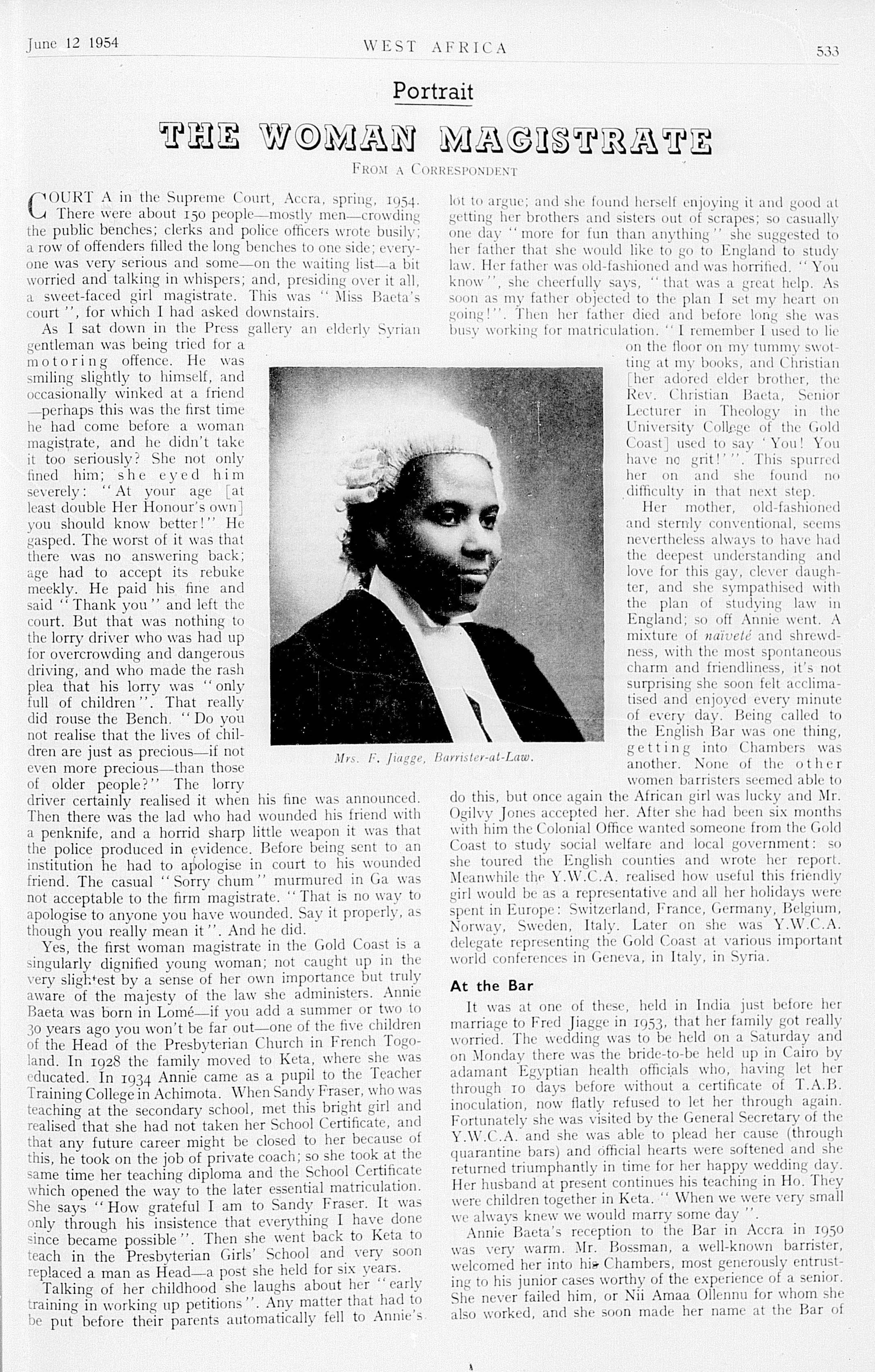
Our latest “Document of the Week”, chosen by our Editorial Assistant, Chloe Haney, is an article from West Africa Magazine titled “The Woman Magistrate”. Published on 12 June 1954, the article provides an overview of the life and career of Annie Jiagge, née Baeta, the first female magistrate in the Gold Coast/Ghana.
Born in Lomé in 1918, Annie Baeta initially trained as a teacher at Achimota College in Accra. Achieving her diploma 1937, she went on to teach at the Presbyterian Girls’ School in Keta, where she “very soon replaced a man as Head—a post she held for about six years.”
Shortly after, in 1946, Baeta was admitted to the London School of Economics to study law, receiving her LLB in 1949. During this time, she also worked closely with the Young Women’s Christian Association, travelling Europe as a representative of the organisation.
In 1950, Baeta moved back to the Gold Coast to practice law in Accra. Three years later, she would become the first woman magistrate in the Gold Coast and, indeed, the British Commonwealth as a whole. In this year, she also married her husband, becoming Annie Jiagge.
In the time after this article was published in West Africa Magazine, Jiagge continued to rise through the ranks, being appointed Judge of the Circuit Court in 1959, Judge of the High Court in 1961, and Judge of the Court of Appeal in 1969, the highest court in Ghana at the time.
Her legal career was defined by her work for women’s rights, particularly in the years after the publication of “The Woman Magistrate”. From 1962 to 1972, she represented Ghana on the United Nations Commission on the Status of Women, during which she drafted the document that would become the Declaration on the Elimination of Discrimination Against Women. She also founded the Ghana National Council on Women and Development, and pledged seed money to what would become Women’s World Banking.
Where to find this document
This document is from our primary source collection, West Africa Magazine, 1917–2003. Featuring over 170,000 images, this comprehensive run of West Africa offers remarkable insights into a period of huge transformation across Africa and the wider world. Through reports, intellectual debate, letters, opinion columns, and photographic coverage, the collection charts the transition from British colonial jurisdiction to independence across Nigeria, the Gold Coast (later Ghana), Sierra Leone, and The Gambia. West Africa also featured news from other African nations, most notably from French West Africa, although events and debates from across central, southern, and eastern Africa were also discussed.
Visit the collection page to learn more.