

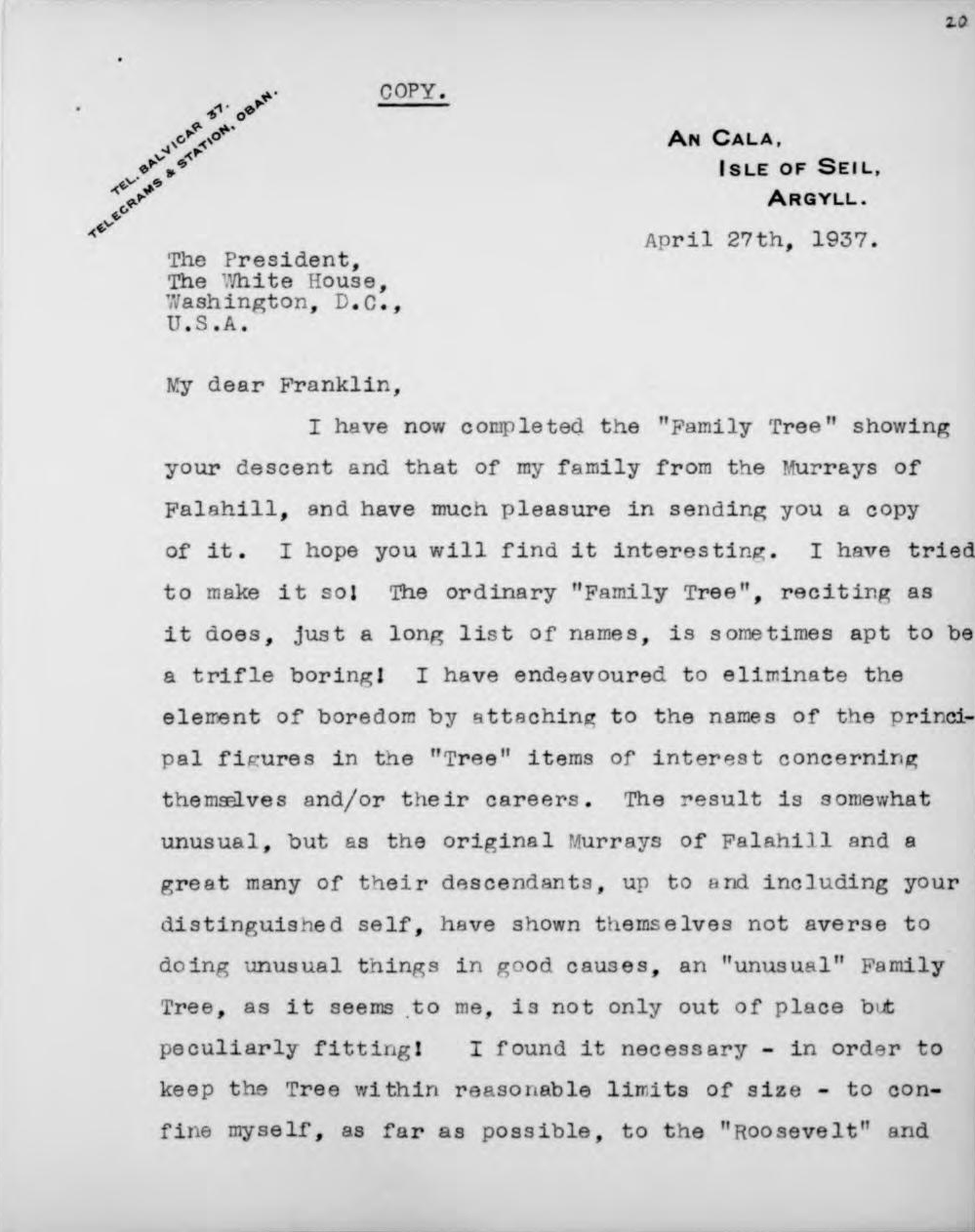
Our latest "Document of the Week" was chosen by our Senior Editor, Dr Tommy Dolan. It is a letter that Arthur Cecil Murray, 3rd Viscount Elibank, wrote to President Franklin D. Roosevelt in April 1937.
Murray was a relatively influential British politician and diplomat. He was elected as a Liberal Party MP for Kincardinshire in 1903, a seat that he held until 1923. In the years leading up to the outbreak of the First World War, he served as Private Secretary to Sir Edward Grey, who in those years held the position of Secretary of State for Foreign Affairs. From 1917 until 1918, Murray served as the Assistant Military Attaché to the British Embassy in Washington. There, he worked with Roosevelt and the two became close friends. For one thing, Murray was a prominent member of the Irish Home Rule Council and Roosevelt found his knowledge of Irish politics instructive. The two men corresponded frequently until Roosevelt's death in 1945, generating an intriguing paper trail.
For example, from his letter to Roosevelt in April 1937, we learn that Murray believed that they were descended from the same Scottish family. "I have now completed the "Family Tree" showing your descent and that of my family from the Murrays of Falahill", as Murray informed Roosevelt in the opening line of his letter. He went on to explain that, as standard family trees tended to be "a trifle boring", he had "endeavoured to eliminate the element of boredom by attaching to the names of the principal figures in the "Tree" items of interest concerning themselves and/or their careers". The "original Murrays of Falahill and a great many of their descendants, up to and including your distinguished self", had, as Murray was keen to highlight, "shown themselves not adverse to doing unusual things in good causes".
Thankfully, Murray’s papers contain Roosevelt’s response to this letter, dated 17 May 1937. "Pretty good stock, these Murrays", as Roosevelt put it. Interestingly, he concluded that Murray’s "liberalism" (initially dubbed "conservatism", but scribbled out and replaced with "liberalism") was due to his descent "from John Murray of Blackbarony". Roosevelt added that he believed that his own "radicalism" descended "direct" from "John’s first cousin"—"John Murray, the "outlaw of Falahill"". "Some day, when I come to visit you", as Roosevelt wrote, "I want to visit the scenes of the living and the dying of our apparently very active ancestors".
Where to find this document
It comes from our primary source collection, British Diplomacy with America and Ireland: an Ambassador's Letters, 1909–1962. Containing over 3,000 images, this resource supplies the papers of Arthur Cecil Murray, 3rd Viscount Elibank. Murray’s wide-ranging correspondence with influential figures, such as Franklin D. Roosevelt and Walter Runciman, constitutes an excellent resource for students, researchers, and educators interested in British and Irish politics, as well as British-American relations, throughout the early to mid-twentieth century. It will also appeal to those exploring broader themes, such as international relations and modern diplomacy.
Visit the collection page to learn more.


