

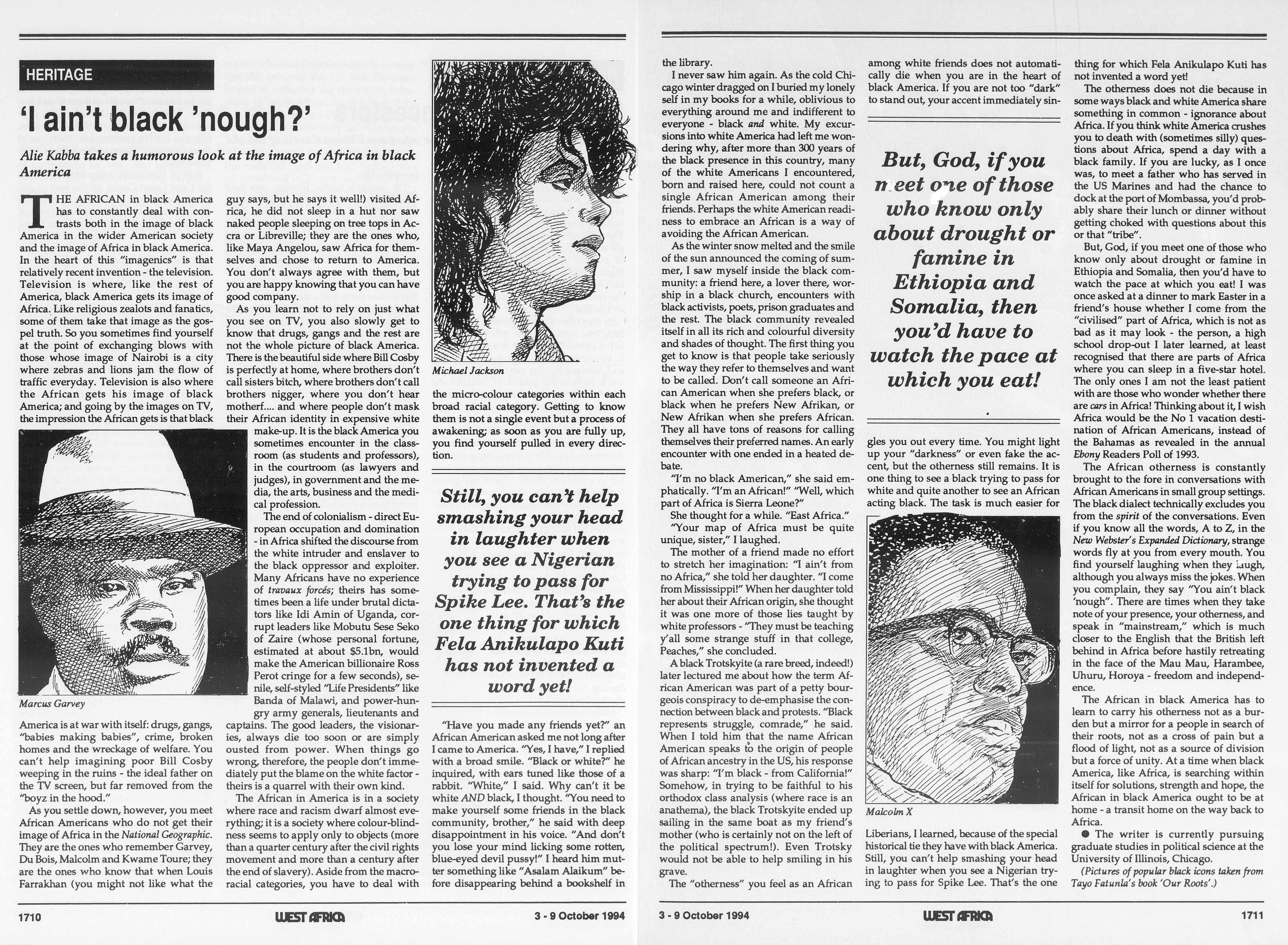
Our latest “Document of the Week”, chosen by our Editor, Nishah Malik, is an article from our new primary source collection, West Africa Magazine, 1917–2003, titled “I ain’t black ’nough?”.
Published in West Africa in October 1994, this piece explores the complicated relationship between Africans and African Americans, particularly around identity, stereotypes, and cultural belonging.
Written from the perspective of an African studying in the United States, the article reflects on how both groups inherit distorted images of each other through television, history, and politics. Authored by Alie Kabba, the piece begins by emphasising the role that television plays in shaping perceptions. Kabba notes how Black Americans are often presented with stereotypical views of Africa, including “images of Nairobi” as “a city where zebras and lions jam the flow of traffic everyday”. At the same time, Africans receive an image of Black America dominated by “drugs, gangs, babies making babies, crime, broken homes, and the wreckage of welfare”.
Kabba argues that television rarely presents the “beautiful side” of Black America—communities “where brothers don’t call sisters bitch” and “where people don’t mask their African identity in expensive white makeup”.
“The African in black America has to constantly deal with contrasts both in the image of black America in the wider American society and the image of Africa in black America.”
Throughout the article, Kabba moves between sharp social critique and humorous personal anecdotes, asking what it really means to belong within Black identity. The writer recalls a moment when an African American man asked him whether he had made any friends since moving to America, and whether they were “black or white”. After Kabba admitted that he had only made white friends, the man responded: “You need to make yourself some friends in the black community”.
The article also explores the sense of “otherness” experienced by Africans in the United States. Kabba observes that the feeling of being different among white Americans does not automatically disappear among Black Americans—you can “fake the accent” or “light up your darkness”, but “the otherness still remains”.
He concludes by suggesting that Africans in Black America should carry their “otherness not as a burden but a mirror for a people in search of their roots”.
In some ways, the message of the piece, that Black Americans are often seen as “too Black” for white Americans and “too white” for Africans, reflects a wider experience shared by many second and third generation immigrant communities across the world. The article’s discussion of how both Africans and African Americans inherit distorted images of each other through television, history, and politics also mirrors tensions commonly found between immigrant communities born abroad and those who migrate later in life. Those born abroad often develop a distorted or romanticised understanding of their parents’ home country, shaped more by media, family narratives, and cultural memory, than by lived experience.
More than thirty years later, Kabba’s “I ain’t black ’nough?” remains a powerful reflection on diasporic identity, media representation, and the enduring question of who gets to define what is “authentically” Black.
Where to find this document
This document comes from our new collection, West Africa Magazine, 1917–2003. Featuring over 170,000 images, this comprehensive run of West Africa, spanning the years 1917 to 2003, offers remarkable insights into a period of huge transformation across Africa and the wider world. Through reports, intellectual debate, letters, opinion columns, and photographic coverage, the collection charts the transition from British colonial jurisdiction to independence across Nigeria, the Gold Coast (later Ghana), Sierra Leone, and The Gambia. West Africa also featured news from other African nations, most notably from French West Africa, although events and debates from across central, southern, and eastern Africa were also discussed.
Visit the collection page to learn more.

.svg)


