

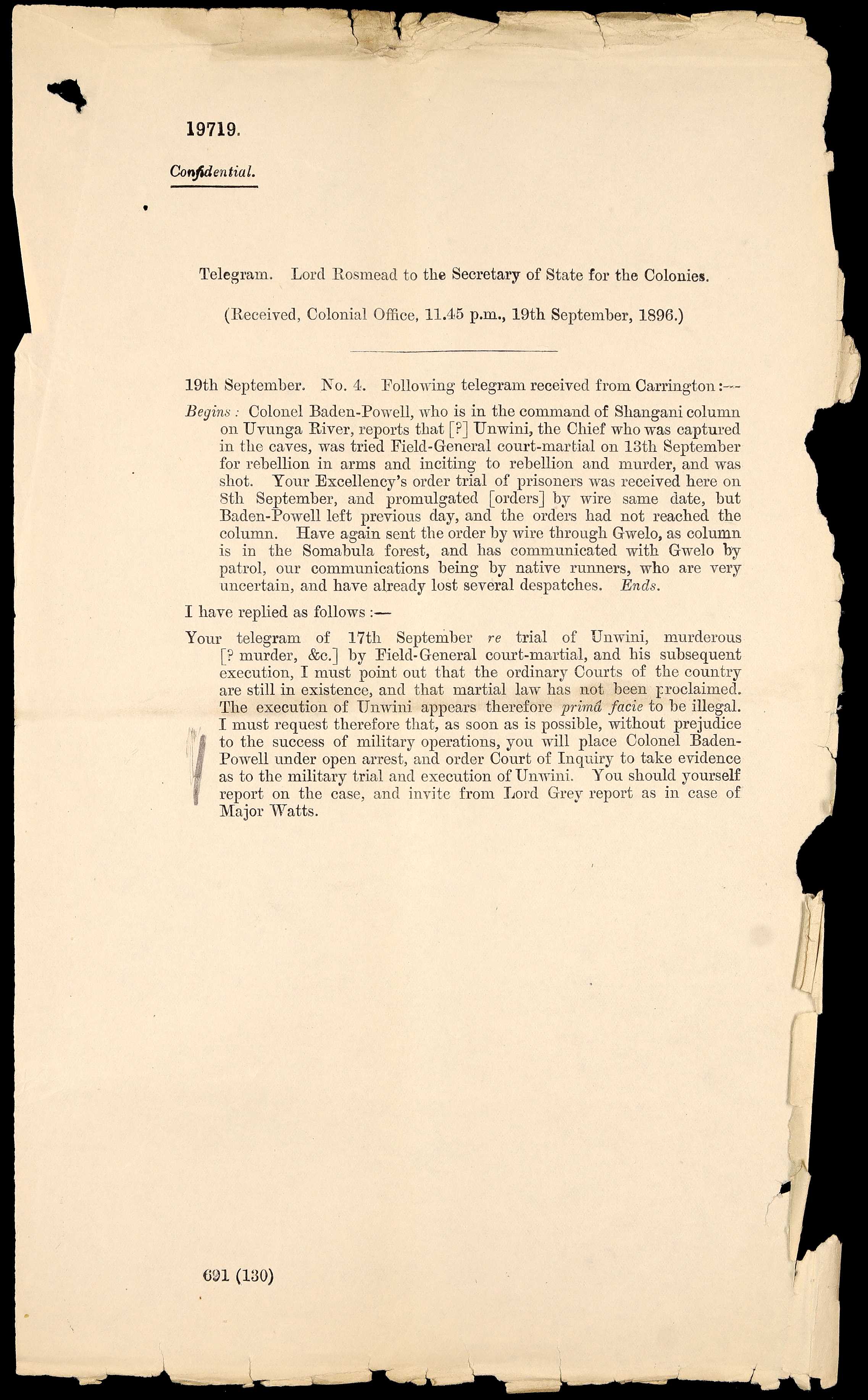
Our latest “Document of the Week” was chosen by our Senior Curator, Dr Charlie Hall. It is a telegram from Lord Rosmead, the British High Commissioner for Southern Africa, to Joseph Chamberlain, the Secretary of State for the Colonies. It was sent in September 1896 at the height of the Second Matabele War, a revolt by the indigenous Matabele and Shona people against British colonial rule in Southern Rhodesia (present-day Zimbabwe).
The telegram calls for the immediate arrest of Colonel Robert Baden-Powell, who would later achieve great renown for founding the Boy Scout movement. Baden-Powell was a career soldier who served extensively in colonial conflicts in India and Africa. Most notably, he was involved in the defence of Mafeking during the Second Boer War.
In 1896, however, he was commanding troops in the Uvunga River region and had ordered the execution, following a court-martial, of the Matabele chief, Unwini, on charges of “rebellion in arms and inciting to rebellion and murder”. As the region was not formally under martial law, and Unwini was a Prisoner of War (who had been promised that his life would be spared if he surrendered), the execution was deemed illegal.
Subsequent correspondence in this file reveals that Baden-Powell’s commanding officer chose not to effect his arrest immediately, as he had “special reasons for keeping him in command”. Indeed, Baden-Powell’s military ability continued to prevail over any potential wrong-doing, and he was eventually cleared by a court of inquiry. As this document shows, the laws of war were enforced very unevenly, especially in colonial contexts.
Where to find this document
This item comes from our primary source collection, The Laws of War: Justice, Rights, and Ethics in Military Contexts. Comprising over 100,000 images drawn from files at The National Archives (UK), this collection explores the efforts taken to regulate the conduct of warfare over the past 300 years. As conflicts grew in scale and impact, as mass citizen armies took to the field, and as questions of human rights gained traction, the need for robust laws of war became ever clearer.
Visit the collection page to learn more.


