Britain Under Threat: Civil Defence in the Era of Total War, 1914–1989

  • Home
  • Collections
  • Britain Under Threat: Civil Defence in the Era of Total War, 1914–1989

Media

Authored by Dr Charlie Hall
Published on 18th May, 2026 2 min read

Document of the Week: Psychological Responses to Nuclear Warfare Document of the Week

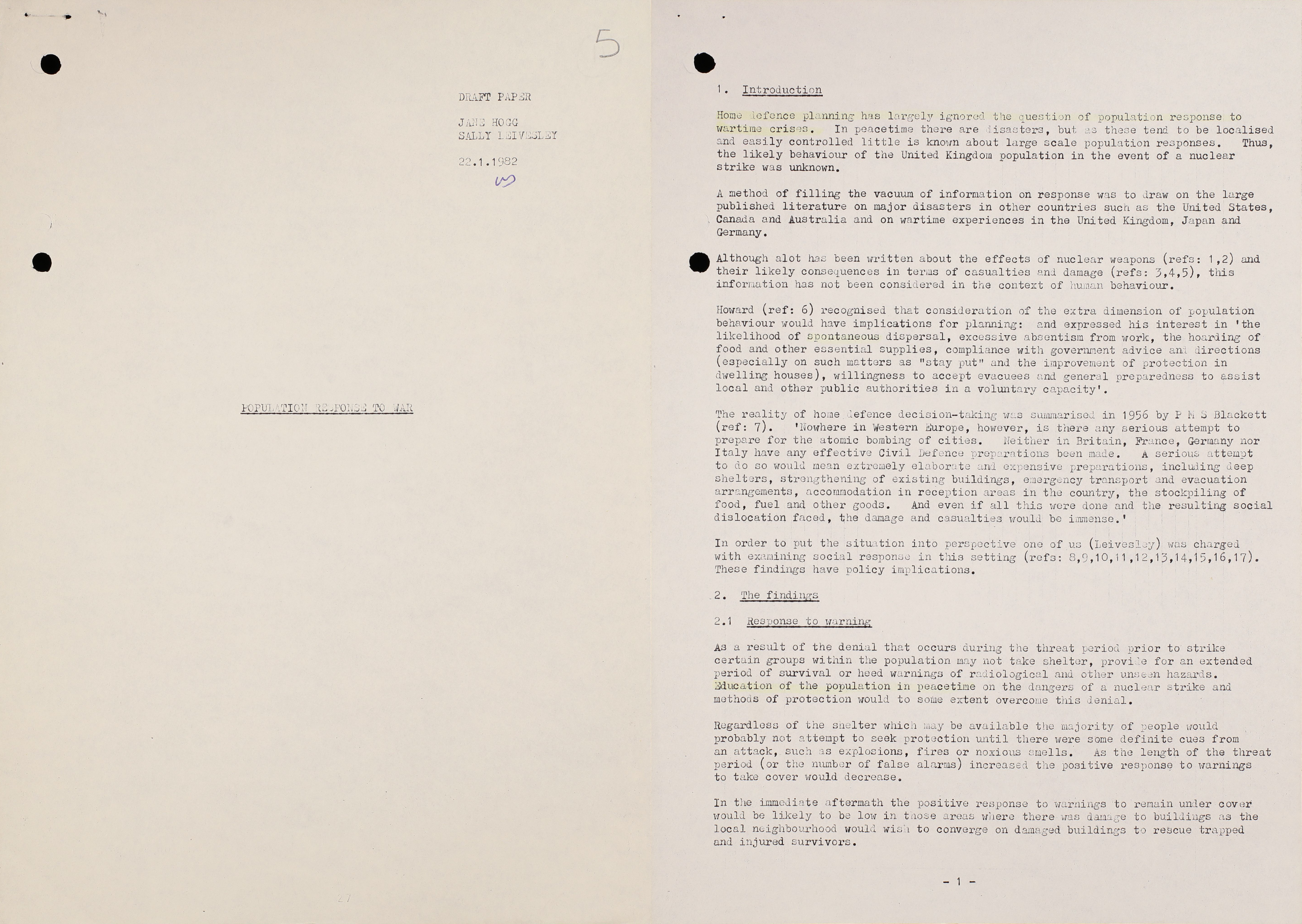
On the left is the front cover of a draft of a report titled "Population Response to War". On the right is a page from the draft report, showing "1. Introduction", "2. The findings" and "2.1 Response to warning".

Our latest “Document of the Week” was chosen by our Senior Curator, Dr Charlie Hall. It comprises a report produced by professional risk analyst, Dr Sally Leivesley, at the request of the Scientific Research and Development Branch of the Home Office, in 1982. It offers a fascinating insight into some of the principal concerns faced by British civil defence planners in this period.

During the 1980s, the threat of nuclear war loomed large, perhaps larger than at any point since the Cuban Missile Crisis of 1962. However, civil defence programmes were underfunded and rudimentary at best. The report opens by noting that “the question of population response to wartime crisis” had been largely ignored to date. As a result, “the likely behaviour of the United Kingdom population in the event of a nuclear strike was unknown”.

To try and address this gap in knowledge, the report considered areas such as “panic in the community”, the “implications of hoarding”, and “anti-social activities post-attack”. It drew on the latest psychological research, coupled with studies of how civilians had responded to bombing during the Second World War and peacetime disasters in the years since.

The report went on to make recommendations regarding government policy in the event of an attack. The main advice was that local authorities should seek to foster community cohesion and a sense of purpose among survivors. Remarkably, the overriding goal of much of this advice was to secure “a viable and effective able-bodied work force”. Without it, the report concluded, “the prospects of regeneration [. . .] are very grim indeed”.

Where to find this document

This item comes from our primary source collection, Britain Under Threat: Civil Defence in the Era of Total War, 1914–1989.

Comprising over 100,000 images drawn from files at The National Archives (UK), this collection explores various aspects of British civil defence throughout the twentieth century.

As civilians became increasingly vulnerable to enemy action in this period, due to developments in technology and strategy, the British government was forced to take innovative and wide-ranging action to keep its people safe.

Visit the collection page to learn more.


Authored by Dr Charlie Hall

Dr Charlie Hall

I am a Senior Curator at BOA and a Senior Lecturer in Modern European History at the University of Kent. My research interests lie in conflict, technology and society in the twentieth century, with a particular emphasis on Britain, Europe and North America.

Read all posts by Dr Charlie Hall.

Share this article

lock_open

Unlock Historical Research for Your Institution

Provide your students and researchers with direct access to unique primary sources.

Colour poster by William Little issued in 1941 showing two groups of armed marching soldiers, one from each of the countries allied to fight Germany, Japan, and Italy, facing a giant V for victory composed of the flags of each of the countries allied in the fight.

Licensed to access British Government Information and Propaganda, 1939–2009

1939   2009
British Library logo
A cover of The Illustrated War News, including an illustration of a tank, the Union Jack flag, and the French flag.

Licensed to access Illustrated War News, 1914–1918 & 1939

1914   1939
Illustrated London News logo
Representatives from the Soviet Union, UK and US at the 1945 Potsdam Conference in Potsdam, Germany.

Licensed to access Establishing the Post-War International Order, 1944–1961

1944   1961
The National Archives (UK) logo
Beige background with red and black lettering. There is a letter header to the Ministry of Information, stamped with a red SECRET stamp. Underneath it reads U.S. Secret Equals British Secret Confidential. Over the top of the image are various symbols depicting a code language.

Licensed to access Censorship: Policy and Practice During the Second World War

1914   1959
The National Archives (UK) logo
Back to Top