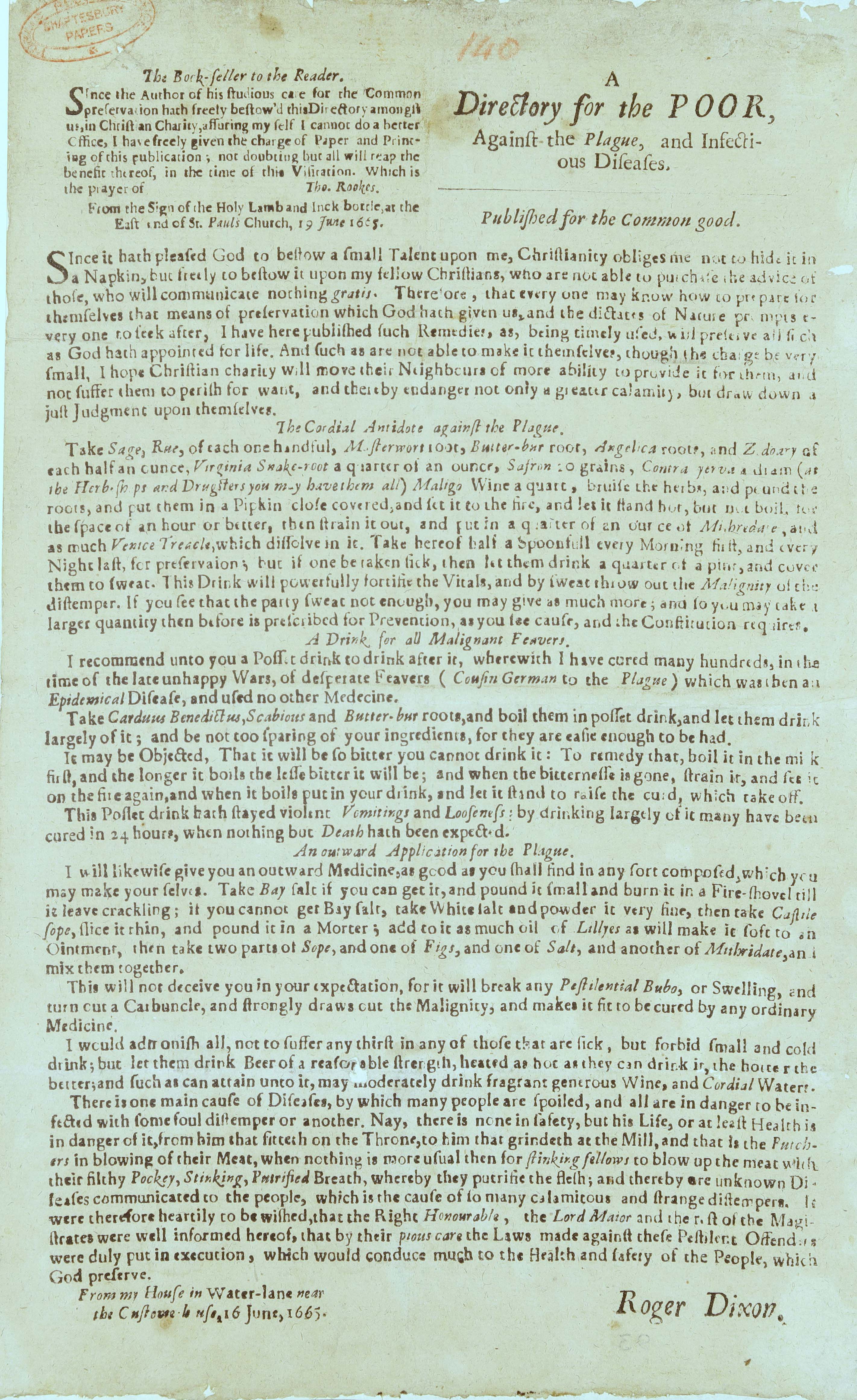
Our latest “Document of the Week”, chosen by our Editorial Assistant, Chloe Haney, is a broadsheet published in 1665 that provides medicinal advice “for the poor, against the Plague, and Infectious Diseases”.
Published “for the common good” at the beginning of what would come to be known as “The Great Plague of London”, the broadsheet intended to serve as public health advice. It was written by Richard Dixon, whose reason for sharing his knowledge of medicine was deeply rooted in his Christian beliefs.
“Since it hath pleased God to bestow a small Talent upon me, Christianity obliges me not hide it in a Napkin, but freely to bestow it upon my fellow Christians, who are not able to purchase the advice of those, who will communicate nothing gratis.”
Consequently, much of the content of the broadsheet was framed around religion and “Christian charity”. The creation and publication of the broadsheet itself epitomised this Christian value, being produced as a freely accessible resource that targeted those who could not typically afford access to medical knowledge or advice.
Likewise, the contents of the “Directory” promoted charity. Though the remedies detailed were able to be made by an individual for a “very small” cost, Dixon also urged “Neighbours of more ability to provide” medical help to those who “are not able to make it themselves”.
Infused with Christian belief, this resource provided useful information to those without the means to access medical resources while encouraging others to use their means to do the same. This sense of community spirit was a key factor in minimising the impact of epidemic diseases such as the plague, as I’m sure we well remember from public health advice during the COVID-19 pandemic. In 1665, as in 2020, neighbours were urged to protect and aid one another during a time of disease.
Where to find this document
This document comes from our primary source collection, Pandemics, Society, and Public Health, 1517–1925. Charting the course and consequences of pandemics over five centuries, this collection collates archival materials relating to four diseases that have left a significant mark upon British history: plague, cholera, smallpox, and influenza.
Visit the collection page to learn more.
![The Hospital of Bethlem [Bedlam] at Moorfields, London: seen from the north, with sheep grazing and people walking in the foreground. Coloured wood engraving by W. H. Prior.](https://d1sxy7l4fhu207.cloudfront.net/uploads/production/1738/conversions/BOA_RBRH_Card_1630494275-800x600.jpg)