

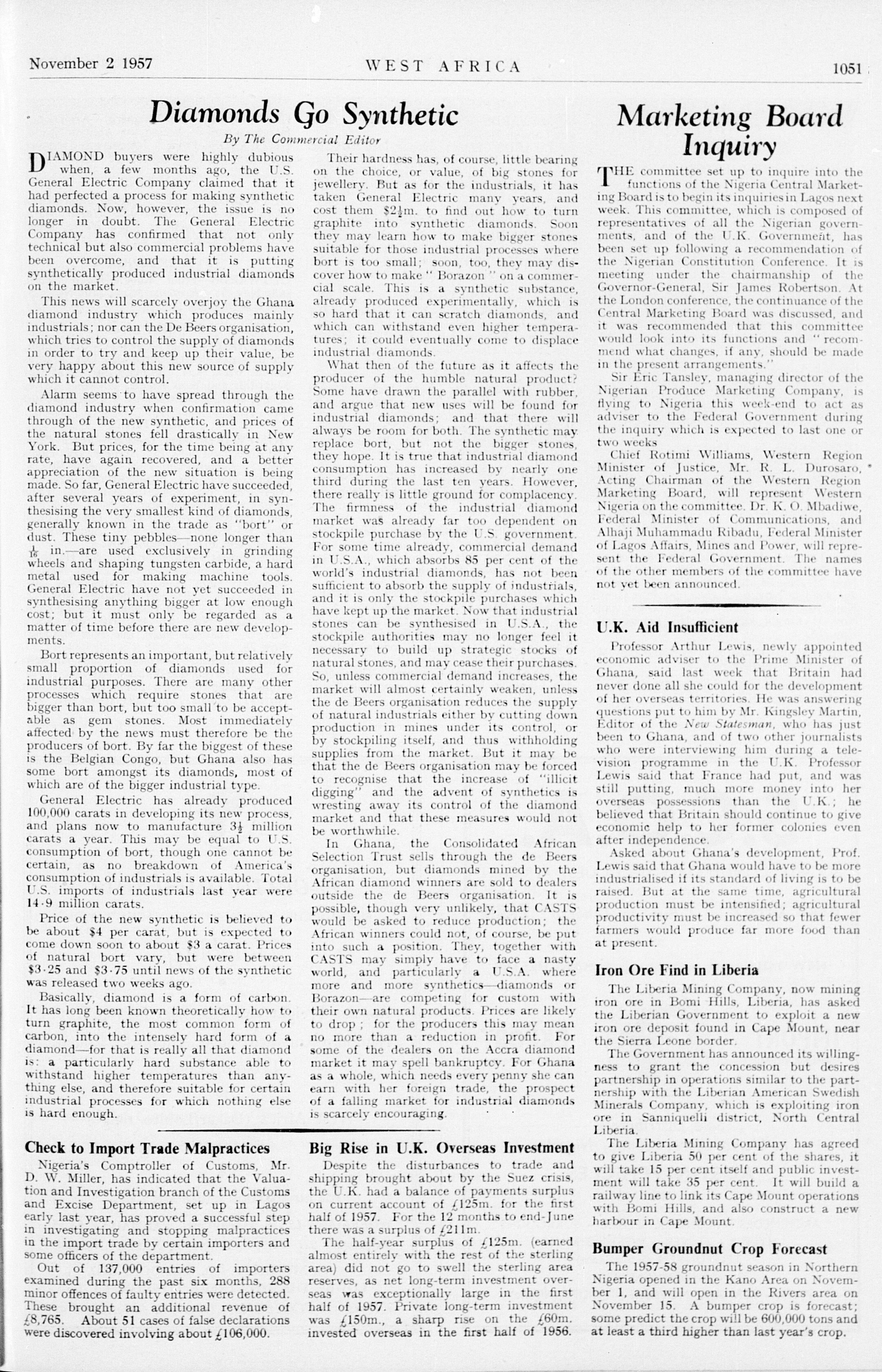
Our latest “Document of the Week”, chosen by our Editorial Assistant, Chloe Haney, is an article from West Africa Magazine titled “Diamonds Go Synthetic”. Published on 2 November 1957, the article focused on developments in the production of lab-grown diamonds by the U.S. General Electric Company.
While the first lab-grown diamonds were produced by Swedish scientists at the Allmanna Svenska Elektriska Aktiebolaget (ASEA) laboratory in 1953, General Electric was the first to publicly announce a process of synthetic diamond growth. The first synthetic diamonds grown in a General Electric laboratory were the result of experiments conducted in December 1954, first by Herbert Strong on 8 December, and then by Herbert Tracy Hall on 16 December. There were difficulties replicating Strong’s experiment, but Hall’s method was duplicated and, by 31 December, had been verified by external physicists. A press conference was held on 15 February 1955 to announce the company’s invention.
By 1957, General Electric had “perfected” their process, eliminating “not only technical but also commercial problems” and making lab-grown diamonds a viable competitor to their natural counterparts. Although the diamonds that they could commercially produce were very small— “none longer than 1/16 in.” —they were very useful in industrial contexts, such as “in grinding wheels and shaping tungsten carbide”. The author of the article in West Africa assumed that it was only “a matter of time before there are new developments” that would allow for larger stones to be grown.
Naturally, General Electric’s ability to produce synthetic diamonds on a commercial scale posed a threat to the lucrative diamond mining industry in Africa. According to the author of the article, the Belgian Congo and Ghana would be worst affected, as key producers of bort (“the very smallest kind of diamonds”) and other small diamonds for industrial use. The author also noted that the De Beers organisation, a company “which tries to control the supply of diamonds in order to try and keep up their value”, would not “be very happy about this new source of supply which it cannot control”.
By the 1970s, the author’s prediction of “new developments” in the synthesis of lab-grown diamonds was proven correct, as the first gem-quality lab-grown diamonds were developed by General Electric. These became commercially available in the 1980s. Since then, their popularity has skyrocketed in both industrial and commercial markets and, by the early twenty-first century, approximately 80% of all diamonds produced have been lab-grown.[1]
Where to find this document
This document is from our primary source collection, West Africa Magazine, 1917–2003.
Featuring over 170,000 images, this comprehensive run of West Africa offers remarkable insights into a period of huge transformation across Africa and the wider world. The collection charts the transition from British colonial jurisdiction to independence across Nigeria, the Gold Coast (later Ghana), Sierra Leone, and The Gambia.
Visit the collection page to learn more.
[1] Robert E. Haag, “Diamond synthesizing”, EBSCO, 2019, available at https://www.ebsco.com/research-starters/history/diamond-synthesizing/.