

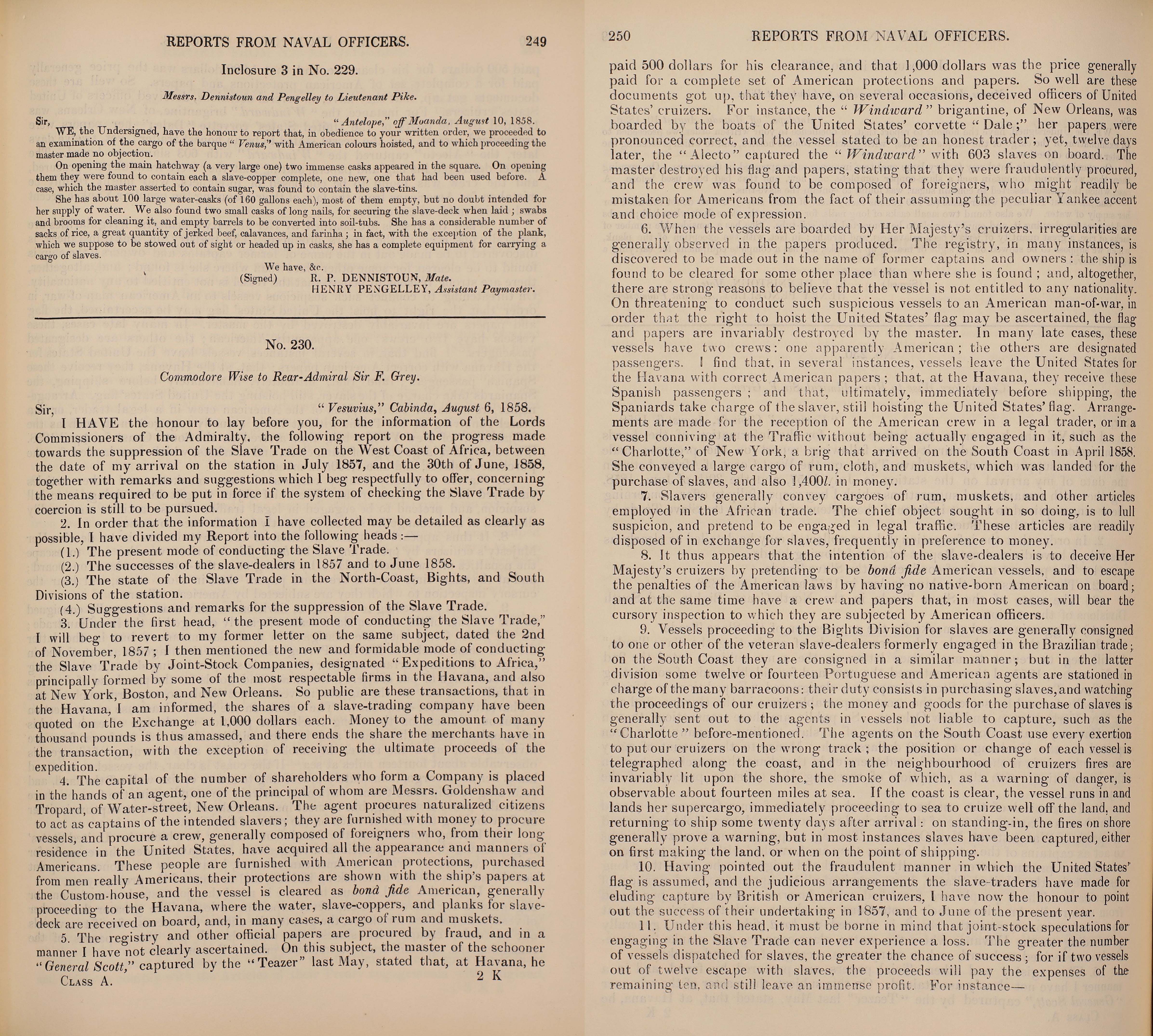
Our latest “Document of the Week” was chosen by our Senior Curator, Dr Mary Wills. It is a report detailing “progress made towards the suppression of the Slave Trade on the West Coast of Africa between July 1857 and June 1858”. The report was authored in August 1858 by Commodore Charles Wise, a senior officer of the Royal Navy, from his ship, Vesuvius, in Cabinda, Angola.
Wise was reporting to the British Admiralty with information about the Royal Navy’s campaign to suppress the transatlantic slave trade. Following the Act for the Abolition of the Slave Trade that was passed by the British parliament in 1807, a Royal Navy squadron was dispatched to the West African coast. This squadron was tasked with enforcing an end to the trade in enslaved Africans, as other nations—including Spain, France, and Portugal—were still engaged in it. The West Africa Squadron was active for around fifty years until the 1860s; it was led by Commodore Wise during the period 1857–1859.
Naval officers served on the squadron for two to three years at a time and were integral players in Britain’s mission to abolish the slave trade. British ships intercepted slavers in West African waters, and Royal Navy sailors were tasked with transporting seized slave ships (“prizes”) for adjudication at courts in the British colony of Sierra Leone. Naval officers also negotiated treaties with West African rulers to end the supply of enslaved people to European traders.
While a valiant operation, the squadron achieved limited success, releasing only a relatively small share of the estimated 3.2 million men, women, and children embarked as slaves between 1808 and 1863. The squadron never had the resources to combat the trade effectively, and British sailors struggled in fraught and unhealthy environments.
In this report, Commodore Wise touched upon a number of issues that continued to impact the efficacy of the Royal Navy’s operations. He discussed the current methods used by slave traders to evade detection, and added his own suggestions for increasing the chances of suppression of the trade. One overriding concern was the continuation of the slave trade by other nations, despite the “strictest and most vigilant system of cruising”. After 1807, a number of bilateral treaties were signed, and by 1836, most international governments had abolished their slave trades. However, illegal slave trafficking flourished in response to the demand for enslaved labourers from the sugar and coffee plantations of Cuba and Brazil.
According to Wise, slave traders were enabled by the “the fraudulent manner in the which the United States’ flag is assumed”. Even though the United States abolished the slave trade in 1808, the US government refused the “right of search”, whereby other sailors of other nations could board their ships. Slave traffickers therefore hoisted the American flag whenever British warships were spotted, rendering them legally immune to foreign interdiction. In this way, hundreds of illegal slaving voyages took place.
In Wise’s words, in the 1850s, “the spirit of slave-trading has been aroused” amongst European agents and notorious and powerful African traders like the Kings of Dahomey (in modern day Benin). Elsewhere, Wise claimed that “as many as 300 slaves a day were purchased by Portuguese agents for foreign exportation” from “the great slave mart at Embomma” (located on the north bank of the River Congo). He noted that for the year 1857, 31 vessels “proceeded to the West Coast of Africa for slaves”; 19 were captured, but 11 escaped with 7400 enslaved people on board. In a later report to the Admiralty in 1859, Commodore Wise described the slave trade as a “cruel system [. . . ] accompanied by the most terrible, most heart-rending loss of life that can well be conceived”.
Wise also discussed his concerns about the alternative systems of labour for formerly enslaved peoples put in place by other European nations. Naval officers were keen to compare, in their eyes favourable, British conceptions of freedom with other European ideas of liberty, in particular the French emigration system. In order to secure labour for their West African and Caribbean colonies, in the 1840s and 50s the French began purchasing the freedom of slaves and then binding them to contracts to work off the cost of their freedom. Over 20,000 African labourers were sent to Martinique or Guadeloupe on six-year contracts. While Britain was keen to show itself leading by example, it too pursued dubious forms of unfree labour for formerly enslaved people, including binding apprenticeship schemes and enforced military service.
Where to find this document
This document is part of our new collection, The Slave Trade, c. 1830–1893: British Foreign Office Confidential Print. Comprising over 31,000 images from Foreign Office files at The National Archives (UK), the collection includes diplomatic correspondence and reports sent between London and British officials, agents, and naval officers working across the world. It offers unrivalled insights into official attitudes towards slavery and the formation of policies relating to formerly enslaved people.
Visit the collection page to learn more.