

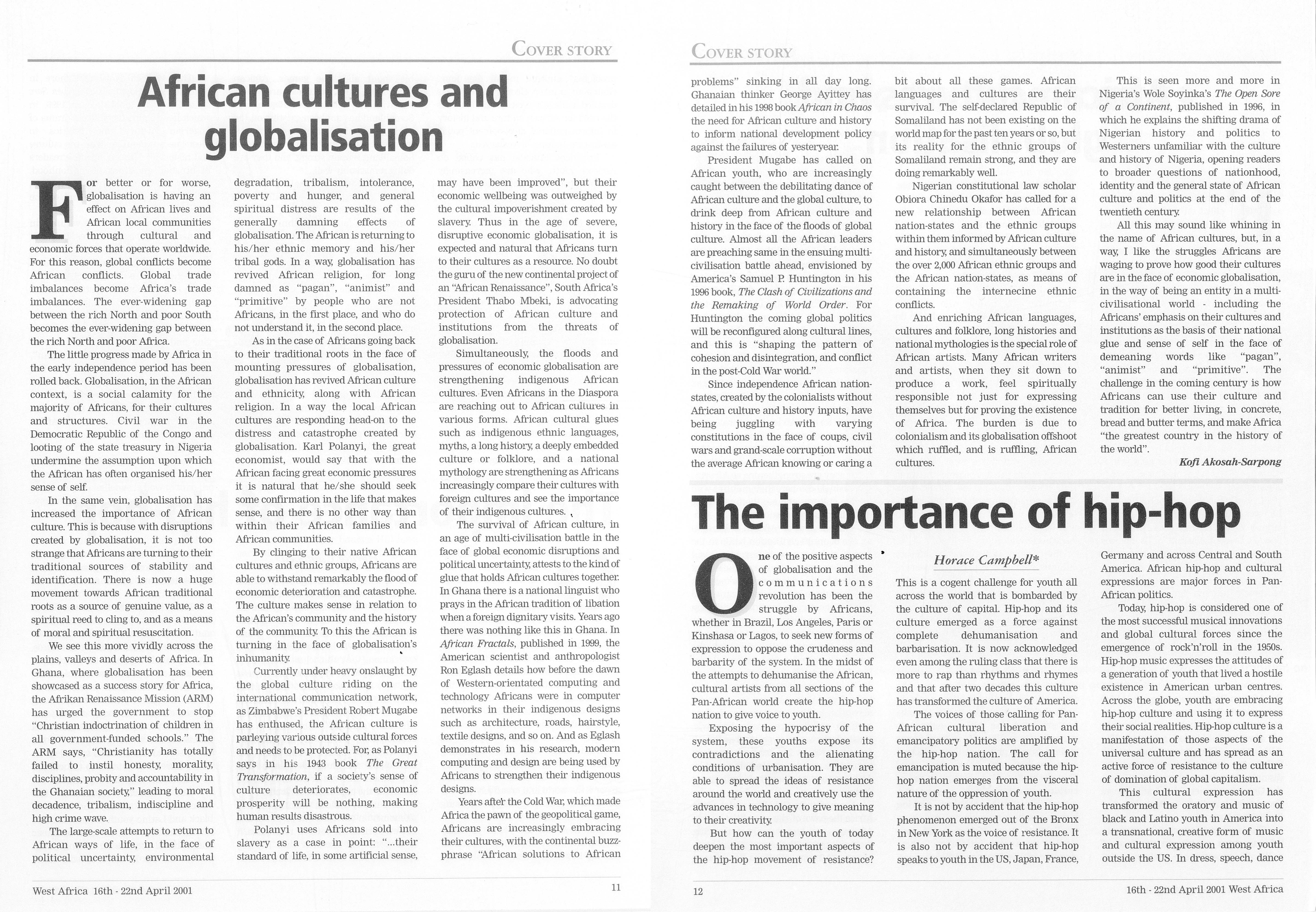
Our latest “Document of the Week”, chosen by our Editor, Nishah Malik, is an article from our new primary source collection, West Africa Magazine, 1917–2003, titled “African Cultures and Globalisation”. Published on 16 April 2001, this piece explores the impact of globalisation on African societies and examines how culture became a source of resistance, identity, and renewal in the post-colonial era.
Authored by Kofi Akosah-Sarpong, the article argues that globalisation has brought both economic hardship and cultural disruption across Africa, widening inequality and weakening local systems and identities. Despite these disruptions, Akosah-Sarpong suggests that African cultures are not disappearing under global pressure because “globalisation has increased the importance of African culture”. Consequently, Africans were turning back to indigenous traditions, languages, religions, and cultural practices as sources of stability, dignity, and survival.
Rather than viewing tradition as backward, Akosah-Sarpong argues that culture has functioned not only as heritage, but also as a form of resistance and collective identity during a period of rapid global change. The article highlights the role of African artists, intellectuals, and writers in preserving and revitalising indigenous cultures in the face of political instability, economic inequality, and the continuing legacy of colonialism.
The article touches on themes that appeared frequently throughout West Africa magazine, including African cultural identity, the creation of post-colonial national identities, the importance of language and oral traditions, and the ways in which African diaspora communities have maintained close connections with their cultural heritage and identity.
The piece also highlights an important topic that still resonates amongst the African diaspora more than two decades later. Former Zimbabwean president, Robert Mugabe, raised the point that African youth were “caught between the debilitating dance of African culture and global culture” and argued that they should instead “drink deep from African culture and history”. This raises an interesting debate about the relationship between globalisation and cultural identity, particularly for younger generations within Africa and its diaspora. While globalisation has created greater international connection and cultural exchange, the article questions whether this trend has also risked weakening indigenous traditions, languages, and historical consciousness.
Although written in 2001, more than two decades later, the themes explored in the article, such as globalisation, identity, diaspora, and cultural preservation, remain highly relevant. Questions surrounding how younger generations engage with their cultural heritage and balance multiple identities remain central to contemporary discussions about migration, nationalism, and belonging.
Where to find this document
This document comes from our new collection, West Africa Magazine, 1917–2003. Featuring over 170,000 images, this comprehensive run of West Africa, spanning the years 1917 to 2003, offers remarkable insights into a period of huge transformation across Africa and the wider world. Through reports, intellectual debate, letters, opinion columns, and photographic coverage, the collection charts the transition from British colonial jurisdiction to independence across Nigeria, the Gold Coast (later Ghana), Sierra Leone, and The Gambia. West Africa also featured news from other African nations, most notably from French West Africa, although events and debates from across central, southern, and eastern Africa were also discussed.
Visit the collection page to learn more.