

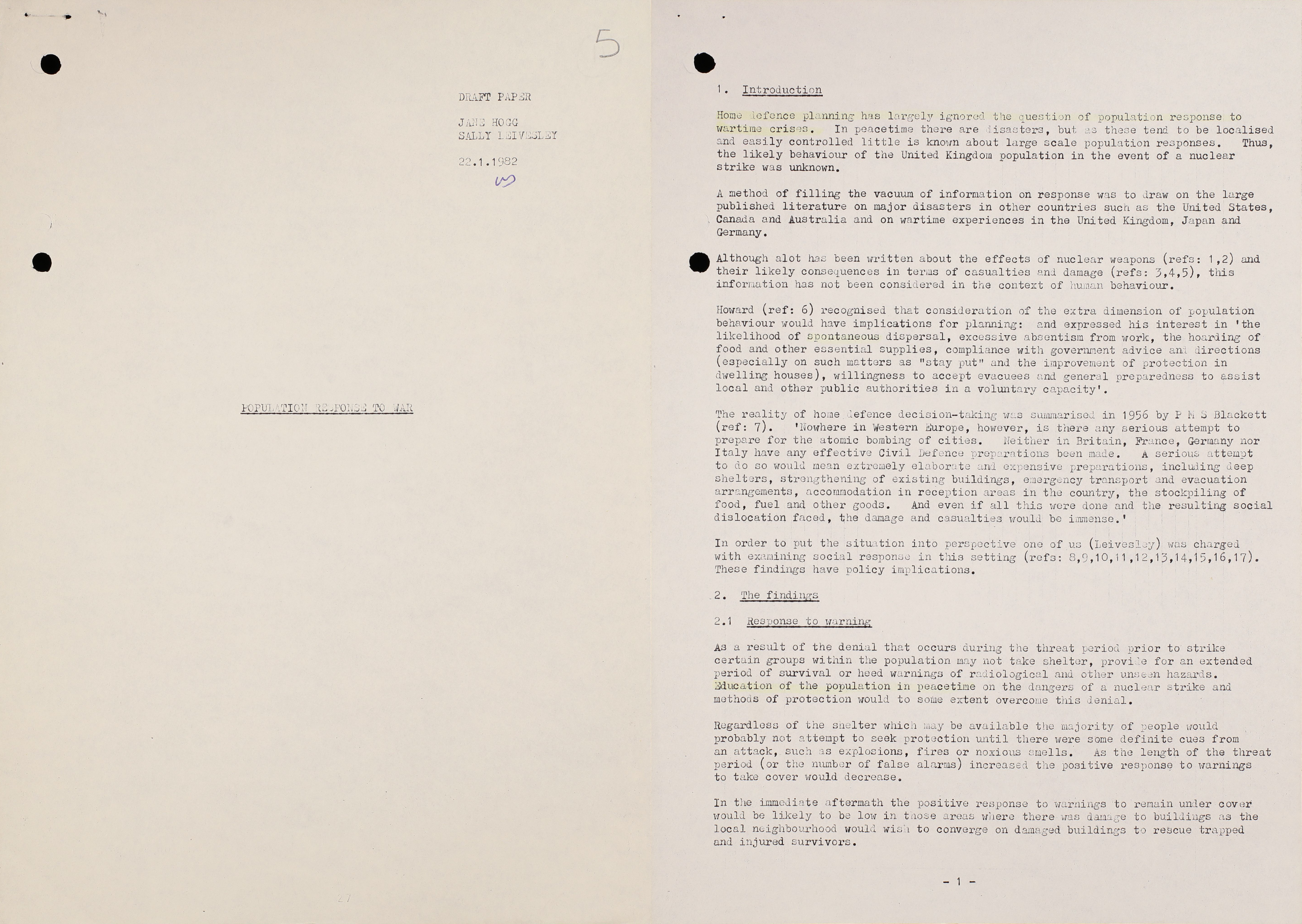
Our latest “Document of the Week” was chosen by our Senior Curator, Dr Charlie Hall. It comprises a report produced by professional risk analyst, Dr Sally Leivesley, at the request of the Scientific Research and Development Branch of the Home Office, in 1982. It offers a fascinating insight into some of the principal concerns faced by British civil defence planners in this period.
During the 1980s, the threat of nuclear war loomed large, perhaps larger than at any point since the Cuban Missile Crisis of 1962. However, civil defence programmes were underfunded and rudimentary at best. The report opens by noting that “the question of population response to wartime crisis” had been largely ignored to date. As a result, “the likely behaviour of the United Kingdom population in the event of a nuclear strike was unknown”.
To try and address this gap in knowledge, the report considered areas such as “panic in the community”, the “implications of hoarding”, and “anti-social activities post-attack”. It drew on the latest psychological research, coupled with studies of how civilians had responded to bombing during the Second World War and peacetime disasters in the years since.
The report went on to make recommendations regarding government policy in the event of an attack. The main advice was that local authorities should seek to foster community cohesion and a sense of purpose among survivors. Remarkably, the overriding goal of much of this advice was to secure “a viable and effective able-bodied work force”. Without it, the report concluded, “the prospects of regeneration [. . .] are very grim indeed”.
Where to find this document
This item comes from our primary source collection, Britain Under Threat: Civil Defence in the Era of Total War, 1914–1989.
Comprising over 100,000 images drawn from files at The National Archives (UK), this collection explores various aspects of British civil defence throughout the twentieth century.
As civilians became increasingly vulnerable to enemy action in this period, due to developments in technology and strategy, the British government was forced to take innovative and wide-ranging action to keep its people safe.
Visit the collection page to learn more.