

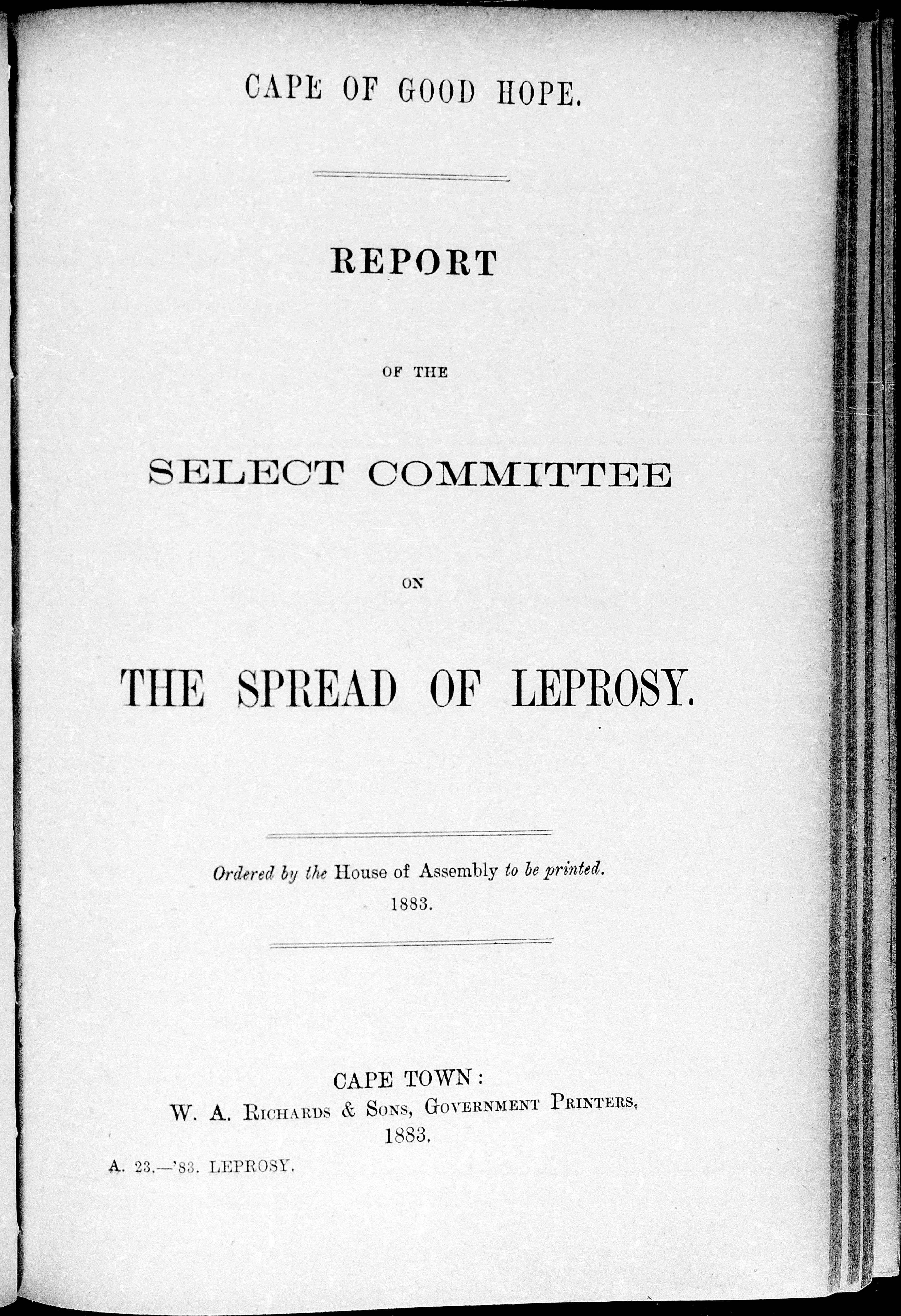
Our latest “Document of the Week”, chosen by our Editor, Nishah Malik, is an extract from a report produced in 1883 regarding the spread of leprosy throughout the Cape colony and the associated use of Robben Island as a site of confinement. The report offers a glimpse into late nineteenth-century debates on the spread of leprosy, revealing the interplay of medical uncertainty, racial prejudice, and imperial policy.
Situated in Table Bay, just north of Cape Town, since 1488 Robben Island has been used for a variety of purposes, from a site of isolation and imprisonment to a military base and, more recently, a popular tourist destination. During the period when the Cape was under British control, the island became a convenient location to confine those deemed unfit for society.
From 1806–1910, Robben Island was transformed from a site of confinement for political prisoners (as it had been utilised when controlled by the Dutch) to something more like a medical institution, primarily serving as a leper colony, lunatic asylum, and quarantine station. Initially designated a leper colony in the 1840s, by the 1850s it was firmly established as a place of isolation for people suffering from leprosy. This is an infection caused by the bacteria Mycobacterium leprae, that can lead to damage of the nerves, skin, and eyes.
The report from 1883 contains minutes of evidence taken before a select committee that sat between 8 and 22 August 1883. Various medical practitioners attended, such as Dr Abecrombie, Dr Biciard, Dr H. Ebden, Dr Landsberg, and Dr Parsons.
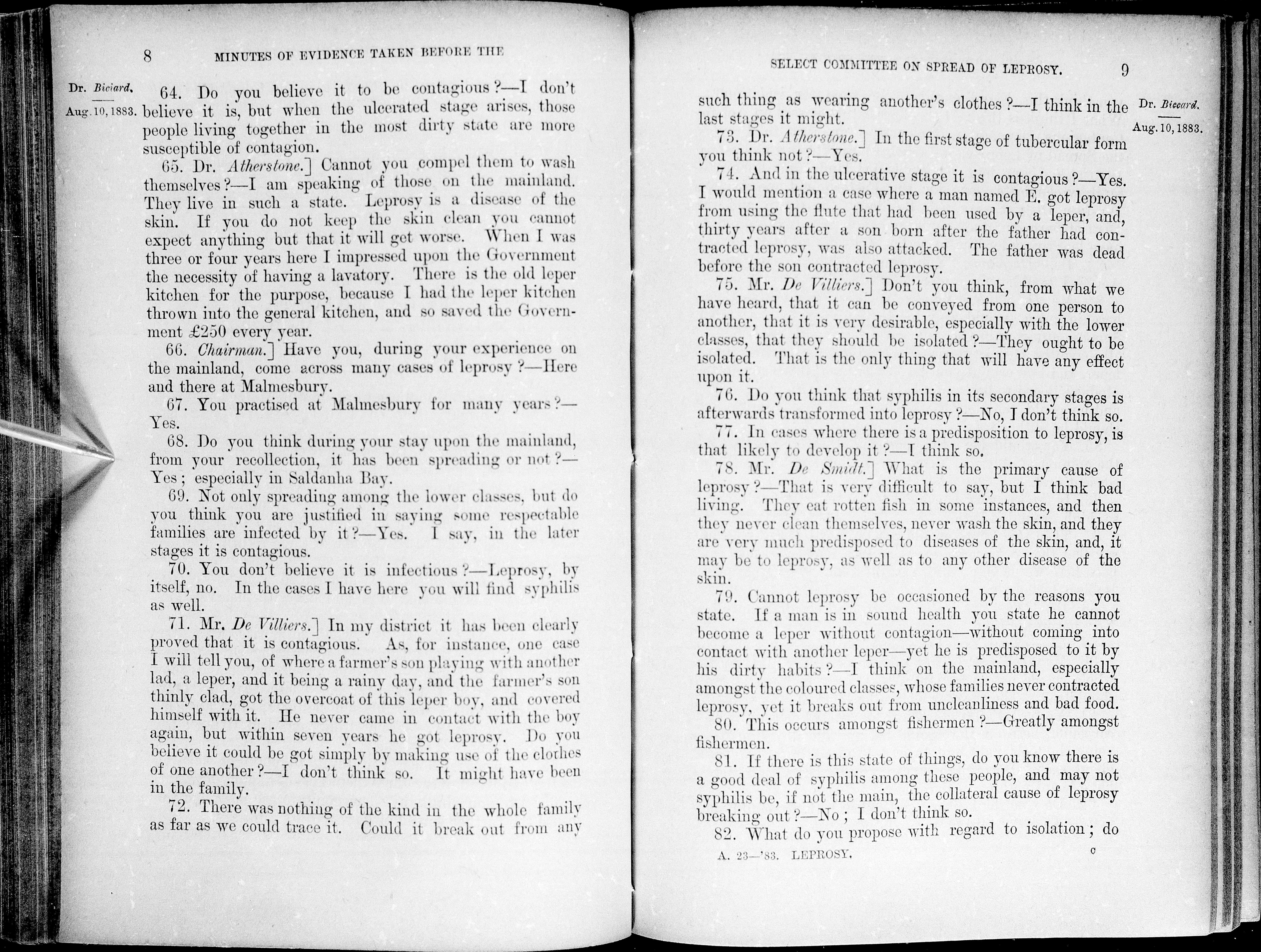
The minutes from 10 August 1883 reveal how medical opinion was shaped by assumptions about cleanliness, class, and race. When asked whether leprosy was contagious, Biciard linked it to poor hygiene and living conditions, arguing that “those people living together in the most dirty state are more susceptible of contagion”. He framed leprosy as a disease associated with uncleanliness, particularly “amongst the coloured classes”, claiming that they
eat rotten fish in some instances, and then they never clean themselves, never wash the skin and they are very much predisposed to diseases of the skin”.
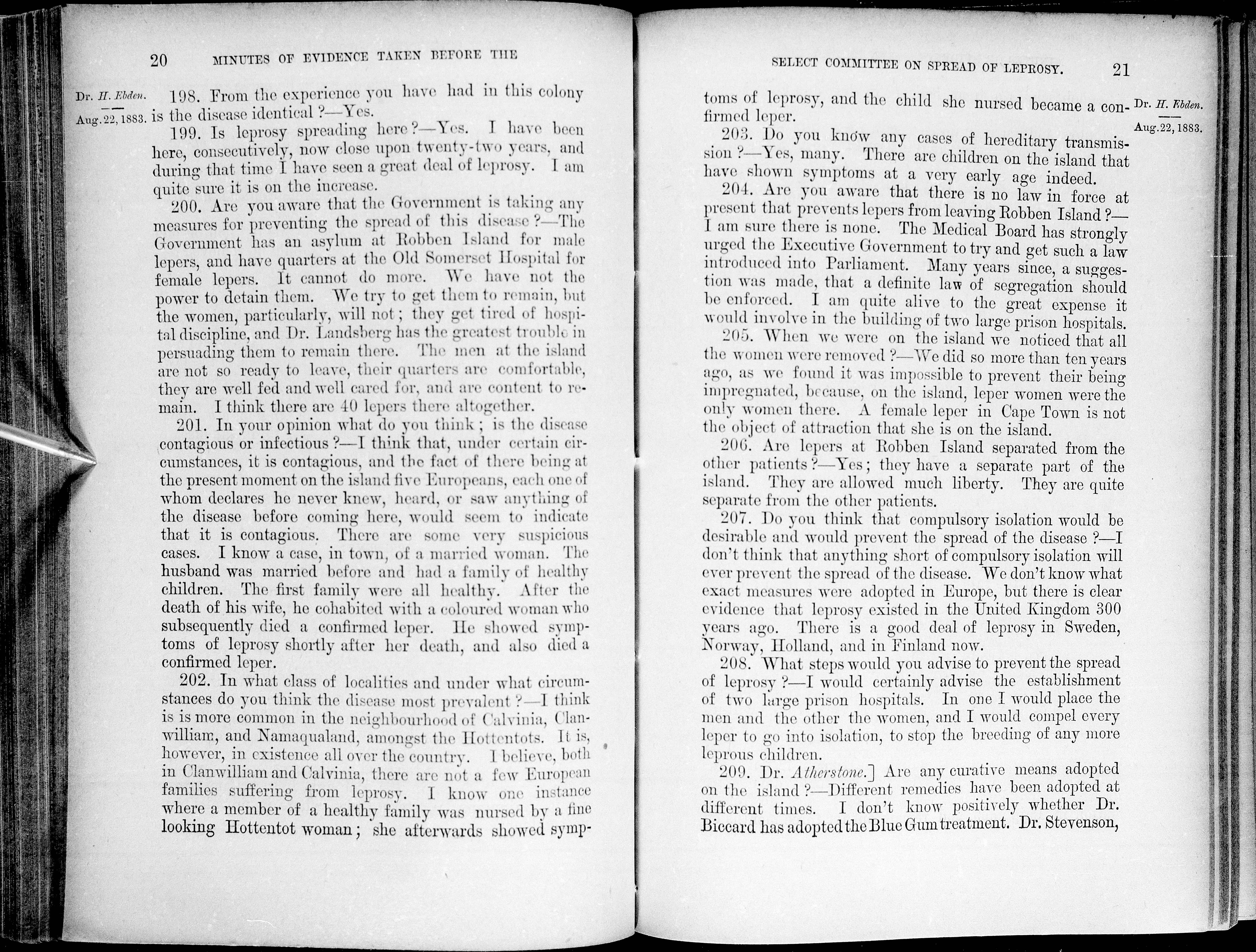
The minutes from 22 August 1883 also illustrate how racial prejudice shaped understandings of disease transmission. Ebden described a case in which a European man, following the death of his wife, “cohabitated with a coloured woman” and later died from leprosy. When asked what “class of localities” was leprosy more prevalent in, Ebden claimed that the disease was most prevalent in areas such as “Calvinia, Clanwilliam, and the Namaqualand, amongst the Hottentots”. An offensive term, “Hottentots” was used frequently by Europeans when referring to the Khoekhoe, the indigenous pastoralists of South Africa. Providing another example, Ebden used this term again, mentioning how a “healthy family was nursed by a fine looking Hottentot woman”, and how the “child she nursed became a confirmed leper”. Such examples presented inter-racial relations as dangerous, reinforcing fears of non-Europeans as carriers of disease.
Both Biciard and Ebden supported the use of Robben Island as a means of controlling leprosy, arguing that isolation “is the only thing that will have any effect upon it”. Ebden went further, proposing the construction of “two large prison hospitals”, one for men and one for women, in order to “stop the breeding of any more leprous children”. His thinking reveals how public health measures extended beyond mere treatment to include segregation, as well as the regulation of movement and even of reproduction.
This document demonstrates that responses to leprosy in the Cape were shaped to a significant extent by racial and imperial ideologies. Robben Island functioned not only as a medical facility, but as an instrument of colonial control, where fears of contamination intersected with efforts to manage and segregate populations. Underpinning these measures were Victorian notions of cleanliness, which linked hygiene to morality, social status, and white superiority.
To some extent, this reflects a broader and enduring pattern: disease has often been interpreted through the lens of race and class, with blame being often disproportionately assigned to marginalised groups.
Where to find this document
It is lifted from our primary source collection, British Colonial Rule in the Cape of Good Hope and Basutoland, 1854–1910. This tracks the administration of the Cape colony in remarkable detail. The sources evidence key historical trends, such as the development of infrastructure in the region, as well as the growth of key industries, such as mining. Although the Cape was controlled by a minority class of white settlers, the collection nevertheless provides valuable glimpses into African cultures and societies, including examples of resistance to colonialism. Visit the collection page to learn more.