South-East Asia, c. 1844–1975: British Foreign Office Confidential Print Coming Soon Overview

  • Home
  • Collections
  • South-East Asia, c. 1844–1975: British Foreign Office Confidential Print
A map of South-East Asia with a photograph of John E. Murray, Tran Van Chon, and Tran Van Minh.

Colonialism, independence, and war across a diverse and volatile region

Receive Updates on Release

This collection is coming soon. However, you can register for a free trial here and obtain access as soon as it is released.

Register Institutional Interest

Register Interest

Explore the clash of nations and empires that shaped South-East Asia throughout the nineteenth and twentieth centuries

A photograph of people marching holding a banner with Chinese text and English text below, reading Semenyih Anti-Communist Demonstration Sponsored by Good Citizens' Committee.

The history of South-East Asia over the nineteenth and twentieth centuries is fascinating, complex, and deeply entwined with Britain’s own experiences in that period. According to the Foreign Office’s own interpretation, the region known as South-East Asia extended from the Indian subcontinent, through present-day Thailand and Vietnam, and out to the island groupings of modern Malaysia, Indonesia, and the Philippines. 

The collection comprises approximately 44,000 images. These include diplomatic correspondence and reports. These offer unrivalled insights into the actions of vast colonial empires. Documentation relating to the British empire features most prominently, but the collection also supplies key information on the French, Dutch, and American empires. The collection likewise spotlights local actors, such as political leaders and regular citizens. Its coverage of the often violent process of decolonisation—including the partition of India, the Malayan Emergency, and the Vietnam wars—is particularly strong.

This collection will be of value to students, educators, and researchers interested in South-East Asia and the themes of empire, war, and diplomacy. It will also appeal to those situated within the fields of political science, economics, geography, and religious studies.

Register Interest

Contents

South-East Asia, c. 1844–1975: British Foreign Office Confidential Print...

Collection release coming soon...

Register Interest
A photograph of the signing of the Cobbold Report. From left to right, Sir David Watherston, Mr. H. Harris, Lord Cobbold, Dato' Wong Pow Nee, and Encik Mohd Ghazali bin Shafie sit at a table. Sir Anthony Abell stands behind them.

Highlights

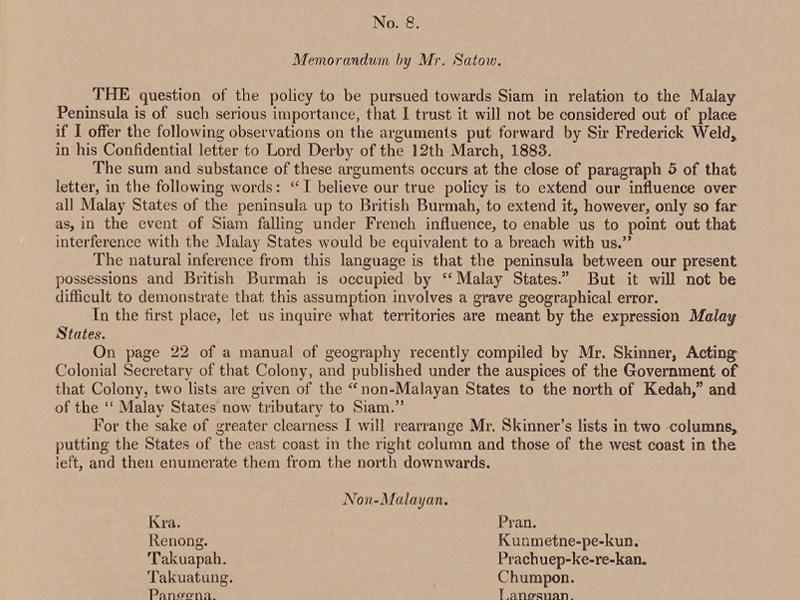
Section of a document titled No. 8. Memorandum by Mr. Satow.

Licensed to access British Influence in the Malay Peninsula, 1885
This document (pp. 9–12) is a memorandum written by Ernest Satow, dated 20 June 1885, that discusses British policy towards Siam and the Malay Peninsula. Satow challenged proposals to extend British influence over the Malay states, warning that aggressive expansion could provoke conflict with Siam and competition with France, potentially leading to Siam’s partition. Satow argued that Britain should preserve Siam's independence and protect its commercial interests in South-East Asia. Malaya became part of the British empire in this period and did not achieve independence until the 1950s. 
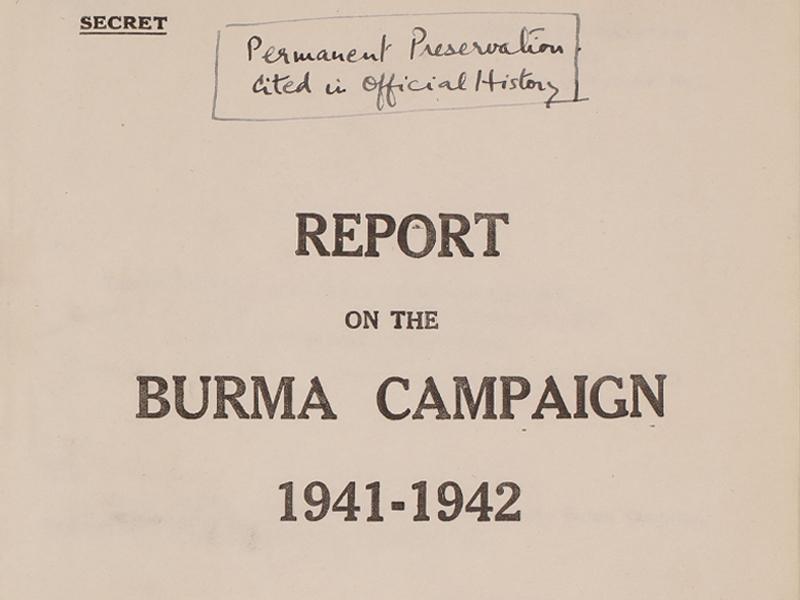
Title page of a document titled Report on the Burma Campaign 1941-1942. Handwritten text on the top reads Permanent Preservation cited in Official History.

Licensed to access Burma Campaign, 1943
Written by the Governor of Burma, Sir Reginald Dorman-Smith, this report describes the Japanese invasion of Burma during the Second World War. The invasion caused extensive suffering among the Burmese people and was one of the most gruelling campaigns that British forces faced during the war. The report has nine sections, such as “Pre-Invasion Burmese Background”, “Episodal story of the invasion”, and “Civil Defence”. It includes maps illustrating the Japanese advance and territory that they occupied. 
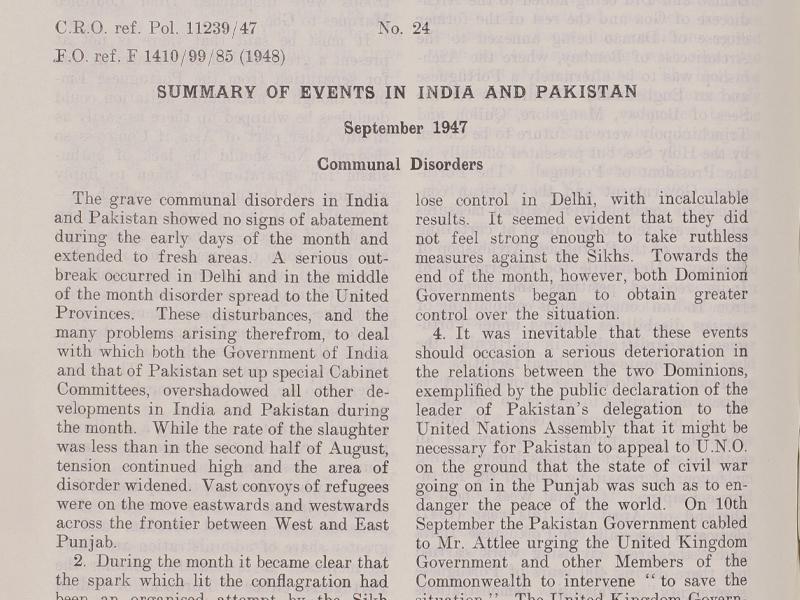
Section of a document titled No. 24. Summary of Events in India and Pakistan September 1947, subtitled Communal Disorders.

Licensed to access Partition of the Indian Subcontinent, 1947
This document (pp. 78–81) summarises the communal violence that broke out in the newly formed states of India and Pakistan and the subsequent difficulties their governments faced in terms of controlling the situation. The source details disturbances in Punjab and Sind, riots in Delhi, and problems regarding commerce, finance, food, and transport. Pakistan appealed to the British Commonwealth to intervene, warning that the situation in Punjab could threaten world peace. Britain, however, encouraged India and Pakistan to resolve the crisis through cooperation. 
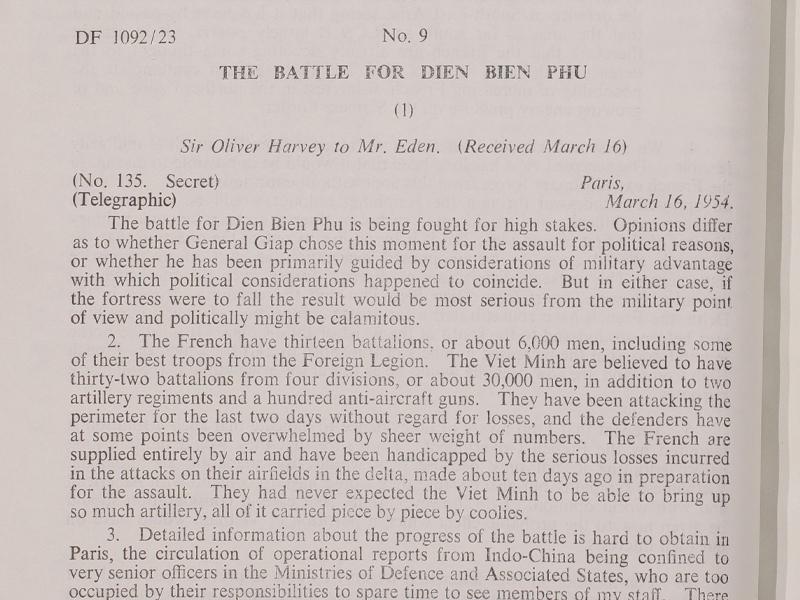
Section of a document titled No. 9. The Battle for Dien Bien Phu, subtitled Sir Oliver Harvey to Mr. Eden (Received March 16).

Licensed to access Battle for Dien Bien Phu, 1954

This document (pp. 28–29) details the early stages of the battle for Dien Bien Phu in March 1954 during the First Indochina War. The Communist Viet Minh, led by General Giap, launched major attacks against the French garrison, capturing several northern strongpoints despite heavy casualties. The British diplomat, Sir Oliver Harvey, warned that if Dien Bien Phu fell, “the result would be most serious” and “politically might be calamitous”. He was soon proved right; the fall of Dien Bien Phu sparked French withdrawal from South-East Asia and prompted American intervention in Vietnam. 

Coming soon...

lock_open

Unlock Historical Research for Your Institution

Provide your students and researchers with direct access to unique primary sources.

Back to Top