

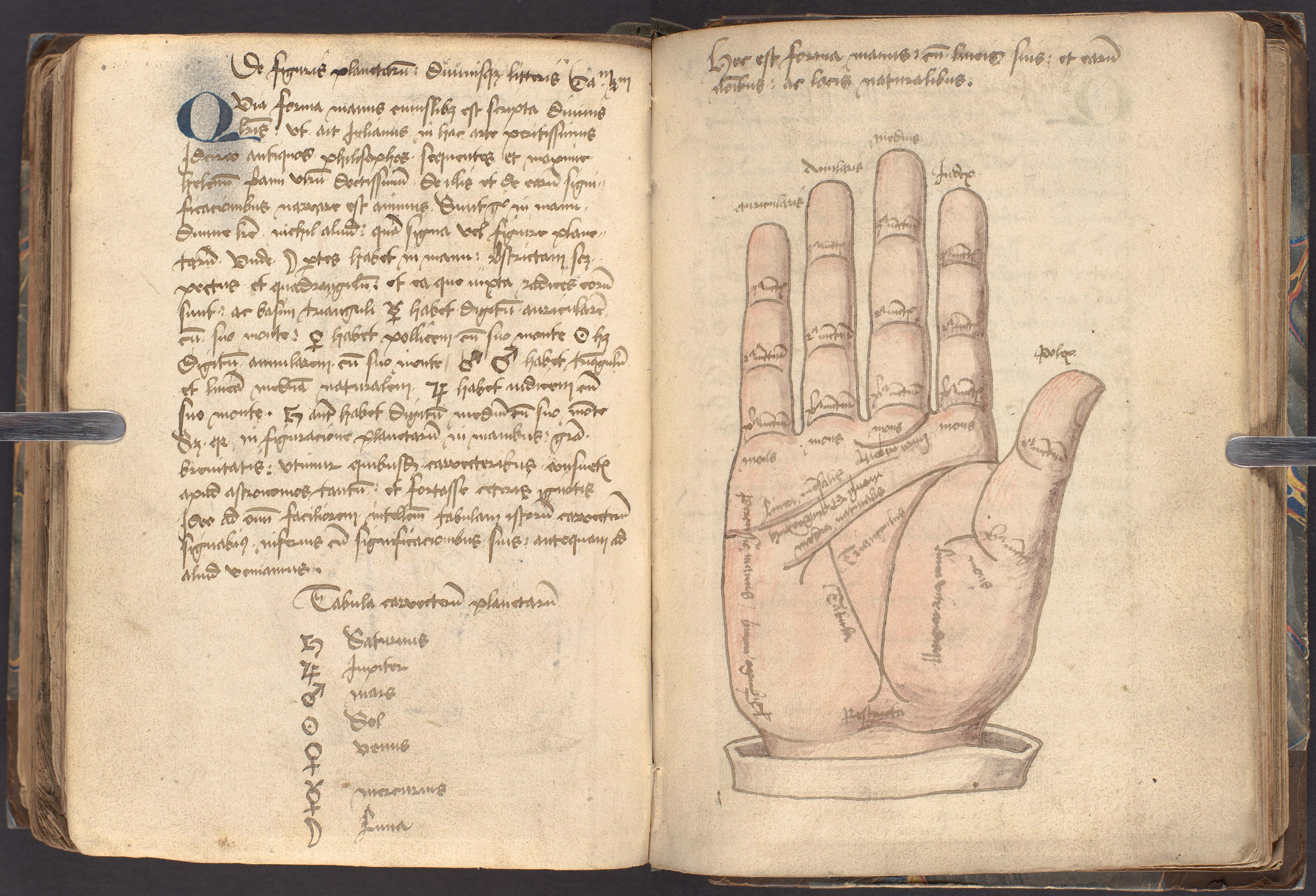
Our latest “Document of the Week” was chosen by our Senior Curator, Dr Mary Wills. This Latin manuscript on palmistry dates from the fifteenth century and is entitled Chyromantia at Natura Planetarum (“Palmistry and the Nature of the Planets”).
Palmistry, or chiromancy, is the ancient art of studying the lines and undulations of the human hand to determine an individual's character, and to divine their future. The history of palm reading and its associated symbols have evolved through multiple civilisations, with roots in classical antiquity across India, China, Greece, and Rome. Records of the practice appear not only in scientific or magical writings, but also in religious texts.
This manuscript (MS LAT/30), from the Special Collections of University College London, formed part of the library of John Thomas Graves (1806–1870), mathematician and Professor of Jurisprudence. It belongs to a group of early European divinatory treatises which explored the links between the human palm and the influence of celestial bodies. Practitioners blended palmistry with astrology, looking to the movements of the sun, moon, and planets as an aid to better understand human characteristics and fate. These popular treatises were a staple of Renaissance occultism, a resurgence of esoteric philosophies in which scholars treated magic as serious scientific study. Many of these books were later restricted or prohibited by the Roman Catholic Church.
The manuscript includes 21 detailed colour diagrams of hands, illustrated with symbols. These symbols link specific features of the palm to the seven classical planets and their associated influence on human character. As set out in the handwritten text, the symbols relate to Saturnus (Saturn), Jupiter, Mars, Sol (Sun), Venus, Mercurius (Mercury), and Luna (Moon). For example, in this image, the symbols for Venus (representing love and passion) and Luna (governing intuition and imagination) are shown at the base of the thumb and smallest finger.
The practice of chiromancy continued to evolve over time. Palm reading was used as evidence during witch trials of the sixteenth and seventeenth centuries, to convict individuals of sorcery or heresy. Longstanding cultural associations with witchcraft continued to affect how the practice was seen, and feared; in the nineteenth century fortune-tellers could be prosecuted in England under the Vagrancy Act of 1824. Palmistry experienced a resurgence in Europe and the United States in the later nineteenth century, as part of a wider movement to explore the occult and spiritualism. The term "cheirosophy", the practice of interpreting character and events through the study of human hands, was popularised in the late nineteenth century by the English scholar, Edward Heron-Allen, in his A Manual of Cheirosophy (1883).
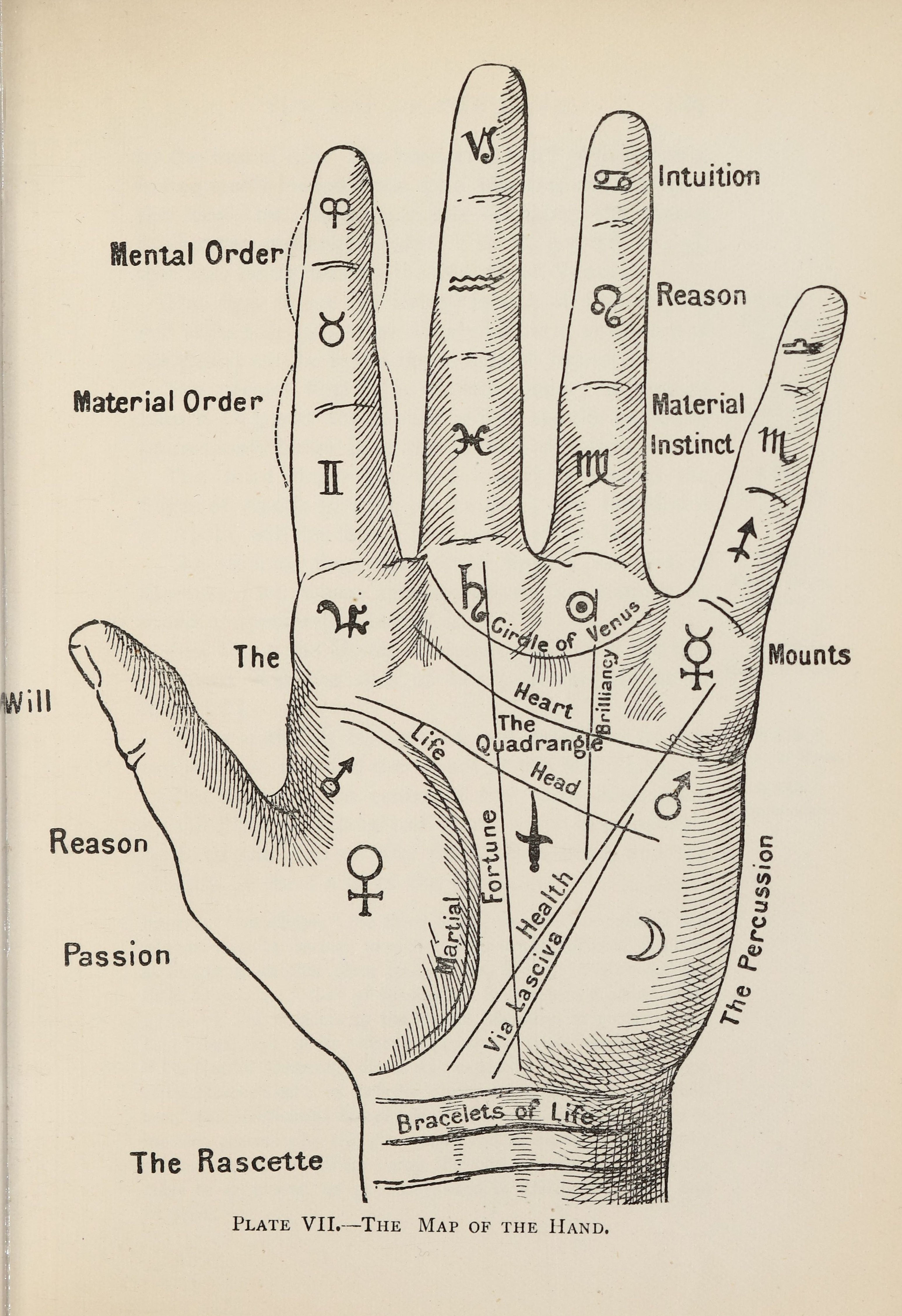 ‘Plate VII: The Map of the Hand’, from Edward Heron-Allen, A Manual of Cheirosophy (STORE 15-1005/9), available at BOA via https://britishonlinearchives.com/documents/60507/store-15-10059-a-manual-of-cheirosophy-by-edward-heron-allen#?xywh=-1110%2C0%2C9747%2C5274&cv=193.
Where to find these documents
These documents feature in our primary source collection, Witchcraft and Magic in England, c. 1400–1920. This fascinating resource charts the evolution of witchcraft and magic in England over five centuries. Incorporating a broad range of records and texts, it facilitates exploration of an array of key topics and themes, such as gender, medicine, politics, religion, and science. Interdisciplinary in ethos and expansive in terms of its chronological scope and the archival materials that it contains, this collection will appeal to students, educators, and researchers working within a range of scholarly fields.
Visit the collection page to learn more.


.svg)


