

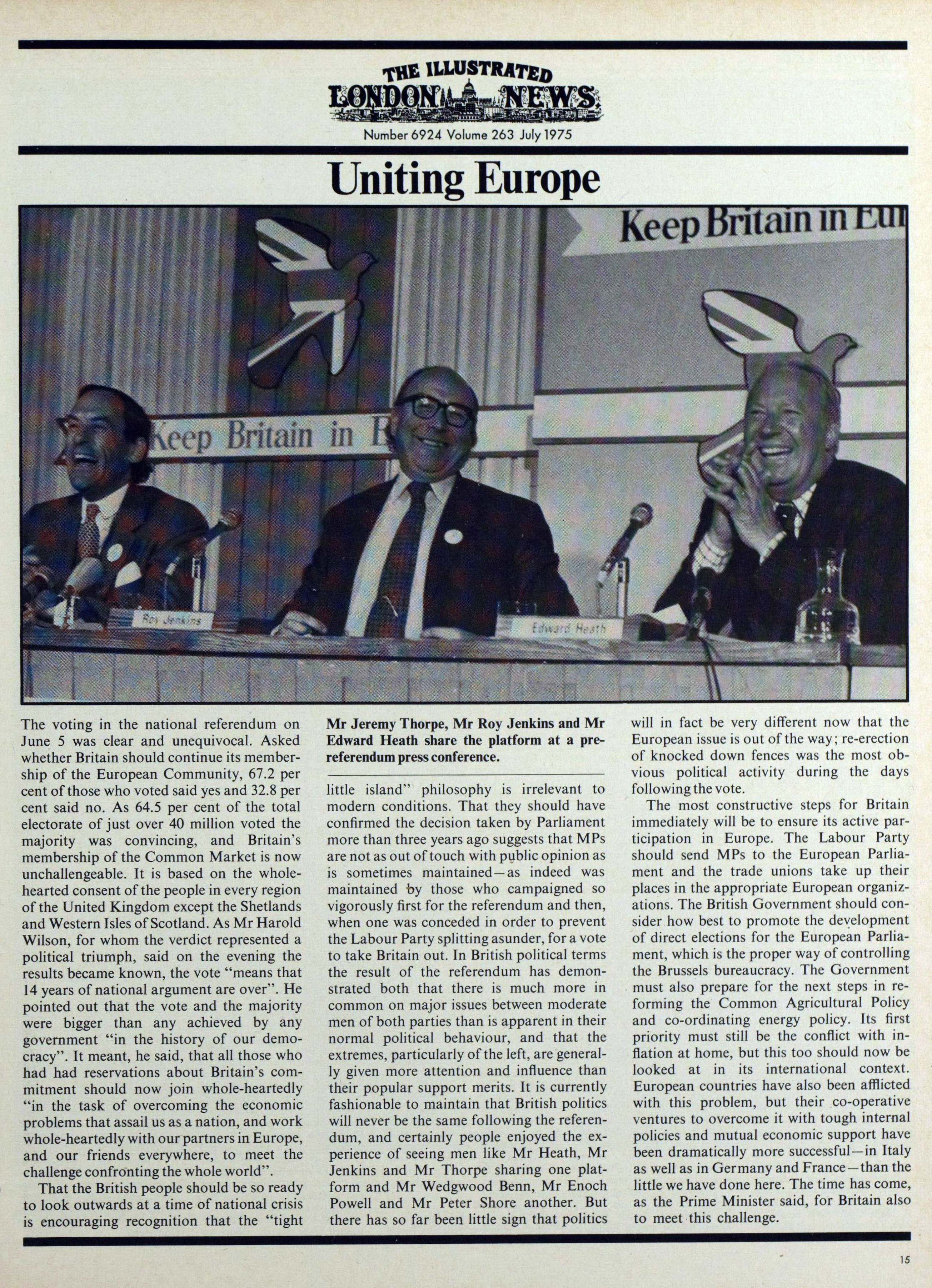
Our latest “Document of the Week” was chosen by our Senior Editor, Dr Tommy Dolan. Published in The Illustrated London News (ILN) in July 1975, it is an article that reported upon the outcome of the UK referendum on membership of the European Economic Community (EEC), the first referendum in British history.
Under Edward Heath’s Conservative government, the UK entered the EEC on 1 January 1973, the same day as did the Republic of Ireland. Understandably, membership of the Common Market had generated political turbulence throughout the previous decade or so, and the terms on which the UK finally entered this evolving economic federation did not solicit universal approval domestically.
Circumstances generated two UK general elections in 1974, held in February and October. In its manifestos, the Labour Party promised to renegotiate the UK’s terms of membership, with the European question to be settled by a referendum on whether the UK should remain a member state. Having won both elections, Harold Wilson’s Labour government negotiated with its eight fellow member states throughout late 1974 and early 1975, achieving, for example, Common Market access for dairy produce from New Zealand. The European Referendum Bill received royal assent on 8 May and the referendum was held on 5 June.
As reported in the ILN, it was “clear and unequivocal”: “67.2 per cent of those who voted said yes and 32.8% said no”, with a turnout of “64.5 per cent of the total electorate of 40 million”. Membership was now “unchallengeable”, as the article put it, based, as it was, upon “the wholehearted consent of the people of every region except the Shetlands and Western Isles of Scotland”. The article noted that the outcome was a triumph for Wilson, who declared that “14 years of national argument were over”. The author also insisted, with evident pride, that the result evidenced how the ‘“tight little island philosophy”’, so conspicuous amidst the rhetoric advanced by those within the leave camp, was “irrelevant to modern conditions”. This reporter likewise contended that the whole affair had evidenced two much-vaunted characteristics of the British political tradition: consensus and moderation—
“the referendum has demonstrated that there is much more in common on major issues between moderate men of both parties than is apparent in their normal political behaviour, and that the extremes, particularly of the left, are generally given more attention and influence than their popularity merits”.
It is interesting to look back upon a point in time when the UK’s membership of the Common Market seemed effectively set in stone. But one might also point to another aspect of this era that, arguably, is just as intriguing and, indeed, consequential: a growing belief in the efficacy of referendums as a means of streamlining political debate and bolstering national unity. Take, for example, the influential strand of political thought articulated by John Hume, the former, long-serving leader of Northern Ireland’s Social Democratic and Labour Party (SDLP) and key architect of the Northern Ireland peace process. Throughout the early to mid-1970s, Hume maintained that holding joint referendums on Irish unity in Northern Ireland and in the Republic of Ireland would remove the constitutional question from the island’s politics and, in turn, defeat the ideology of the Irish republican movement.
Yet although the UK referendum on Common Market membership did more or less jettison (at least for a time) the European question from British political debate—just as Wilson and like-minded individuals hoped it would—surprisingly, there would not be another referendum in the UK until that held on the issue of the alternative vote in 2011. Significantly, whilst the 1975 referendum seemed to evidence the effectiveness of this political tool, the thorny legacy spawned by its successor, the “Brexit” vote of 2016, much like that generated by the Scottish independence referendum of 2014, has brought many scholars and commentators to a surprising and, moreover, unsettling realisation: referendums can divide just as much, if not more, than they unite.
Where to find this document
It comes from our primary source collection, The Illustrated London News, 1842–2003. Containing over 250,000 images, this fascinating and visually stunning collection brings together the extensive back catalogue of one of the most influential and successful publications in the history of British print media.
Visit the collection page to learn more.

.svg)


