

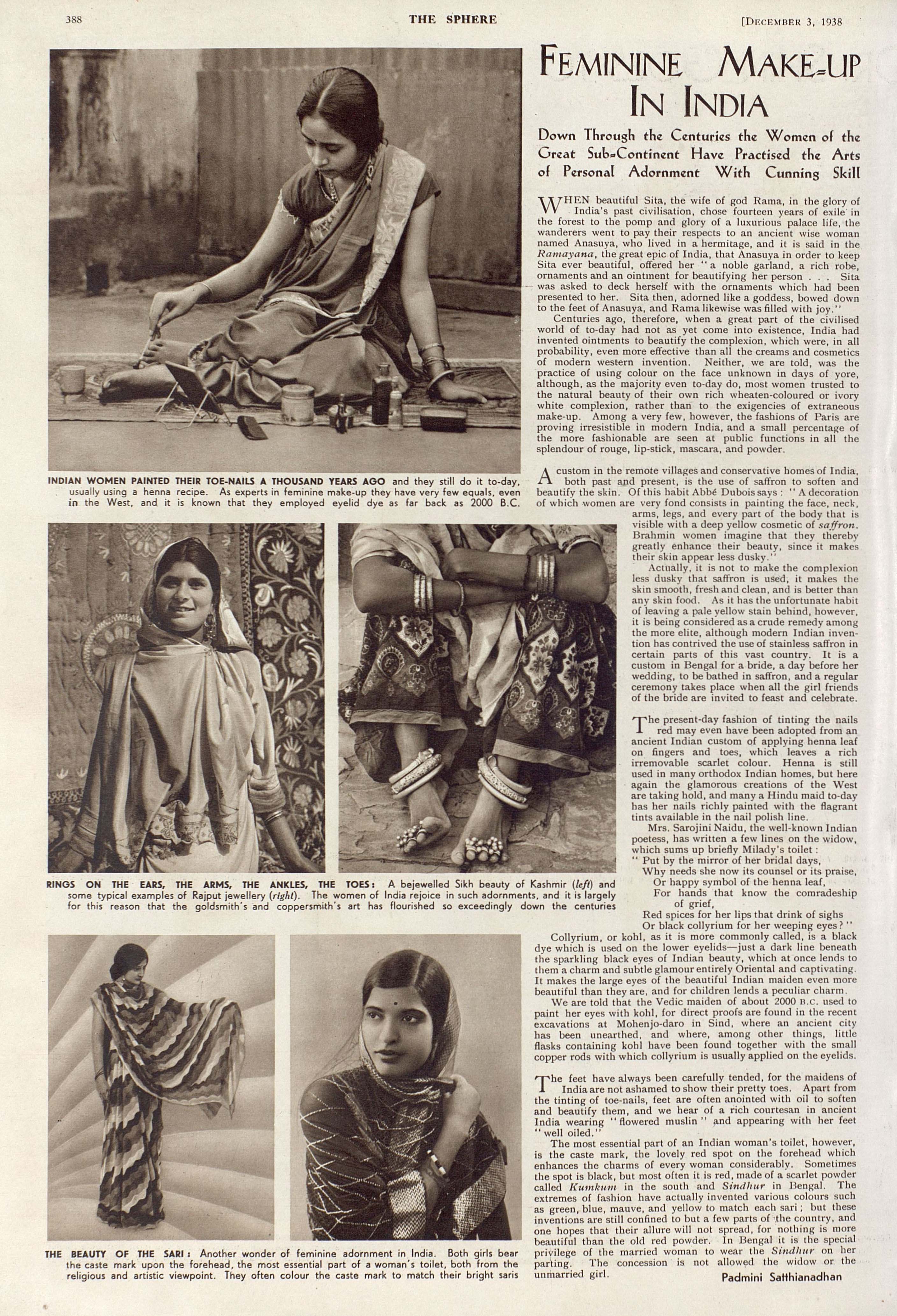
Our latest “Document of the Week” was chosen by our Editor, Nishah Malik. It is an article titled “Feminine Make Up in India” from The Sphere. Published on 3 December 1938, this piece discusses how women of the subcontinent practiced the “art of personal adornment”.
Rather than depicting Indian cosmetic practices as exotic curiosities or dismissing them as uncivilised, a common trend in writing dating from India’s colonial era, the author of the article finds them intriguing and presents them in a celebratory manner. From the outset, the article emphasises the antiquity of Indian beauty traditions, suggesting that Indian women had mastered cosmetics and adornment long before the “modern Western invention” of creams and powders. The piece presents these practices not as novelties, but as sophisticated customs rooted in history, ritual, and artistry.
The article discusses a range of beauty practices, including the use of kohl, henna, and jewellery. According to the author, kohl, a black dye applied to the lower eyelids, is said to have been in use “as far back as 2000 B.C”. The author felt that it lent “a charm and subtle glamour entirely Oriental and captivating”, noting how it made the large eyes of Indian women “even more beautiful”. The article also mentions how kohl was commonly applied to children’s eyes, reflecting its widespread cultural use.
The “present day fashion” of painting one’s nails is described as an “ancient Indian custom”. Indian women have often applied henna leaves to their fingers and toes, leaving a scarlet stain on the nails. Bridal rituals receive particular attention in the article, such as ceremonial bathing in saffron and the careful decoration of hands and feet before marriage celebrations.
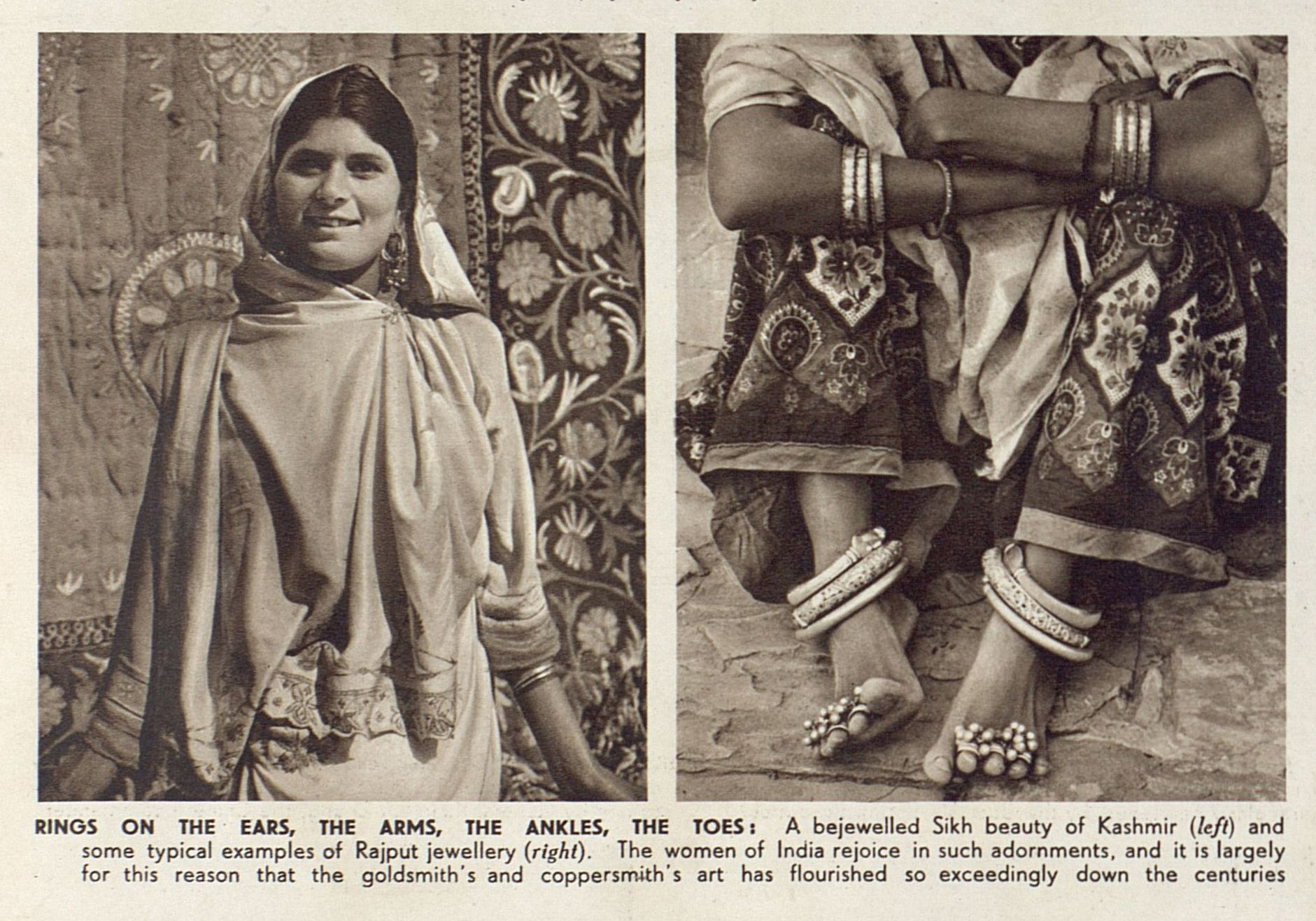
Jewellery has played a central role in Indian women’s adornment. The article describes women as rejoicing “in such adornments” as rings worn on the fingers and toes, anklets known as payal, bangles on the wrists called churiyan, and traditional earrings such as jhumkay or baaliyan. This rich profusion of ornaments was not only due to their visual appeal, it was also closely connected to the flourishing of local craftsmanship, particularly the skilled work of goldsmiths and coppersmiths. Personal adornment also reflects South Asia’s artistic heritage and has supported its thriving artisan traditions.
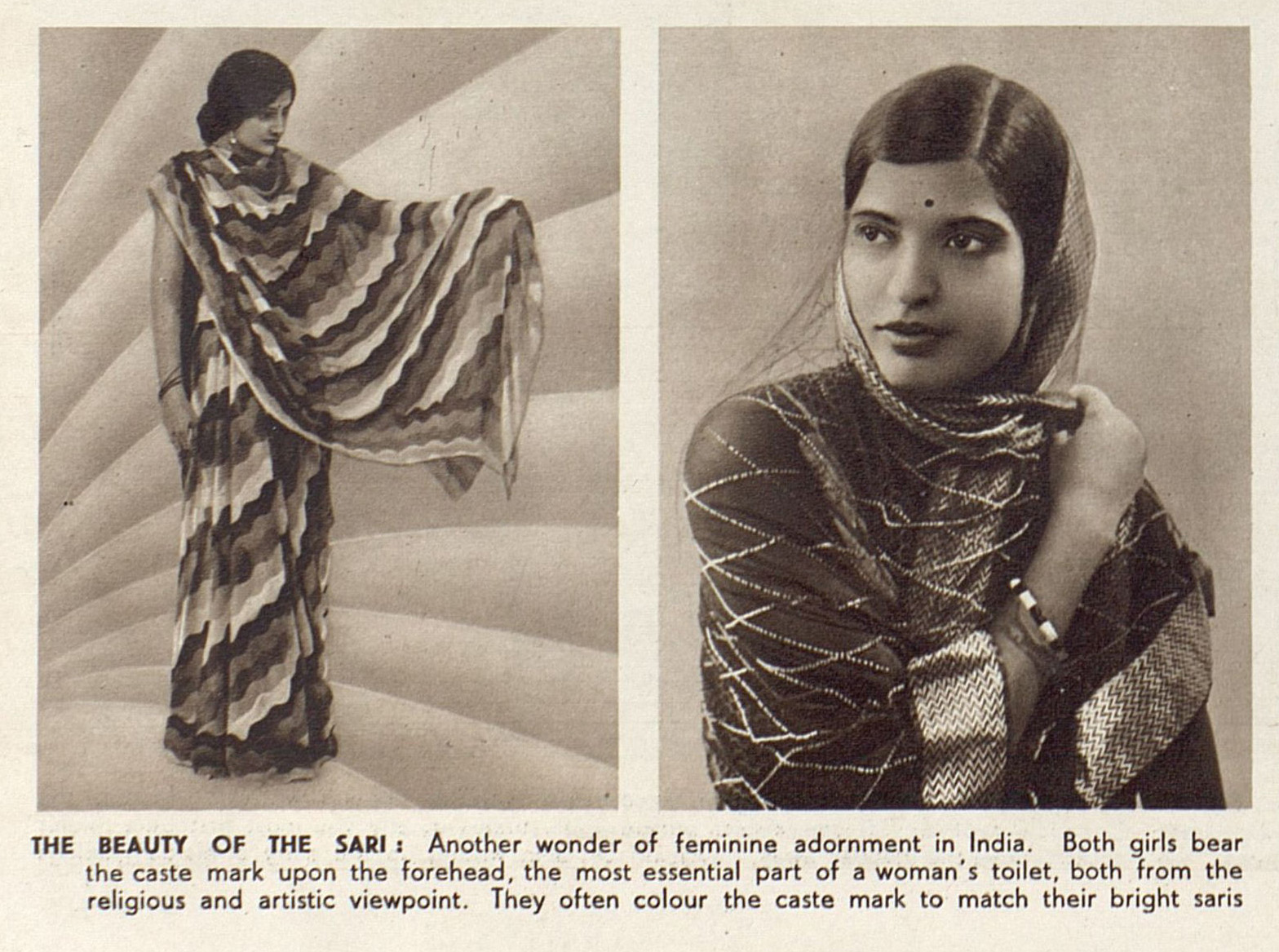
The sari is celebrated as “another wonder of feminine adornment in India”, combining artistry with cultural significance. The article also goes on to describe how married women apply sindhur, a red powder worn in the parting of the hair. The author highlighted how sindhur is a “special privilege” that is not permitted to widows or unmarried girls, underscoring how cosmetics can signify social status and identity.
This article highlights how adornment is never merely decorative. Whether through the use of kohl, henna, jewellery, or sindhur, beauty practices can carry history, belief, and identity. What makes this article particularly striking is how familiar many of these practices still are in 2026. Across the subcontinent and throughout the South Asian diaspora, women continue to carry on these traditions. Far from being relics of a distant past, these forms of adornment remain vibrant expressions of identity, culture, and continuity.
Where to find this document
It is from our collection, The Sphere, 1900–1964. This features nearly 160,000 images from almost 4,000 weekly issues of the publication, which was owned by The Illustrated London News. The Sphere provides key insights into the social and political transformations of the early to mid-twentieth century, making it an excellent resource for students, educators, and researchers. Visit the collection page to learn more.