

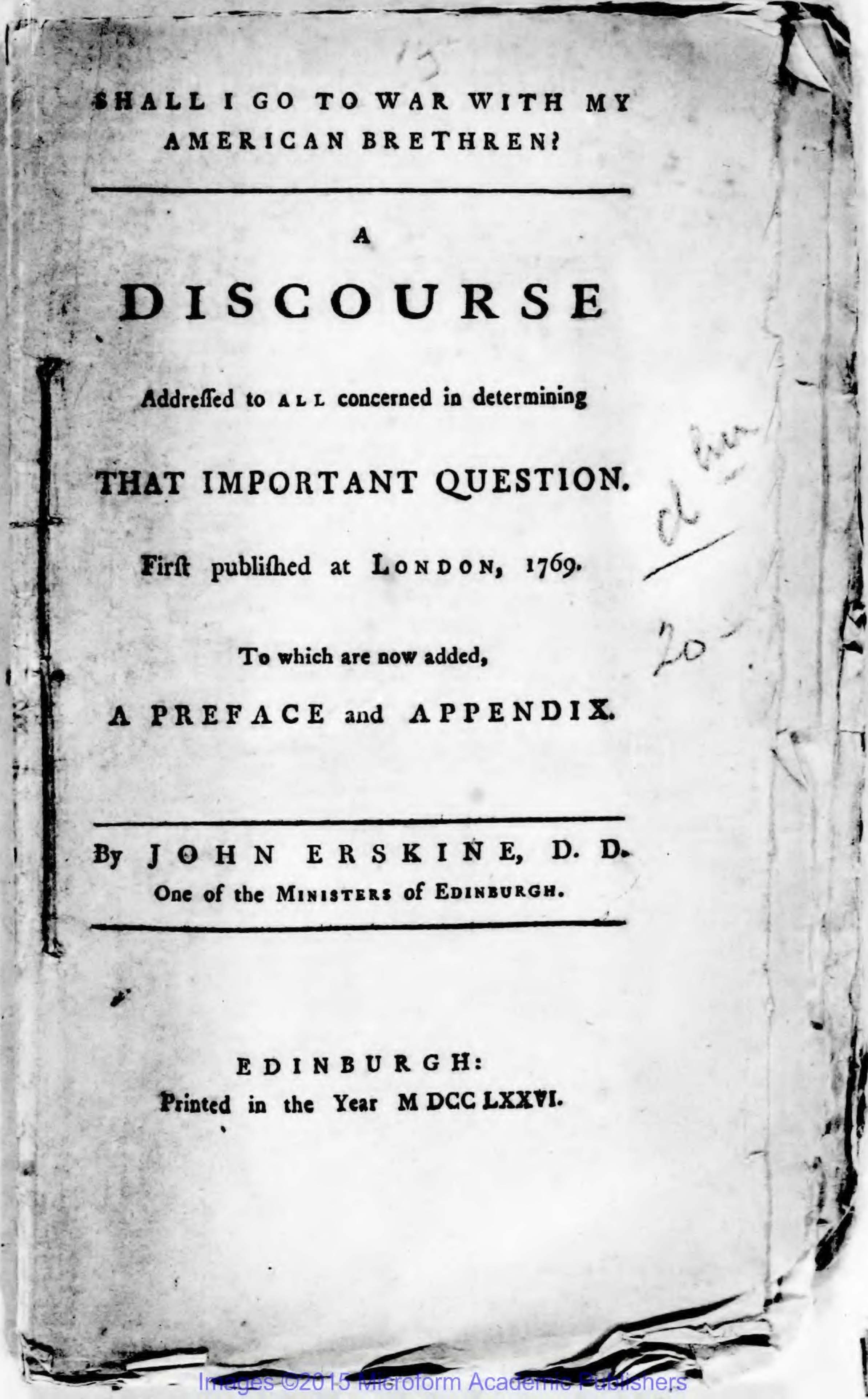
Our latest “Document of the Week” was chosen by our Academic Liaison Manager, Dr Catherine Bateson. It is a pamphlet title page, published in 1776, about Britain’s growing tensions with the American Colonies.
For the Scottish Church minister, John Erskine, on the eve of America’s break with Great Britain, there was only one major concern to address: “SHALL I GO TO WAR WITH MY AMERICAN BRETHREN?” Erskine had been worried about the growing tensions between Britain and America since the 1760s, and had watched increasing colonial grievances come up against Westminster’s intransigence in hearing demands over taxation, representation, and military abuses by colonial forces. So concerned was Erskine that he first wrote this pamphlet in 1769, around the time when colonial boycotting of British trade goods had started in Virginia and Pennsylvania, a practice which made those across the Atlantic realise the gravity of rising opposition to the status quo. As the situation became worse and eventual fighting broke out in Boston in 1770—and more consequentially in 1775 at Lexington and Concord, Massachusetts—Erskine took out his pen and reissued his original pamphlet, this time with an added preface and appendix material detailing the decline state of affairs.
The title page of this pamphlet makes Erskine's concerns very clear. His inquiry about whether Britain would soon find herself at war with her colonial brethren was, he stated bluntly, a most “IMPORTANT QUESTION” for the whole country. “Addressed to all concerned in determining” the answer, the theologian’s new preface went on to detail the tensions of the intervening seven years since his first publication. Britain now found itself closer “to the danger to which a war with her colonies might expose” weakness and fragility. His main worry was that if further fighting broke out, it would cause “a crisis fatal to Britain’s prosperity”. Appealing to higher authority, the theologian hoped a calm and diplomatic approach would renew peace and prosperity for “the harmony of Britain and her colonies, without further effusion of blood”. If not, Erskine prophesied, political division, the separation of America, and attacks from France and Spain, would all leave Britain weaker on the global stage.
Erskine's pamphlet is one of many which circulated routinely throughout Britain and across to America in the decade proceeding the Revolution, during the War of Independence, and in its aftermath. Though a simple title page to just one such example, this reissuing of Erskine’s arguments indicates not only how informed the British public were about the colonists’ plight, but how keen they were to hear as much updated discourse as possible during what was effectively a trans-Atlantic civil conflict. Erskine published this document in May 1776—barely two months later, the colonists had taken another divisive step by declaring independence from Britain. Erskine continued his American discourse in other pamphlets, siding with the colonists during “Britain’s crisis” over the coming years.
Where to find this document
This document comes from our primary source collection The American Revolution from a British Perspective, 1763–1783. It contains a range of pamphlets written and published on both British and American sides of the Atlantic in the aftermath of the Seven Years’ War up to the conclusion of the American War of Independence twenty years later. The pamphlets are an excellent primary source of tensions and debates over the American colonies’ actions, British government reactions, and how ordinary citizens viewed what was happening on either side during the Revolution. Visit the collection page to learn more.