

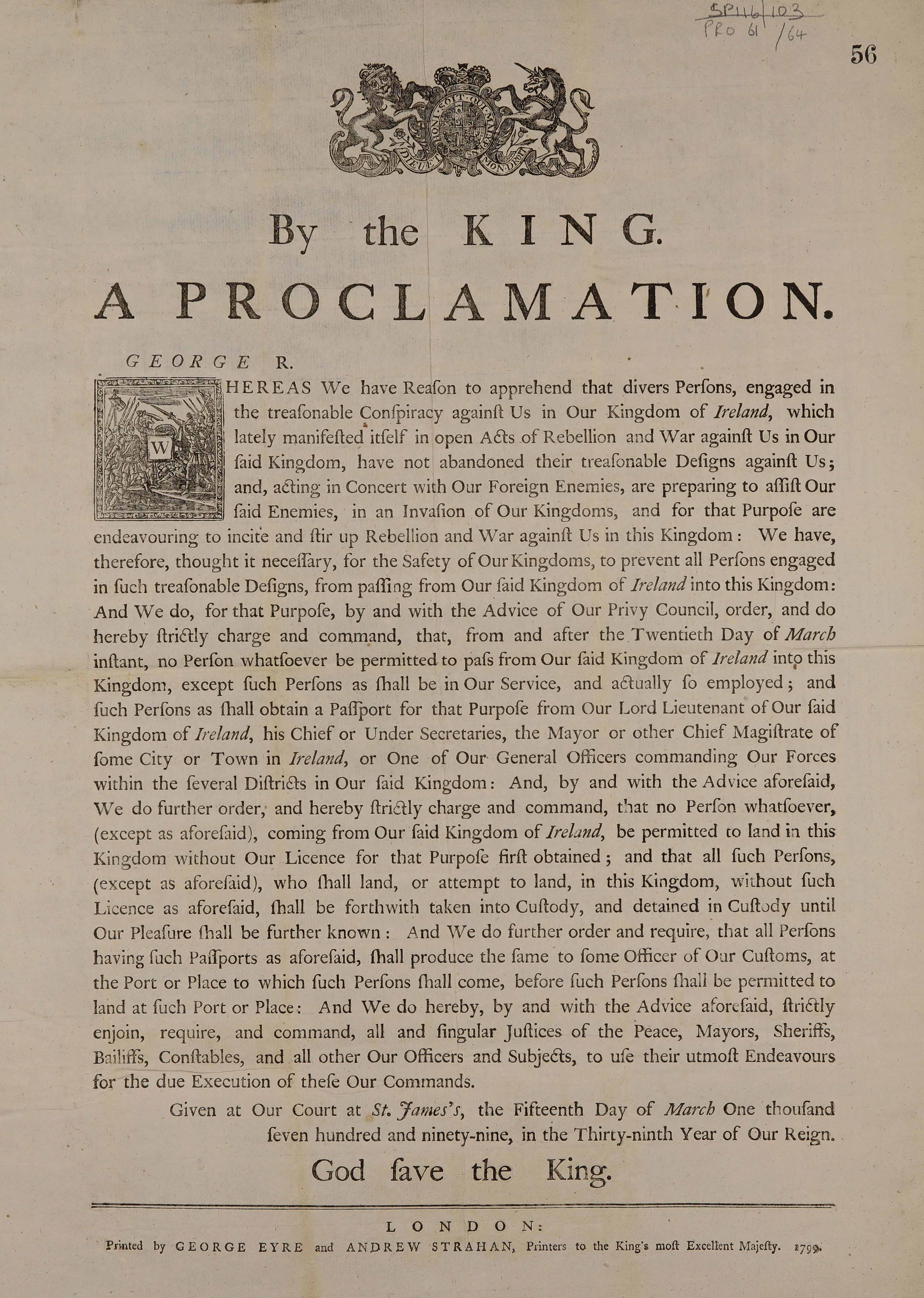
Our latest “Document of the Week” was chosen by our Senior Editor, Dr Tommy Dolan. It is a royal proclamation issued by King George III on 15 March 1799. Its purpose: “to prevent all Persons engaged in . . . treasonable Designs passing from Our Said Kingdom of Ireland into this Kingdom”, i.e. Britain.
It was issued in the wake of the rebellion against British rule in Ireland that was fomented by the United Irish Society. Formed in Belfast in 1791 as a constitutional pressure group seeking parliamentary reform and the end of the debilitating penal laws against Ireland’s significant Presbyterian and Roman Catholic communities, by the mid-1790s the society had morphed into a clandestine movement aiming at the establishment of an Irish republic with the help of French military aid. The short, unsuccessful, but nonetheless bloody and influential, rising that unfolded saw something like 50,000 rebels take to the field in the summer of 1798, faced by around 76,000 Crown soldiers.
By the time the French flagship, the Hoche, was captured by the Royal Navy on 12 October 1798, with one of the society’s leaders, Wolfe Tone, onboard, the rebellion was all but crushed. Yet discontent and revolutionary zeal were by no means extinguished in Ireland, nor was the threat posed by France. This precarious situation continued to alarm the British authorities throughout the spring of 1799. As the royal proclamation put it:
“We have Reason to apprehend that divers Persons, engaged in the treasonable Conspiracy against Us in Our Kingdom of Ireland, which lately manifested itself in open Acts of Rebellion and War [. . .] have not abandoned their treasonable Designs against Us; and, acting in concert with our Foreign Enemies, are preparing to assist Our Said Enemies, in an Invasion of Our Kingdoms.”
Henceforth, only those in the service of the Crown were permitted to pass from Ireland into Britain. They were required to gain a “Passport” from the Lord Lieutenant of Ireland or his undersecretaries. Indeed, anyone from Ireland wishing to land at British ports were required to apply for a “Licence for that Purpose”, without which they could be taken into custody.
But what is perhaps most interesting about this document is not necessarily the fact that it is a relatively early example of the modernising British state restricting the movement of people between its constituent kingdoms. It could be argued, rather, that its true value stems from the way in which it prompts consideration of a much broader and intriguing theme within British and Irish history—the British state’s tendency to try to quarantine itself from Irish influence, both demographic and ideological. For example, one could draw a parallel between the proclamation of March 1799 and, say, the exclusion order provisions of the Prevention of Terrorism (Temporary Provisions) Bill that was passed in the wake of the Birmingham bombings by the Provisional Irish Republican Army in November 1974. This legislation gave the government the power to prohibit individuals suspected of involvement in terrorism from entering or residing in Great Britain.
The Home Secretary at the time, Roy Jenkins, wrote in his memoirs that he perceived this legislation as vital because, as he put it, Ireland was where the “terrorists came from [. . .] both in origin and motive, and it was hard-headed sense to try and protect the trunk against the gangrene in one limb” (Jenkins, 1991, p. 396). A similar, isolationist mindset is discernible in George’s proclamation of March 1799 and, moreover, in the statement made by Edward Cooke, William Pitt’s undersecretary, in the wake of the 1798 rebellion—“Ireland is like a ship on fire, it must either be extinguished or cut adrift.”
Where to find this document
This document features in our collection, Radicalism and Popular Protest in Georgian Britain, c. 1714–1832. It contains over 90,000 images, sourced from The National Archives (UK) and the Working Class Movement Library, relating to radicalism, riots, dissent, activism, and protest. Visit the collection page to learn more.