

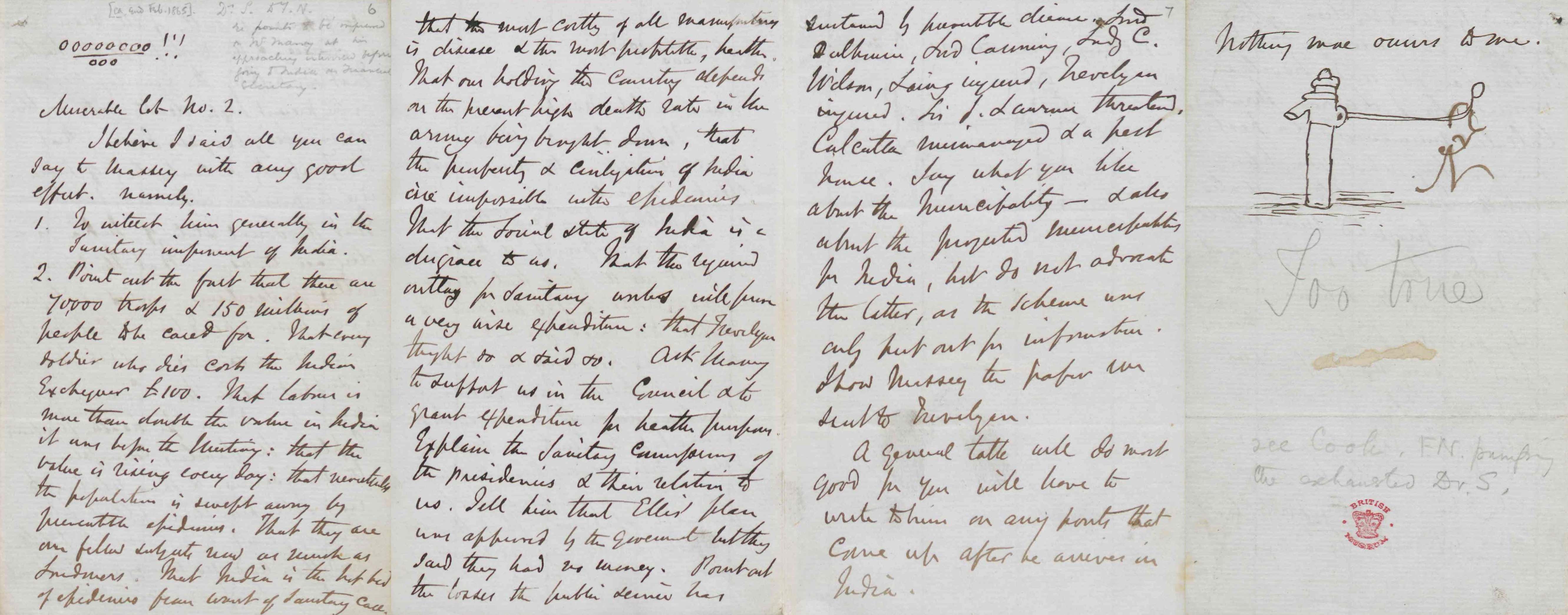
Our latest “Document of the Week” was chosen by our Editor, Nishah Malik. It is drawn from correspondence between the sanitary reformer, John Sunderland, and the famous nurse, Florence Nightingale, exchanged between 1865 and 1867. The letter, written by Nightingale, stresses the critical importance of addressing sanitary conditions in India following a cholera outbreak. Nightingale urged influential officials, such as James Massey, to support investment in sanitation, connecting disease to economics, imperial stability, and morality.
Her letter argued that more than 70,000 British troops and around 150 million civilians were living under constant risk from preventable disease. Nightingale stressed that epidemics were devastating lives and undermining imperial rule, making it clear that neglecting sanitation was not only a humanitarian failure, but also an economic disaster. Every soldier lost, in her view, represented a financial cost to the Indian government and caused a loss in valuable labour.
The first cholera pandemic began in Bengal and spread across India between 1817 and 1824. It caused the death of hundreds of thousands of Indians and many British troops. This outbreak spread as far as China, Japan, Indonesia, Sri Lanka, and Thailand. Due to the expansion of trade routes, the second outbreak, which began in 1826, reached Great Britain, Europe, and the Americas. Despite key developments in British understandings of sanitation, hygiene, and disease transmission, cholera was frequently referred to as “Asiatic Cholera” or “the Indian Cholera”. Often, many blamed the subcontinent for the onset of the disease and Nightingale’s letter takes a similar stance.
She claimed that India had become a “hot bed of epidemics” because of inaction and mismanagement, adding that the “social state of India” was a disgrace to the imperial government. The language of the letter strongly reflects Victorian ideas about cleanliness. For Victorians, cleanliness was never just about hygiene, it symbolised morality, civilisation, discipline, and social order. Nightingale’s letter stated that “the prosperity and civilisation of India” was “impossible with epidemics”. Her words present disease as shameful, while cleanliness is equated with progress and responsibility. India is described as “mismanaged” and a “pest house”, while sanitation is framed as a civilising force.
Narratives like this have contributed to xenophobia, discriminatory policies, and racialised ideas of health that still echo in modern debates about migration, pandemics, and global health inequality. In particular, stereotypes portraying South Asians as “dirty” or inherently diseased have proved remarkably persistent. Other pandemics have been denounced as foreign and framed using racial tropes, from the so-called “Spanish flu” to more recent outbreaks of what some referred to as “Chinese COVID”. These patterns show how disease is rarely understood as purely biological; instead, it is tied to ideas of morality and prejudice.
Where to find this document
This document is from our collection, Pandemics, Society, and Public Health, 1517–1925. This charts the course and consequences of pandemics over five centuries. Containing over 79,000 images, the collection concentrates on four diseases that have left a significant mark upon British history: plague, cholera, smallpox, and influenza. Visit the collection page to learn more.