

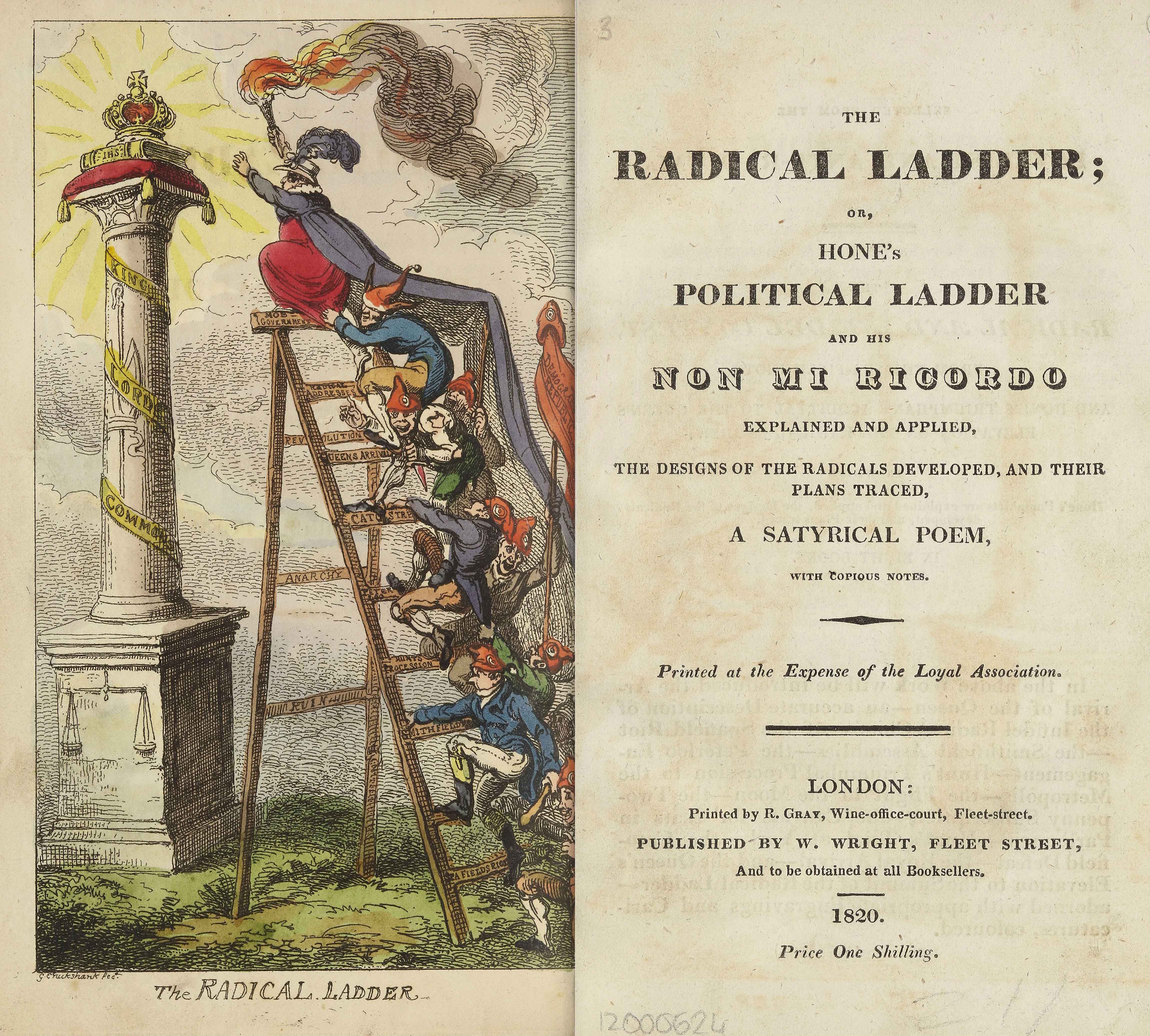
Our latest “Document of the Week” was chosen by our Senior Curator, Dr Mary Wills. Taken from our new primary source collection, Radicalism and Popular Protest in Georgian Britain, c. 1714–1832, it is a print by the caricaturist, George Cruikshank, satirising the “Queen Caroline Affair” of 1820. This unprecedented episode in British history saw Queen Caroline, the estranged wife of King George IV, put on trial for adultery in the House of Lords as part of the king’s efforts to divorce her. “The Radical Ladder” is one print of many from this period offering a satirical response to current affairs. In this case, it also is the frontispiece to a collection of pamphlets published by the satirist and bookseller, William Hone.
In 1795, Princess Caroline, from Brunswick in Germany, married George, then Prince of Wales. The marriage was unhappy, however, as George was already secretly married to Maria Fitzherbert. Caroline held an alternative court (that attracted accusations of indiscreet behaviour) at her house in Blackheath. When George III died in 1820, the new king tried to divorce Caroline to prevent her from being crowned as queen, and parliamentary proceedings were launched against her for adultery. The trial generated unprecedented media attention and public scrutiny, and portrayals of the queen appeared many times in periodicals, pamphlets, prints, and newspapers.
In “The Radical Ladder”, Queen Caroline is depicted at the top of an unsteady stepladder, attempting to burn the royal crown of her husband. The devilish-looking figures portrayed behind her, sheltering under her cloak, are Jacobins, supporters of the French Revolution. The followers wear caps of “Liberty” or “Folly” and one holds a banner reading “Democracy Republic”. Only a few years had passed since the defeat of the French in 1815 and there were fears of a French-style revolution occurring in England. The rungs of the ladder are inscribed with “Mob Government”, “Radical Addresses”, “Revolution”, and “Anarchy”. Also mentioned are events of this period associated with radicalism and popular protest, including “Cato Street”, “Peterloo”, “Smithfield”, and “Spa Fields Riot”.
With the public still reeling from the impact of the Peterloo Massacre in 1819 and the oppressive clampdown of the so-called “Six Acts”, Queen Caroline’s trial became a symbolic illustration of the British state’s resistance to democratic reform. Hundreds of petitions in favour of Caroline were addressed to both Houses of Parliament, as Caroline became a figurehead for the oppressed, a victim of a corrupt government and monarchy. Links were also made to the rights of women. In July 1821, Caroline was famously refused entry to George IV’s coronation, and died a fortnight later.
The radical press lampooned proceedings in satirical prints and pamphlets. Cruikshank had previously produced caricatures in support of Caroline, but in “The Radical Ladder” he was paid to produce an anti-radical response. Originally, it was published in The Loyalist Magazine to highlight the opposition to Queen Caroline, and it exemplifies the interplay of satirical image and text in such prints. Such documents provide fascinating details on the relationship between the radical press, high politics, and the viewing public in times of controversy and unrest in Georgian Britain.
Where to find this document
This document features in our collection, Radicalism and Popular Protest in Georgian Britain, c. 1714–1832. It contains over 90,000 images, sourced from The National Archives (UK) and the Working Class Movement Library, relating to radicalism, riots, dissent, activism, and protest. Visit the collection page to learn more.