

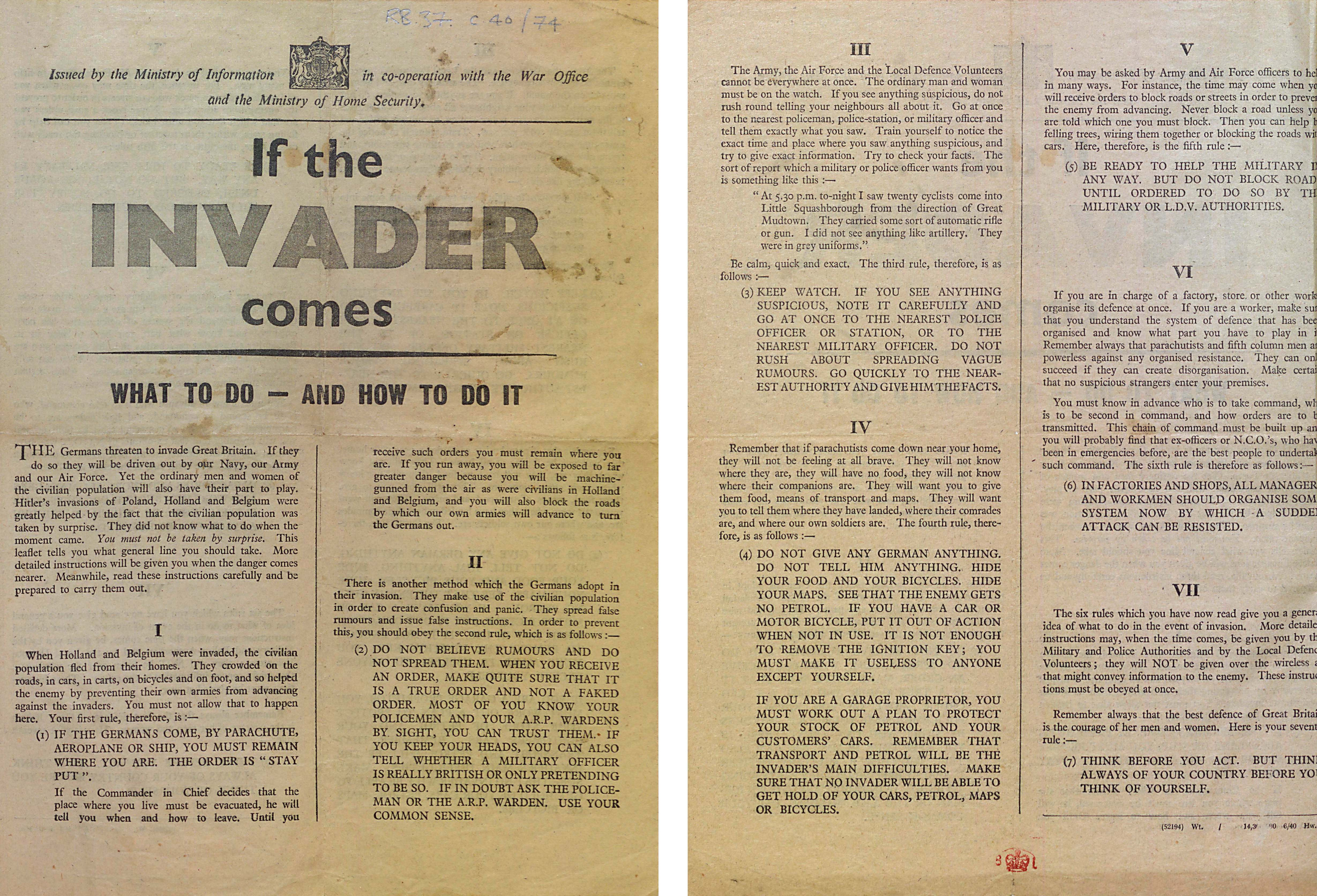
Our latest “Document of the Week” was chosen by our Senior Curator, Dr Charlie Hall. It comprises a leaflet produced by the UK government’s Ministry of Information and distributed to every household in Britain in June 1940, when the threat of German invasion was at its highest. It offers a fascinating insight into the government’s attempt to prepare the public for the worst, at a critical juncture in the Second World War.
Nazi Germany launched its offensive into western Europe on 10 May 1940, and quickly swept through Belgium, the Netherlands, Luxembourg, and most of France. By mid-June, German forces appeared poised to launch an invasion of the British Isles. As the leaflet states, the Royal Navy, British Army, and Royal Air Force would repel them, but “the ordinary men and women of the civilian population will also have their part to play”.
The leaflet provided seven instructions designed to keep civilians safe and aid the war effort. People were encouraged not to panic or flee, not to spread rumours, to keep an eye out for enemy activity, and to follow orders from members of the armed forces. In conclusion, they were urged to “think before you act. But think always of your country before you think of yourself.”
Thankfully, the Nazi invasion never materialised, but the leaflet was still heavily criticised. One report noted that the public felt the leaflet’s tone was “out of touch with common sense”, and that they were being treated as “blithering idiots”.
Where to find this document
This item comes from our primary source collection, British Government Information and Propaganda, 1939–2009. Comprising over 27,000 images drawn from files at the British Library, this collection provides a wide range of propaganda and public information materials produced by the British government throughout much of the twentieth century. The collection offers fascinating insights into the ways that the authorities sought to communicate with the public on a wide range of issues, such as war and defence, pensions, healthcare, and the country’s relationship with Europe.
Visit the collection page to learn more.