

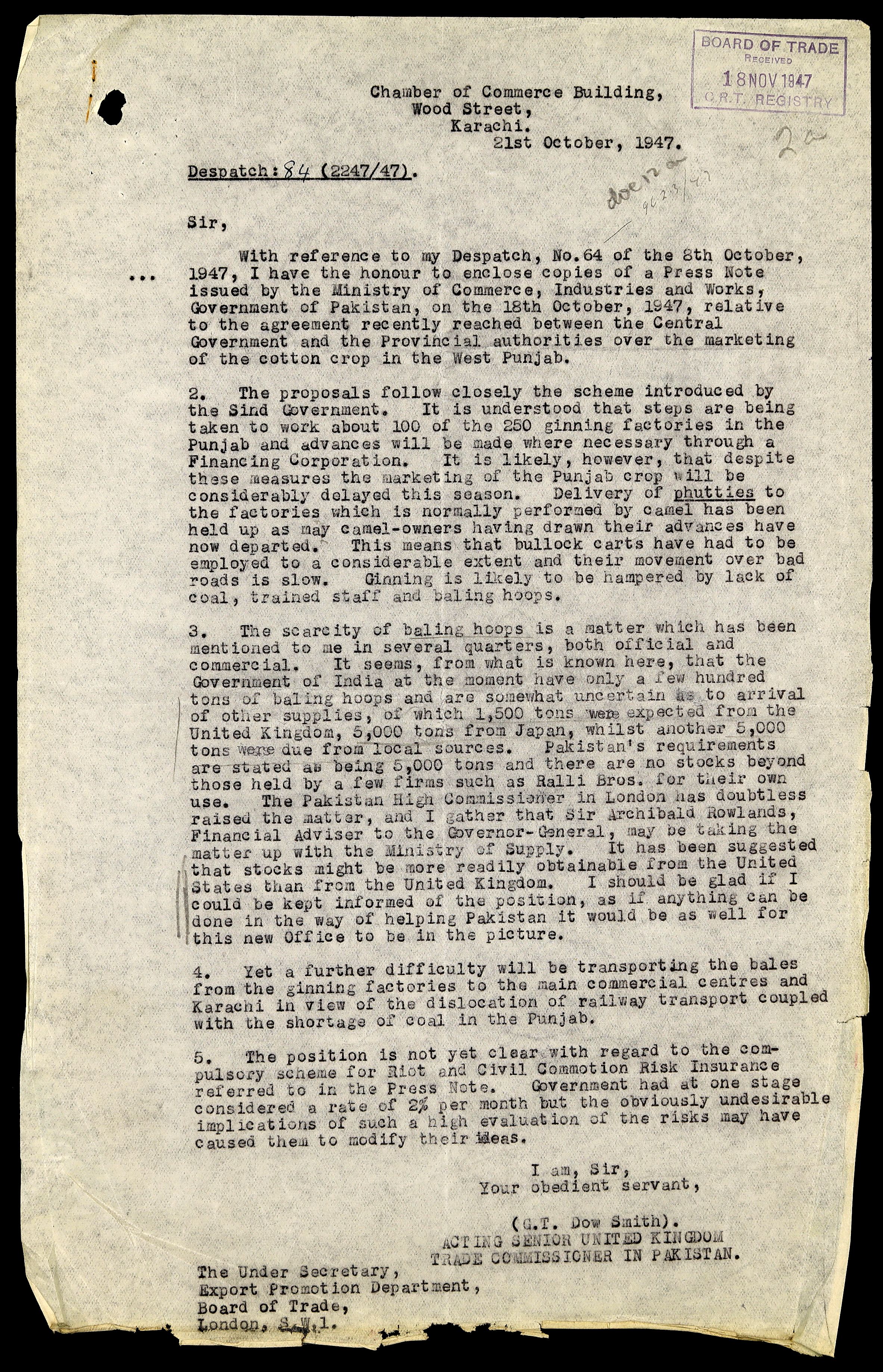
Our latest “Document of the Week” was chosen by our Editor, Nishah Malik. The document is a letter, dated 21 October 1947, from G. T. Dow-Smith, Acting Senior United Kingdom Trade Commissioner in Pakistan, to the Under Secretary of the Export Promotion Department of the Board of Trade in London. The letter encloses a press note issued by the Pakistani government’s Ministry of Commerce, Industries and Works, dated 18 October 1947, concerning the “Disposal of Cotton in West Punjab: Formation of a Financing Corporation”.
The partition of the subcontinent caused immense distress. Over fourteen million people were displaced, over two million people died, and around 75,000 women were raped and abducted. The drawing of the Radcliffe Line caused widespread devastation almost overnight on both sides of the newly formed borders. When the partition of British India in 1947 is discussed, religion, politics, and tensions dominate many narratives. The division of Punjab and Bengal, however, was not only a division of land and people: it was also a division of crops. This document concerns the marketing and disposal of the West Punjab cotton crop and the economic difficulties faced by the new Pakistani government in maintaining the normal flow of trade following partition.
Under British rule, Punjab developed into a major centre of cotton cultivation, supported by the expansion of irrigation, railways, and agricultural infrastructure. By the early twentieth-century, the province was producing a significant share of the cotton grown in India. The crop was important not only to local farmers and merchants, but also to the wider textile economy, supplying mills in India and supporting British commercial interests. Partition transformed this established system. West Punjab, one of the principal cotton-producing areas, became part of Pakistan, placing a valuable agricultural resource within the new state while leaving much of the processing and industrial infrastructure elsewhere. The division therefore created an immediate challenge: how could Pakistan maintain the production, processing, and movement of a crop that had previously been part of an integrated regional economy?
The importance of cotton to the region can be seen from the scale of the crop discussed in the letter and the press note. The letter reveals the extent of the disruption to normal trade and transport. As Dow-Smith explained, the “delivery of phutties to the factories, which is normally performed by camel has been held up”, because many camel owners had left after receiving their advances. As a result, “bullock carts have had to be employed to a considerable extent”, while the movement of goods was made more difficult by “bad roads”. The letter also states that ginning was likely to be affected by a lack of “coal, trained staff, and baling hoops”. This highlights how the problems facing the cotton industry were not simply financial; the disruption affected transportation, labour, fuel, and the physical equipment required to process the crop.
A particularly interesting part of the letter is the discussion of baling hoops, which were necessary for preparing cotton for transportation. Dow-Smith highlighted that the government of India had “only a few hundred tons of baling hoops” and was uncertain about the arrival of further supplies. The letter states that “1,500 tons were expected from the United Kingdom, 5,000 tons from Japan”, while another “5,000 tons were due from local sources”. Pakistan's requirements were estimated at “5,000 tons”, suggesting that the government was concerned about whether sufficient supplies would be available to process and transport the cotton crop. The letter therefore demonstrates how seemingly small shortages in industrial materials could threaten a much larger agricultural and trading system.
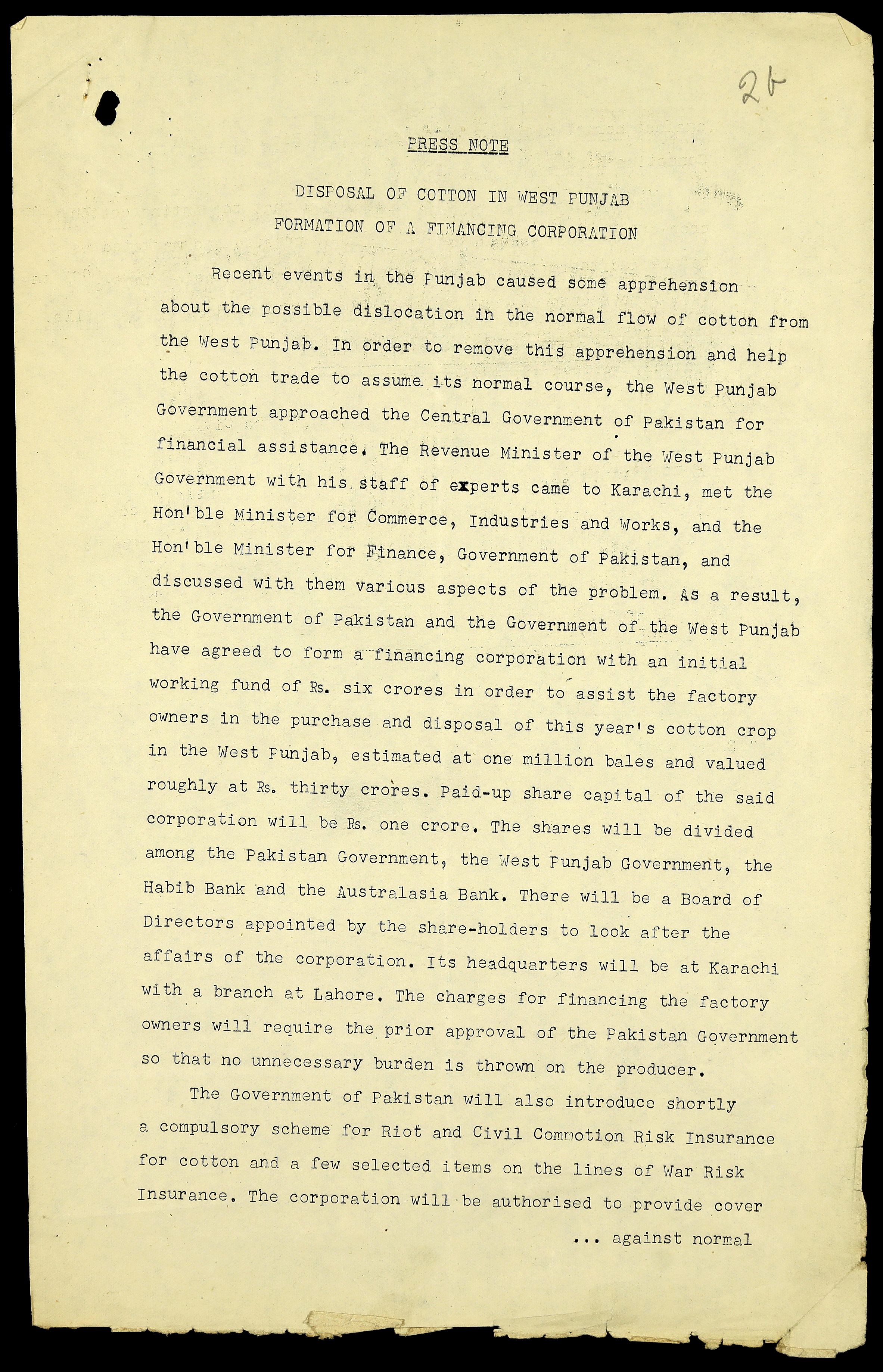
The accompanying press note stated that, following partition, there was a possibility of “dislocation in the normal flow of cotton from the West Punjab”. Furthermore, the press note stated that the governments of Pakistan and West Punjab “have agreed to form a financing corporation” to assist factory owners in the “purchase and disposal of this year’s cotton crop in the West Punjab, estimated at one million bales and valued roughly at Rs. thirty crores”. This demonstrates the considerable economic importance of cotton and explains why maintaining its production and distribution was a priority for the Pakistani government.
The press note also explained that the governments of Pakistan and West Punjab had agreed to create a financing corporation with an initial working fund of “Rs. six crores”. Its purpose was to assist factory owners in purchasing and disposing of the cotton crop. The shares of the corporation would be divided between “the Pakistan Government, the West Punjab Government, the Habib Bank, and the Australasia Bank”. This suggests that the Pakistani government was taking an active role in supporting the cotton industry, while also working with banks and private commercial interests.
However, while the press note is a valuable source, it is important to recognise that it is primarily concerned with the commercial and administrative consequences of partition rather than the experiences of ordinary people, including the farmers and workers affected by these disruptions.
Written only a few months after partition, this document provides valuable contemporary evidence of the economic disruption that accompanied the creation of Pakistan in 1947. Beyond the political and communal upheaval, the creation of new borders disrupted established systems of production, transportation, finance, and trade. The document offers an important reminder that partition was not only a division of land and people, but also had profound economic consequences.
Where to find this document
This item comes from our primary source collection, Establishing the Post-War International Order, 1944–1961. Comprising over 230,000 images drawn from files at The National Archives (UK), this collection explores the institutions, treaties, and agreements which emerged in the critical years at the end of the Second World War, and which continue to shape our world. The collection explores global governance, international political economy, and pacts of mutual military assistance. It covers organisations as diverse as NATO, the International Monetary Fund, and the European Economic Community.
Visit the collection page to learn more.