

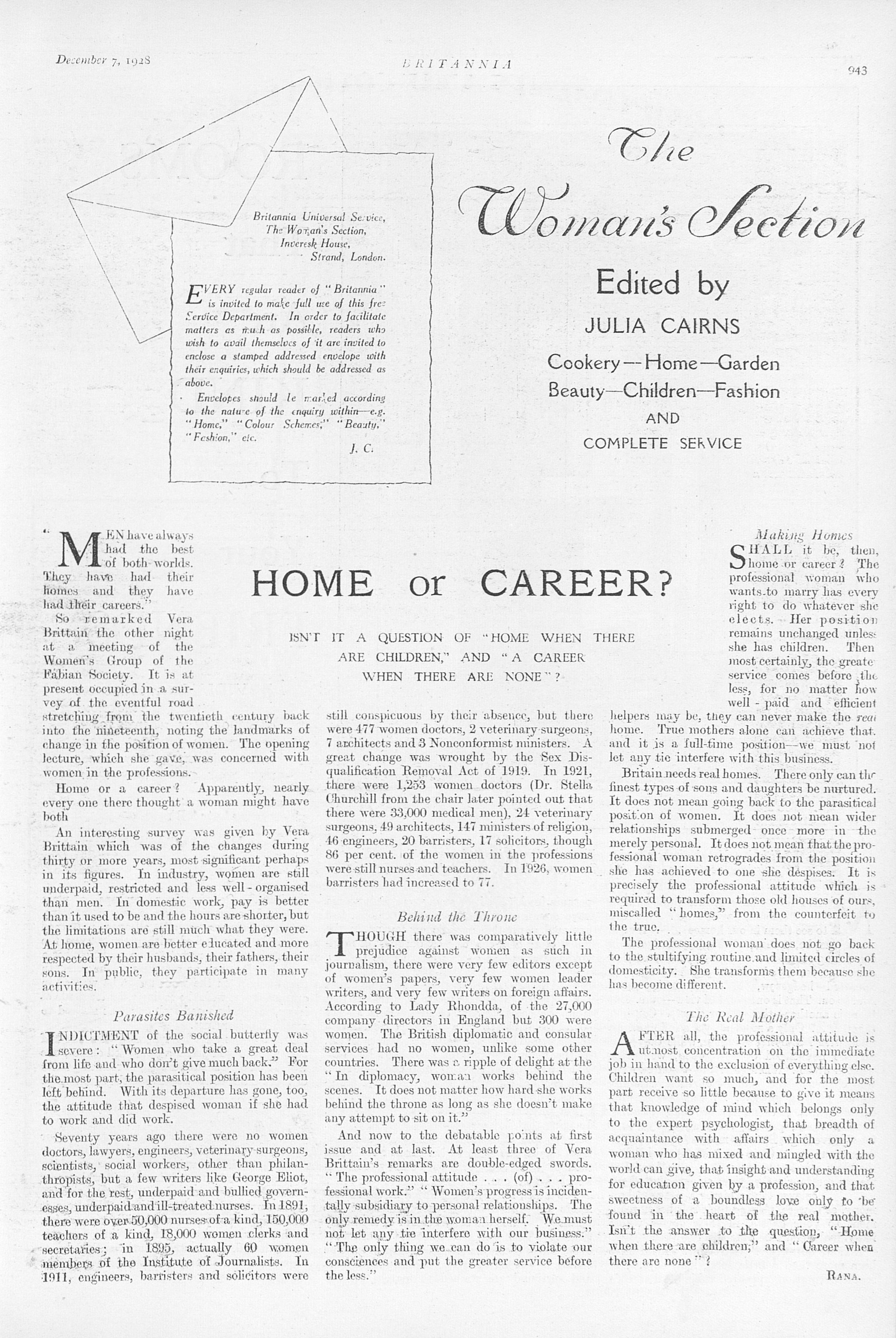
Our latest “Document of the Week” was chosen by our Editor, Nishah Malik. It is an article titled “Home or Career?”, published in Britannia on 7 December 1928, and was edited by Julia Cairns. The article discusses the changing roles of women and asks whether women should have to choose between having a career or having a family. It challenges the traditional idea that women should only be homemakers and argues that women can combine professional work with family life.
The piece opens with a statement made by Vera Brittain whilst addressing the Women’s Group of the Fabian Society: “Men have always had the best of both worlds. They have had their homes and they have had their careers”. This quote highlights the unequal expectations placed on men and women. While men were expected to be able to have both a family and a career, women were often expected to choose between domestic responsibilities and professional ambitions. The article explains that, at the meeting, “nearly everyone” thought that “a woman might have both”.
The article was published in 1928, during a period when women’s roles in Britain were changing. The article acknowledges this change by stating that “seventy years ago there were no women doctors, lawyers, engineers, veterinary surgeons, scientists, social workers, other than philanthropists”, and only a “few writers”. The author then provides statistics to demonstrate how dramatically the number of women working in professional occupations had increased. In 1891, for example, there were over “50,000 nurses, 150,000 teachers, 18,000 women clerks and secretaries, and 60 women members of the Institute of Journalists”. By 1911, there were “477 women doctors, 2 veterinary surgeons, and 7 architects”, showing that women were increasingly entering occupations that had been dominated by men.
The article attributed some of this progress to the Sex Disqualification (Removal) Act of 1919, which removed legal restrictions preventing women from entering certain professions and from holding public office. As the article pointed out, by 1921, there were 1,253 women doctors, 24 veterinary surgeons, 49 architects, 147 ministers of religion, 46 engineers, and 20 barristers, with the number of women barristers increasing to 77 by 1926. These statistics provide evidence of the growing presence of women in British professional life during the 1920s.
However, the article was not simply celebrating women’s entry into employment; it was also responding to concerns about whether professional women could still fulfill their responsibilities as wives and mothers. The author makes an interesting comment: that “it is precisely the professional attitude” that is “required to transform those old houses of ours, miscalled ‘homes’”. This statement suggests that the author did not believe that simply staying at home made someone a good mother. Instead, she argues that professional attitudes and experiences could improve family life. The article goes on to describe “the real mother” as someone who has “knowledge of mind which belongs only to the expert psychologist” and has gained understanding through education and experience. The author believed women’s education and professional experiences could enhance motherhood, particularly for “a woman who has mixed and mingled with the world”. Rather than presenting a career as something that takes women away from their families, the article contends that experiences outside the home can give women greater knowledge, independence, and understanding, which, ultimately, could benefit their children. Significantly, “Home or Career?” provides contemporary evidence of the debates surrounding women’s employment, education, marriage, and motherhood in Britain in the 1920s.
Where to find this document
It is from our collection, Britannia and Eve, 1926–1957, which includes over 38,000 images from 350 issues. Owned by The Illustrated London News, Britannia and Eve targeted a wealthy, conservative, and largely female readership. Throughout its existence, it maintained a particular emphasis on fashion, beauty, and the home.
Visit the collection page to learn more.