

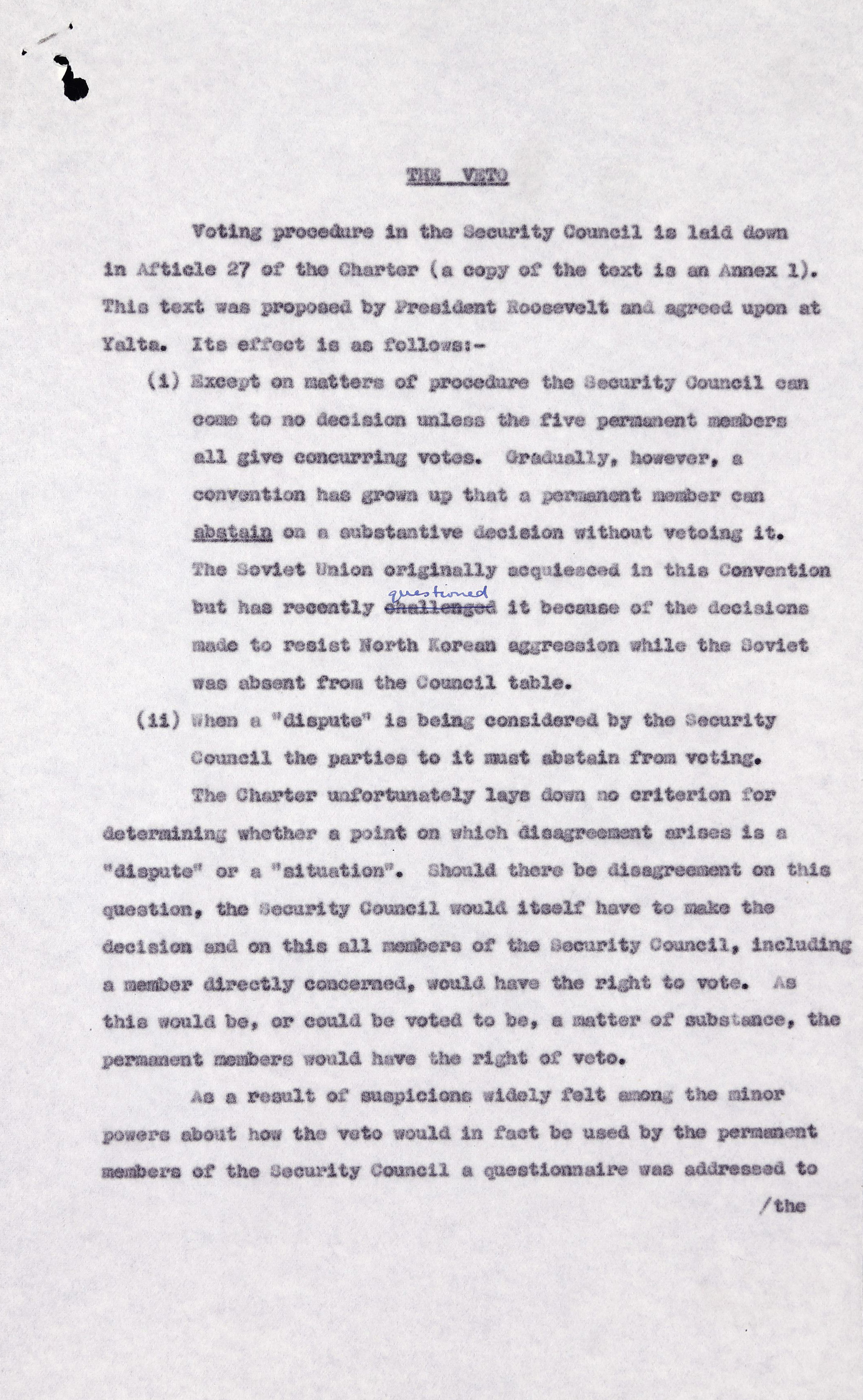
Our latest “Document of the Week” was chosen by our Senior Curator, Dr Charlie Hall. It is a short report from 1951, setting out the terms, both formal and informal, by which the veto was wielded by permanent members of the United Nations (UN) Security Council—Britain, China, France, the Soviet Union, and the United States.
The UN was established at the end of the Second World War to act as a successor to the League of Nations, which had all but collapsed on the outbreak of war. The founders of the UN were the five most powerful states in 1945, and they hoped that it would be an improvement on its predecessor and be better able to deliver on the lofty goals of securing international co-operation and preserving peace. However, they also wanted to ensure that this new organisation protected and even reinforced their power, rather than challenging it.
As such, they appointed themselves as permanent members of the Security Council—the most significant decision-making body within the UN—and established the protocol whereby it could make no decision without their unanimous support. This was particularly problematic given the fractious geopolitical environment of the early Cold War, which presented very few courses of action on which all members could agree.
This document explains that these rules effectively gave all of the permanent members a veto and explores some of the ways this was deployed. It also discusses what approach the British delegation to the UN might wish to take, especially in light of Soviet attempts to use the veto to thwart what they saw as a pro-Western agenda.
Where to find this document
This item comes from our primary source collection, Establishing the Post-War International Order, 1944–1961.
Comprising over 230,000 images drawn from files at The National Archives (UK), this collection explores the institutions, treaties, and agreements which emerged in the critical years at the end of the Second World War, and which continue to shape our world.
The collection explores global governance, international political economy, and pacts of mutual military assistance. It covers organisations as diverse as NATO, the International Monetary Fund, and the European Economic Community.
Visit the collection page to learn more.