

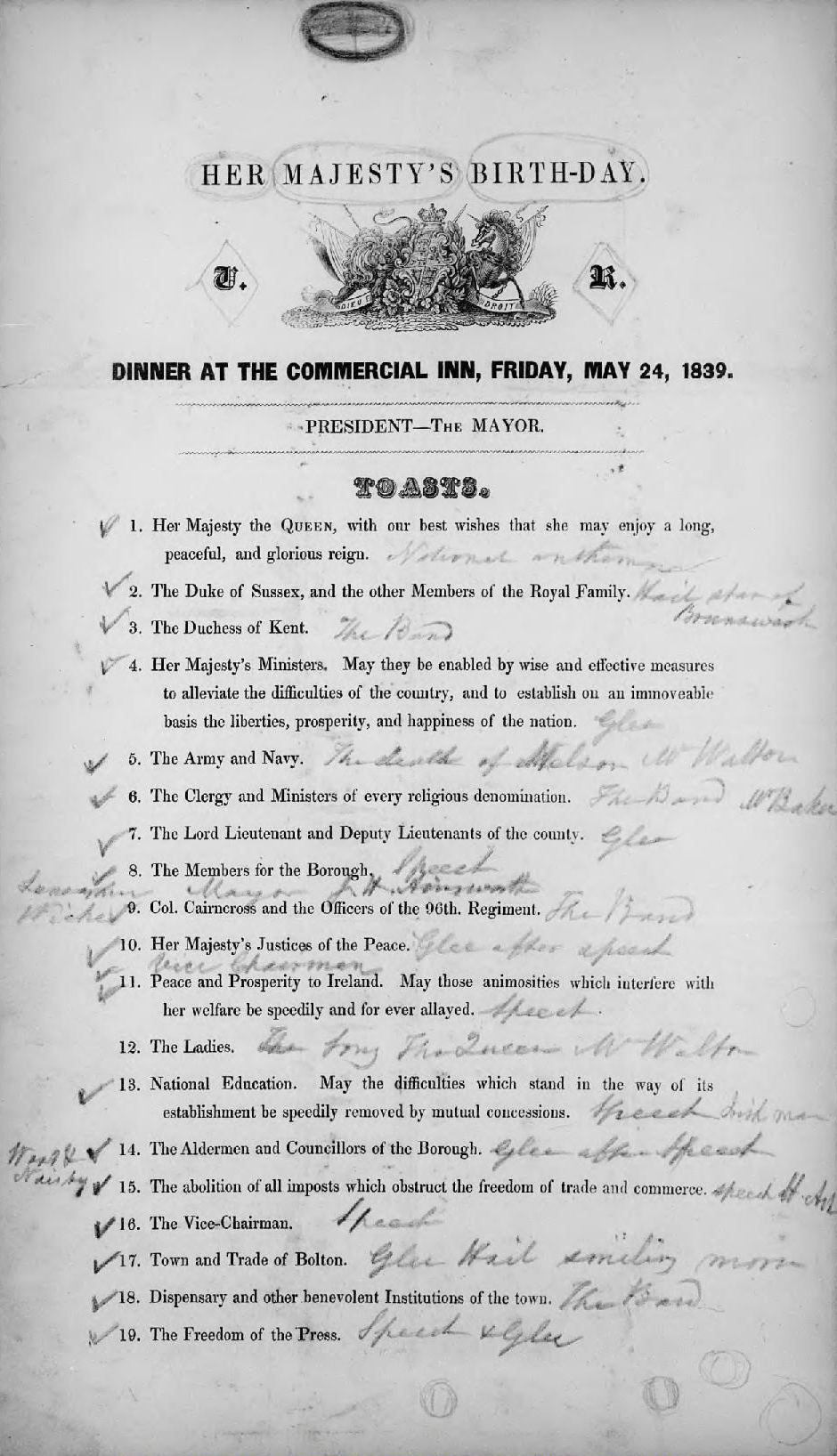
Our latest “Document of the Week” was chosen by our Senior Editor, Dr Tommy Dolan. It is a list of toasts that were raised at Bolton’s Commercial Inn in May 1839 by Robert Heywood, the city’s mayor at the time.
Heywood was Bolton’s second mayor, a position that he held throughout 1839–1840. He was a successful textile merchant and travelled abroad extensively—his papers detail his travels and commercial activities throughout Europe, North America, and the Caribbean. Heywood was a liberal, committed, like many other industrialists of his day, to reform, playing an active and consequential role in the social, economic, and political life of Bolton throughout the mid-1800s.
This was a period when the amenities and institutions that we associate with urban modernity, such as, say, street lighting and the provision of public water, were being developed by energetic (and typically wealthy) citizens such as Heywood. For example, papers dating from his time as mayor contain a set of rules drawn up by the 1st Marquess of Normanby, Home Secretary in Lord Melbourne’s government at the time, for “Establishing a Uniform System for the Government, Pay, Clothing, Accoutrements, and Necessaries for Constables”— in 1839, the Rural Constabulary Act was passed by the British government, allowing county areas to establish police forces.
A fair few of the toasts raised by Heywood at Bolton’s Commercial Inn were somewhat to be expected, such as those to members of Britain’s royal family. Yet a couple catch the eye, illuminating, as they do, some of the principal ideological components of the liberal agenda during the mid-1800s. These toasts likewise evidence how wider, national issues influenced debate in a plethora of local contexts, like Bolton, across the United Kingdom.
Heywood’s toast to “National Education”—his hope that “the difficulties which stand in the way of its establishment be speedily removed by mutual concession”—is a case in point. So too his toast to the “Freedom of the Press”. “Peace and Prosperity to Ireland” is likewise noteworthy—“May those animosities that interfere with her welfare be speedily and for ever allayed”, as Heywood put it. For one thing, it evidences that sense of guilt which (as several scholars have observed) has tended to haunt the English mindset, particularly amongst those of a liberal persuasion, when it comes to Ireland and its history. It might also be argued that Heywood’s toast regarding Ireland is interesting given that by the late 1830s, whilst by no means tranquil, Ireland was rather more stable that it had been, certainly more so than during the 1790s, whilst the tragic onset of the potato blight would not occur for several more years.
Add to this that militant nationalism was by no means the key dynamic in Irish affairs at this point in time. Rather, many Catholic nationalists pinned their hopes on constitutional agitation in the form of Daniel O’Connell’s (ultimately unsuccessful) campaign to engineer the repeal of the Union of Great Britain and Ireland that had come into effect in 1801—O’Connell had, of course, succeeded in attaining Catholic emancipation in 1829.
Thus, a toast raised in Bolton’s Commercial Inn on an evening in 1839 helps to evidence the strong and salient influence that Ireland has had upon the thoughts and outlook of those residing upon its sister island. Perhaps just as intriguingly, Heywood’s toasts demonstrate how a variety of sources, however seemingly innocuous at first glance, offer gateways into broader local and national histories.
Where to find this document
It is lifted from our primary source collection, The Industrial Revolution: Technological Innovation in the Textile Industry, 1672–1929. Featuring over 7,000 document images, it traces the development of the Industrial Revolution in Britain through two prominent families connected to Bolton’s textile industry: the Cromptons and the Heywoods.
Visit the collection page to learn more.