

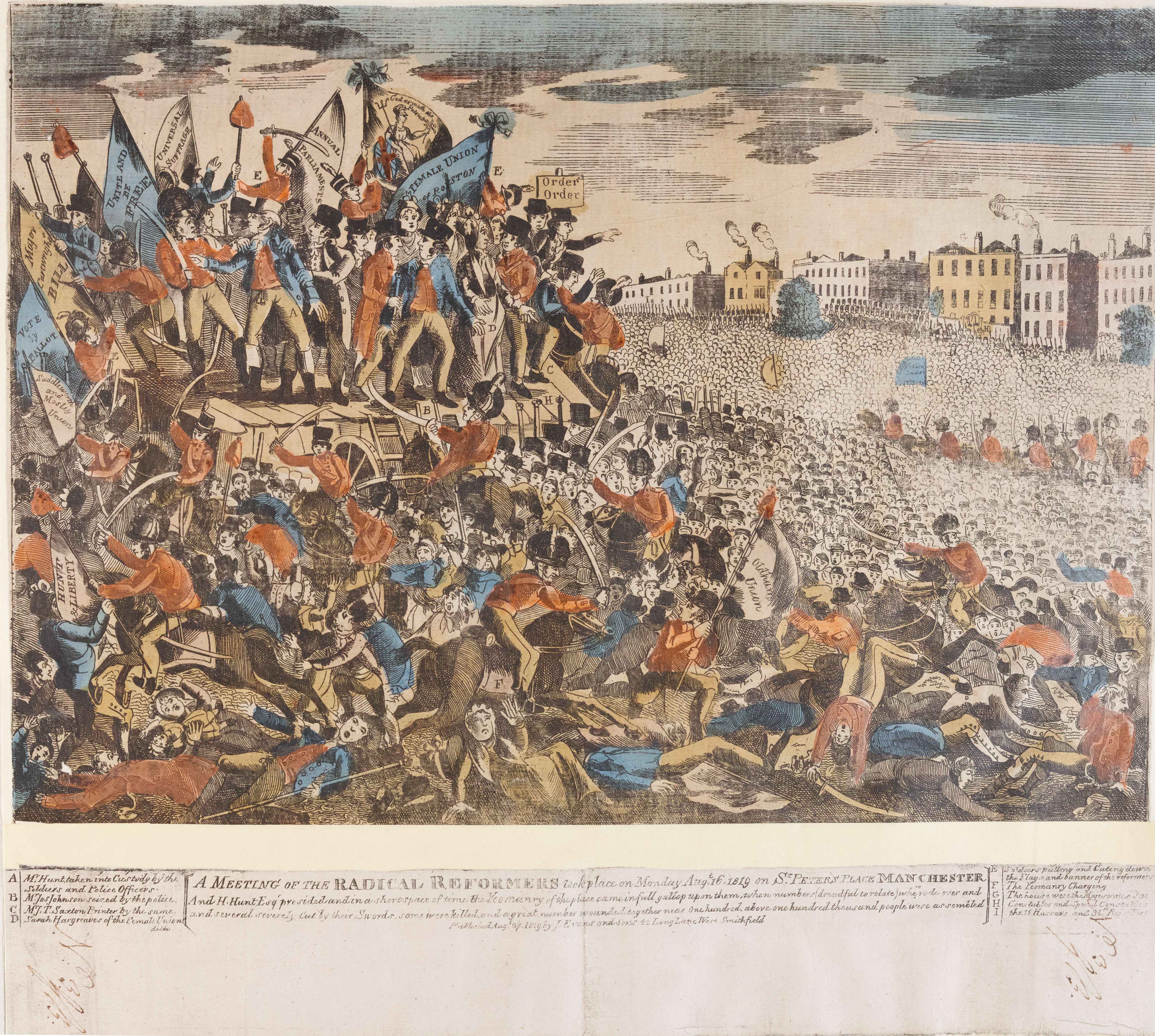
Our latest “Document of the Week” was chosen by our Senior Curator, Dr Mary Wills. It is a coloured engraving of what came to be known as the “Peterloo Massacre”: the violent dispersal of a peaceful reform meeting that took place at St Peter’s Field, Manchester, on 16 August 1819. The engraving vividly depicts the violence, chaos, and despair of the events that took place 207 years ago.
There was mass discontent in 1819, during a period of economic depression, wage cuts, and widespread unemployment. The peaceful rally at St Peter’s Field (highlighted in blue on the map) was organised by radical reformers as part of a run of mass meetings calling for parliamentary reform and universal suffrage. A crowd of 60,000 people from surrounding mill towns gathered to hear the speakers, including the reformer, Samuel Bamford, known as “the Orator” for his rousing speeches.
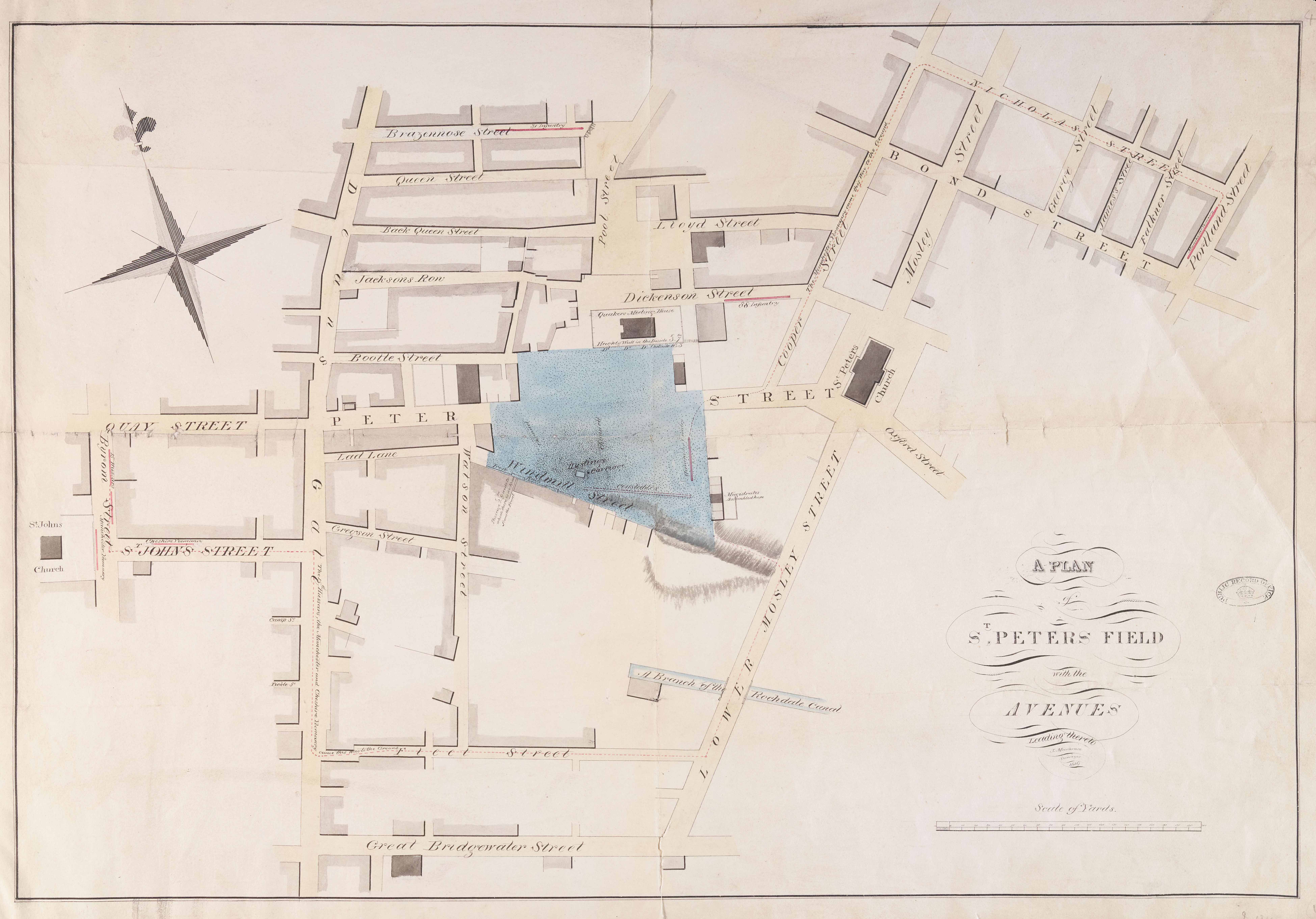
Fearing potential unrest, local magistrates ordered the Manchester and Salford Yeomanry to arrest the organisers. In the resulting cavalry charge into the crowd, 18 people died and hundreds were injured. The moniker "Peterloo" was given by the press as a scornful comparison to the British victory against the French at the Battle of Waterloo in 1815.
The engraving demonstrates how “Peterloo” soon became used as radical propaganda. According to the accompanying text, “in a short space of time the Yeomanry of the place came in full gallop upon them, when numbers (dreadful to relate) were rode over and several severely cut by their swords.” Attendees are shown lying injured and distraught, attacked by cavalrymen wielding long swords. Those portrayed on the speakers’ platform, holding banners with slogans including “Unite and be Free”, “Universal Suffrage”, and “Annual Parliaments”, appear panicked and distressed.
Key figures listed in the accompanying key include the reformer, Henry Hunt, and the editor of the Manchester Observer, Mr Joseph Johnson, who, we are told, was “seized by the police”. Also identified as arrested by police is the activist “Sarah Hargreaves of the Female Union”. Lancashire was a hotbed of radical politics in this period, producing some of the earliest recorded examples of independent female political activity in Britain. For example, the Manchester Female Reform Society was formed in July 1819, with the aim of spreading democratic ideals among women. Their President, Mary Fildes, also appeared on the speakers’ platform at St Peter’s Field.
This engraving is part of the collections of the Home Office (HO) that are kept at The National Archives (UK). In November 1819, it was exhibited by John Jenkins, an ex-weaver and ex-Royal Marine, living in Chudleigh, Devon. Jenkins was arrested and sent to the Exeter House of Correction after his activities came to the attention of the local vicar and magistrate, Gilbert Burrington. Information concerning Jenkins’ “seditious” conduct was passed to the Home Secretary.
The government responded to “Peterloo” by passing a series of repressive laws known as the “Six Acts”, intended to restrict public meetings and to suppress publication of what was perceived to be radical literature. The chaos and tragedy of the Manchester meeting became one of the defining political moments of nineteenth-century Britain and is seen as a key turning point in the long struggle for rights and representation.
Where to find this document
These documents feature in our primary source collection, Radicalism and Popular Protest in Georgian Britain, c. 1714–1832. The collection contains over two thousand documents, sourced from The National Archives (UK) and the Working Class Movement Library. It contains a range of primary source material that illuminates protest, dissent, activism, unrest, conspiracies, rebellion, and grievances in Georgian Britain. Visit the collection page to learn more.