

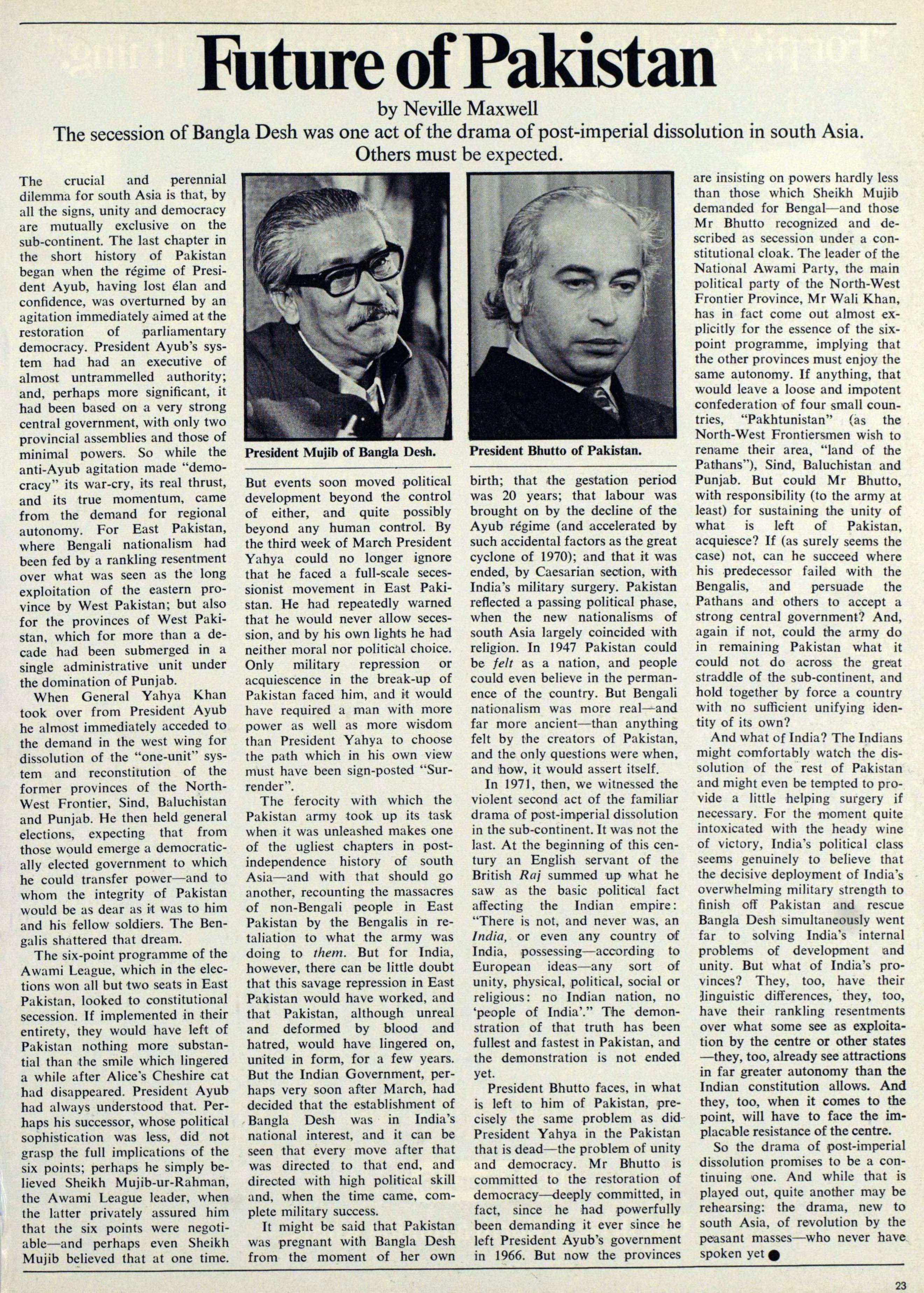
Our latest “Document of the Week”, chosen by our Editor, Nishah Malik, is an article from our primary source collection, The Illustrated London News, 1842–2003, titled “Future of Pakistan”. With the 79th anniversary of the partition of the Indian subcontinent falling this week, it is worth taking a closer look at this article in order to explore the aftermath of Bangladesh's independence and to reflect upon on the political consequences of partition, nationalism, and state-building in South Asia.
Published on 25 March 1972, Neville Maxwell's “Future of Pakistan” argued that Pakistan’s breakup (as East and West Pakistan) was the result of long-standing inequalities, rather than simply the 1971 Bangladesh Liberation War. The article was critical of Pakistan's handling of East Pakistan and of the military response to Bengali nationalism, but the author’s primary purpose was to analyse the political forces that led to Bangladesh's independence and to speculate about the future stability of states in South Asia.
A major theme of the article was the rise of regional nationalism. Maxwell opened by claiming that “unity and democracy are mutually exclusive on the sub-continent”. Maxwell went on to argue that Bengali nationalism had become “more real—far more ancient—than anything felt by the creators of Pakistan”, suggesting that cultural and linguistic ties were stronger than the relatively new national identity promoted by the Pakistani state. He presented Bangladesh's independence not as an unexpected event, but, rather, as the inevitable outcome of decades of political and economic marginalisation.
On a similar note, Maxwell used the metaphor that Pakistan “was pregnant with Bangladesh”, suggesting that West Pakistan’s hold of East Pakistan was bound always to be temporary. Furthermore, he stated that Pakistan had a “gestation period of 20 years”, while “labour was brought on by the decline of the Ayub regime” and ended with “Caesarion section with India’s military surgery”.
He contended that the Pakistani government failed to accommodate democratic demands from East Pakistan and instead relied on centralised authority and military force. According to Maxwell, the Pakistani government’s reliance upon force only accelerated the country’s collapse. The article described the violence in East Pakistan, brought on by the war, as “one of the ugliest chapters in post-independence history of South Asia”, highlighting the human cost of the conflict and criticising the use of force to maintain national unity. Maxwell acknowledged retaliatory violence against non-Bengalis in East Pakistan, but he placed this within the broader context of the Pakistani army's brutal crackdown on the Bengali population.
Towards the end of his article, Maxwell contended that the secession of Bangladesh exposed the weaknesses of Pakistan's nation-building project and raised questions about the future of the remaining state. He questioned the future stability of this state, noting that leaders in Sindh, Balochistan, and the North-West Frontier Province were demanding greater autonomy and asked whether Pakistan could be held together by a strong central government. Despite the “military strength” shown by India when “rescuing Bangladesh”, the article reminded readers that India’s provinces also had their linguistic differences and rankling resentments, highlighting how these issues were a direct result of the hasty partition of the subcontinent in 1947.
Maxwell concluded by stating that “the drama of post-imperial dissolution promises to be a continuing one”. While Maxwell makes many well-thought-out points throughout the article, to simply call this a “drama” minimises what the Bangladesh Liberation War, the partition of the subcontinent in 1947, and the conflicts surrounding disputed territories such as Kashmir actually were: humanitarian catastrophes that resulted in the deaths of hundreds of thousands of people, the displacement of millions, and widespread sexual violence. Although Maxwell was primarily concerned with the political consequences of Bangladesh's independence, his choice of language here risks understating the immense human suffering that accompanied the conflict.
Despite some of its limitations, Maxwell’s “Future of Pakistan” remains a valuable contemporary source for understanding how international observers interpreted the creation of Bangladesh in 1971. Written only months after independence, the article captured the uncertainty surrounding the future of Pakistan and of South Asia more broadly. The piece is useful not only for what it reveals about the events of 1971, but also for what it tells us about contemporary perceptions of decolonisation and political change in South Asia.
Where to find this document
It comes from our primary source collection, The Illustrated London News, 1842–2003. Containing over 250,000 images, this fascinating and visually stunning collection brings together the extensive back catalogue of one of the most influential and successful publications in the history of British print media.
Visit the collection page to learn more.