

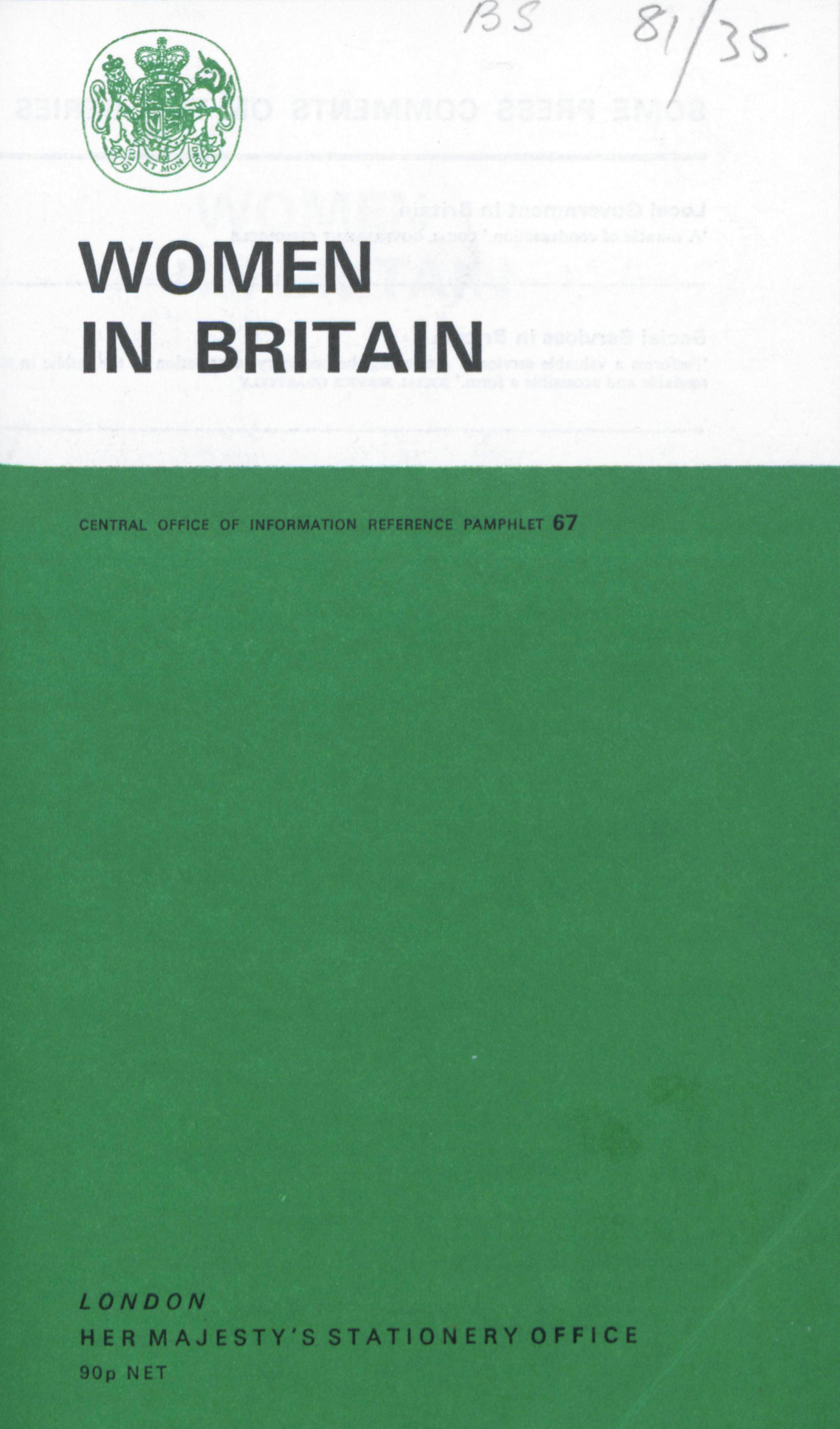
Our latest “Document of the Week” was chosen by our Editor, Nishah Malik. This week, we spotlight a 1975 pamphlet titled Women in Britain. Produced by the Central Office of Information (COI), this pamphlet outlines the number of ways women’s status in British society had improved by the early-1970s.
Referencing women’s status in the nineteenth century, the pamphlet begins by discussing how the “restriction and repression of women at this time were due partly to direct legal discrimination” and a political system that denied women the right to vote. It goes on to explain how women’s status changed significantly during the nineteenth and twentieth centuries. The pamphlet attributes these developments to legal reforms, changing employment practices following the Second World War, shifts in family life, and the efforts of “exceptional women”, such as Mary Wollstonecraft and Elizabeth Fry.
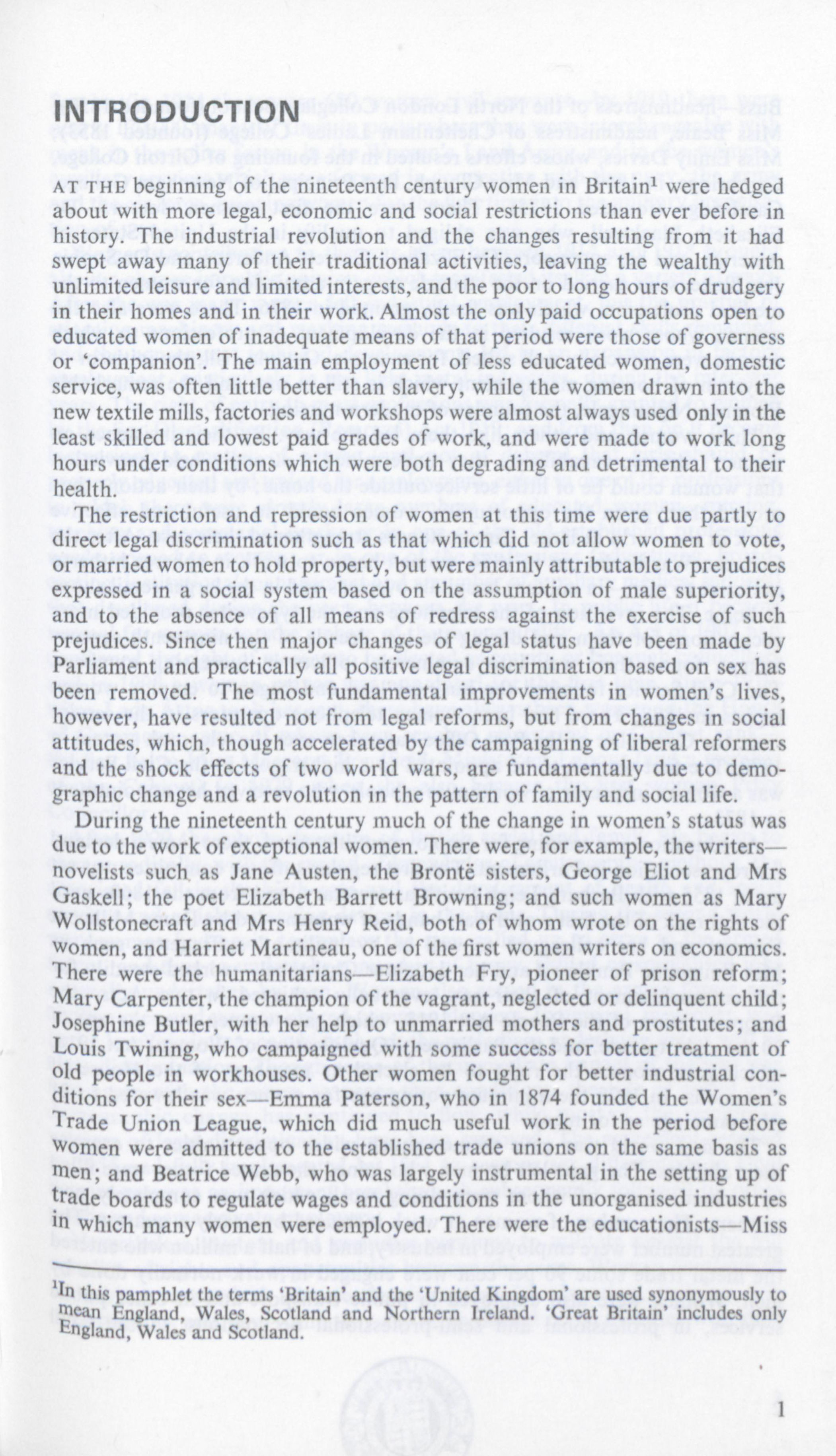
The historical overview presented in the introduction reflects how the authors viewed the previous century of social change. For example, the pamphlet highlights the role of the suffrage movement in securing the vote for women through the Representation of the People Act of 1918 and the Parliament (Qualification of Women) Act of 1918. It also points to the transformative effects of the First and Second World Wars, during which women entered occupations traditionally reserved for men and demonstrated their ability to undertake skilled industrial, professional, and public service work. According to the pamphlet, these wartime experiences helped challenge long-standing assumptions about women’s capabilities and contributed to a broader acceptance of women in public life.
The pamphlet is divided into eleven sections, each exploring a different area of life and further explaining the erosion of repressive practices. The eleven sections are titled: “Demographic and Social Change”, “Political and Legal Status”, “Education”, “Women at Work”, “Income and Wealth”, “Marriage and Family”, “The Old, The Chronic Sick, and the Disabled”, “Social Security”, “Spare-Time Activities”, “Women’s Organisations”, and “Sex Discrimination Bill”.
When referring to political status, the pamphlet highlights how the rights of husbands and wives were now practically equal with respect to property and children, due to recent legislation. Furthermore, when discussing education, the authors note the way in which women’s enrolment in higher education had risen to 30% in 1972, in comparison to 23% in 1961. When referring to work, it states how more women were working outside the home, as in 1971 women formed 36.6% of the labour force, in comparison to the 27% in 1921. Out of that 36.6%, 63% of the women were married, which is a sharp rise from the 13% in 1921. These vast changes are not surprising considering the context of the time the pamphlet was written.
Published in 1975, the same year as the Sex Discrimination Act, the pamphlet captures a moment when gender equality was receiving unprecedented attention in Britain. While celebrating the progress that had been made, it also acknowledged that "custom and prejudice continue to militate against the full equality of rights and opportunities between the sexes". As a result, the document provides a valuable snapshot of how the British government sought to present women's changing role in society during a period of significant social and legislative reform. It reveals both the achievements that had been secured by 1975 and the recognition that further progress was still required.
Analysing this pamphlet can uncover a wealth of information about the atmosphere of optimism surrounding women's changing position in British society during the 1970s. However, while the topics covered are valuable for understanding these developments, they represent only part of the story. The pamphlet touches only briefly on wider social changes, such as the increasing availability of contraception and changing attitudes towards sexuality and family life.
If you would like to learn more about the social transformations that shaped women's lives during this period, read Nishah Malik’s article, "From the Archive: Women's Liberation, Miniskirts and The Pill in 60s and 70s Britain". Taking a social history approach, the article places Women in Britain within the wider context of the 1960s and 1970s, exploring some of the cultural and social factors that contributed to changing women's position in society by 1975. In particular, Nishah’s article examines the post-war "Youthquake", the impact of Mary Quant's rising hemlines, and the sexual revolution that reshaped British society during the 1960s and 1970s.
Where to find this document
This item comes from our primary source collection, British Government Information and Propaganda, 1939–2009. Comprising over 27,000 images drawn from files at the British Library, this collection provides a wide range of propaganda and public information materials that were produced by the British government throughout much of the twentieth century. The collection offers fascinating insights into the ways that the state has sought to communicate with the public on a wide range of issues, such as war and defence, pensions, healthcare, and Britain’s relationship with Europe.
Visit the collection page to learn more.