

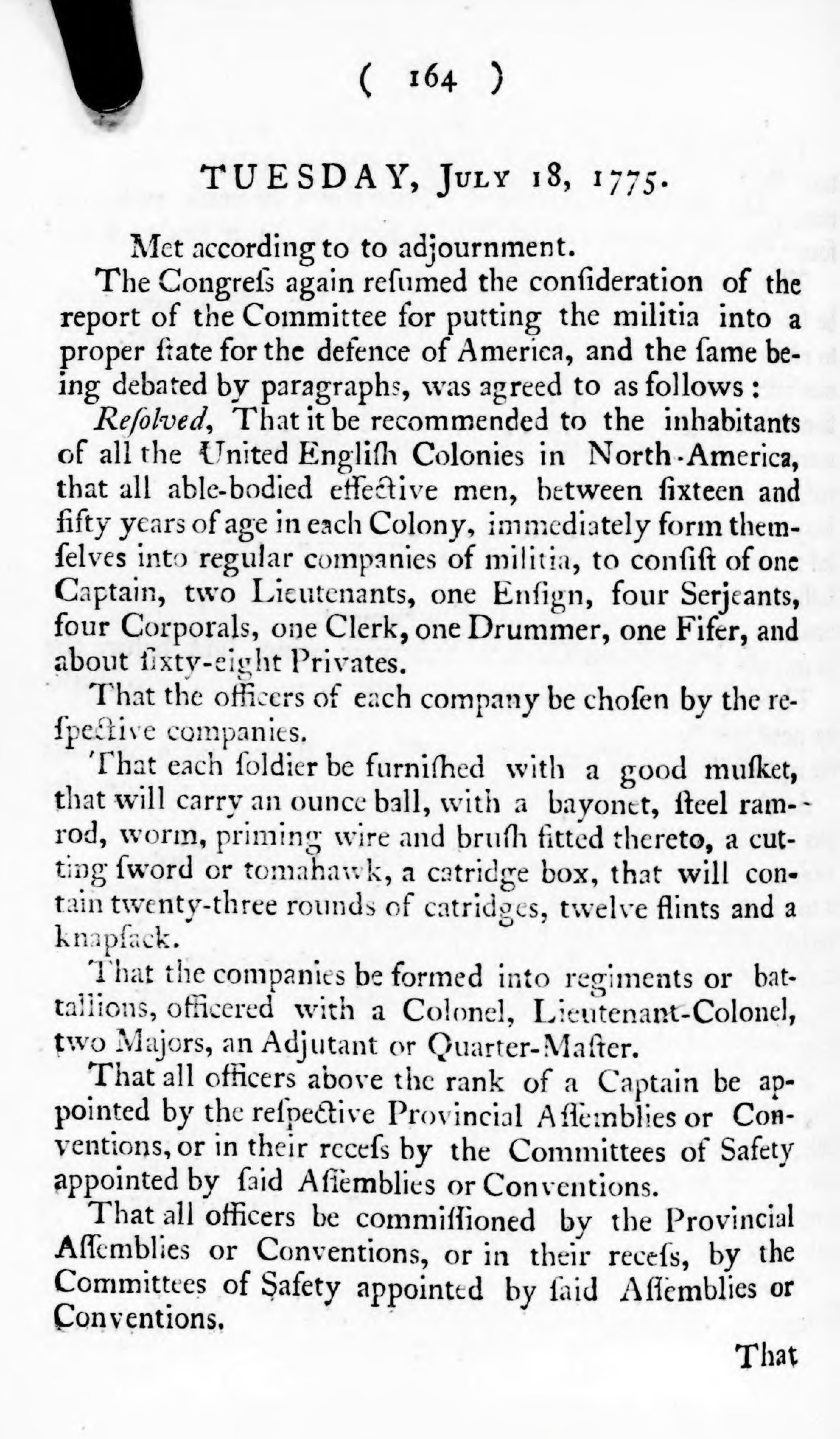
Our latest “Document of the Week” was chosen by our Academic Liaison Manager, Dr Catherine Bateson. It is a page from the Proceedings of the US Continental Congress in July 1775.
While the commemorations for America’s 250th independence anniversary have focused mostly on the rhetoric of freedom and liberty, and the actions of the Founding Fathers and authors of the Declaration of Independence in 1776, it is easy to forget that the famous document appeared one year into a long war that lasted until 1781. The US Continental Congress members did not shut up shop after 4 July 1776. Indeed, the Declaration was only part of already-ongoing proceedings. Almost a year before the Declaration was published, the delegates met on Tuesday 18 July 1775 to discuss a more pressing matter: how to make a strong fighting stand against Great Britain.
This week’s Document of the Week highlights those proceedings, with Congress resolving that the militiamen then fighting the British Army should be put “into a proper state for the defence of America”. It is a clear sign that any notion of independence was a long way off from being achieved by force. It is also telling how quickly the rebelling colonists needed to get into fighting shape in the aftermath of the April battles at Lexington and Conchord, Massachusetts, which had started the War of Independence. Debate on the 18 July 1775 centred on whether each of the “United English Colonies” could be made to send all able-bodied men aged between fifteen and fifty years old to militia services. “Each soldier would be furnished with a good musket” with shot, sharp bayonets, “a cutting sword or tomahawk”, flints and lighting equipment, cartridges and powder, “and a knapsack”. The rest of the debated resolutions went into detail about militia hierarchy for each colonial complement, the earliest makings of the country’s “well-regulated militia” that the US Constitution would layout over a decade later.
The militia resolutions on 18 July—and the accompanying resolutions debated by the Continental Congress (including those following the Declaration of Independence a year later)—show how passionate its members were in bringing about not just liberty from British rule, but having a clear, organised structure to their cause of bringing about unified colonies. This copy of the proceedings was first published in Philadelphia, before re-publication in London’s printing houses. This particular version was printed by J. Almon in Piccadilly later in 1776. By circulating their discussions across the Atlantic, the rebelling colonists were sending a clear message. These proceedings about finite details such as militia regulation and martial structure show the severity of which they would fight for their independence, and how they would maintain their military unity over subsequent years.
Where to find this document
This image comes from our primary source collection, The American Revolution from a British Perspective, 1763–1783. The collection contains a range of pamphlets written and published on both British and American sides of the Atlantic in the aftermath of the Seven Years’ War up to the conclusion of the American War of Independence twenty years later. The pamphlets are an excellent primary source of tensions and debates over the American colonies’ actions, British government reactions, and how ordinary citizens viewed what was happening on either side during the American Revolution.
Visit the collection page to learn more.