

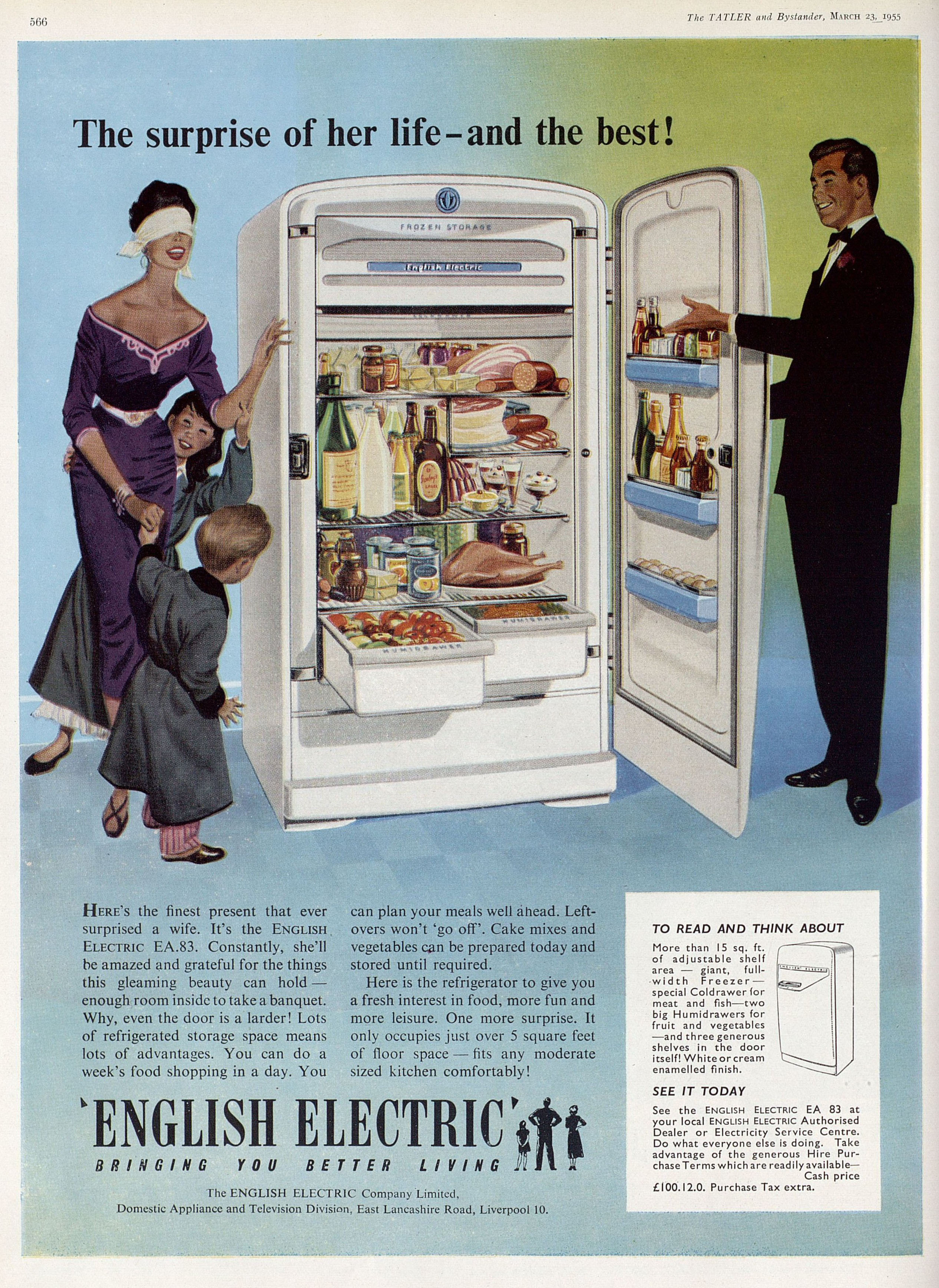
Our latest “Document of the Week”, chosen by our Editor, Nishah Malik, offers a striking glimpse into the consumer revolution that transformed British homes in the post-war years. Published in The Tatler and Bystander on 23 March 1955, this colourful advertisement for the English Electric EA.83 refrigerator is more than a simple sales pitch: the advertisement reveals contemporary attitudes towards family life, gender roles, and the growing expectation that technological innovation could transform the home.
This advert appeared during a period when refrigerators were becoming increasingly accessible to middle-class families. Although domestic refrigerators had been available since the early twentieth century, they remained beyond the reach of many households until the 1950s. Most families relied on larders, pantries, and frequent shopping trips to keep food fresh. However, as Britain emerged from years of rationing and austerity, domestic appliances came to represent modernity, convenience, and rising living standards. Rising incomes, expanding consumer credit, and advances in mass production made refrigerators increasingly affordable to ordinary families. Once considered luxury items, refrigerators became one of the most sought-after household purchases of the 1950s, alongside washing machines, vacuum cleaners, and televisions.
The advert depicts a husband unveiling a new refrigerator as a surprise gift for his wife. Accompanied by the slogan, "The surprise of her life—and the best!", the refrigerator is presented not simply as a household appliance, but as a desirable symbol of modern living and family prosperity.
The advertisement highlighted the EA.83's impressive capacity, informing potential customers that they could store a “banquet” in its freezer compartment, adjustable shelves, and specialised drawers for meat, fish, fruit, and vegetables. English Electric promised that the appliance would reduce shopping trips, keep food fresh for longer, and give the housewife "more fun and more leisure" by making domestic work easier.
The advert’s reassurance that “leftovers won’t ‘go off’” reflects a growing awareness of food safety and food preservation in post-war Britain. By the 1950s, scientific understanding of germs, bacteria, and the causes of foodborne illness was becoming increasingly widespread through public health campaigns, schools, and popular media. Articles in publications similar to The Tatler targeted housewives, encouraging the use of refrigerators and explaining their hygienic benefits. Similarly, an article in Britannia and Eve from the 1920s emphasised the importance of covering food in fridges to preserve “their individual flavours”. Refrigerators were therefore marketed not only as convenient household appliances, but as modern tools that helped families keep food fresh and protect their health.
The advert also reflects the gender expectations of 1950s Britain. Although the refrigerator is purchased by the husband, it is described as “the finest present that ever surprised a wife”, who is assumed to be responsible for cooking, shopping, and household management. Companies frequently marketed domestic appliances as labour-saving devices that would help women become more efficient homemakers.
Today, refrigerators are considered an essential household item. In 1955, however, owning a large, modern refrigerator signified that a family had entered a new era of comfort and prosperity, reflecting the broader optimism associated with Britain’s post-war economic recovery.
Where to find this document
This document is part of our collection, The Tatler, 1901–1965. Consisting of more than 250,000 images, and comprising over 3,000 issues published between July 1901 and September 1965, The Tatler was one of various publications owned by The Illustrated London News (ILN). Focusing mainly on fashion, theatre, and sports (especially cricket and golf), The Tatler habitually regaled readers with news and gossip about Britain’s most prominent socialites, including aristocrats, athletes, and actors.
Visit the collection page to learn more.