

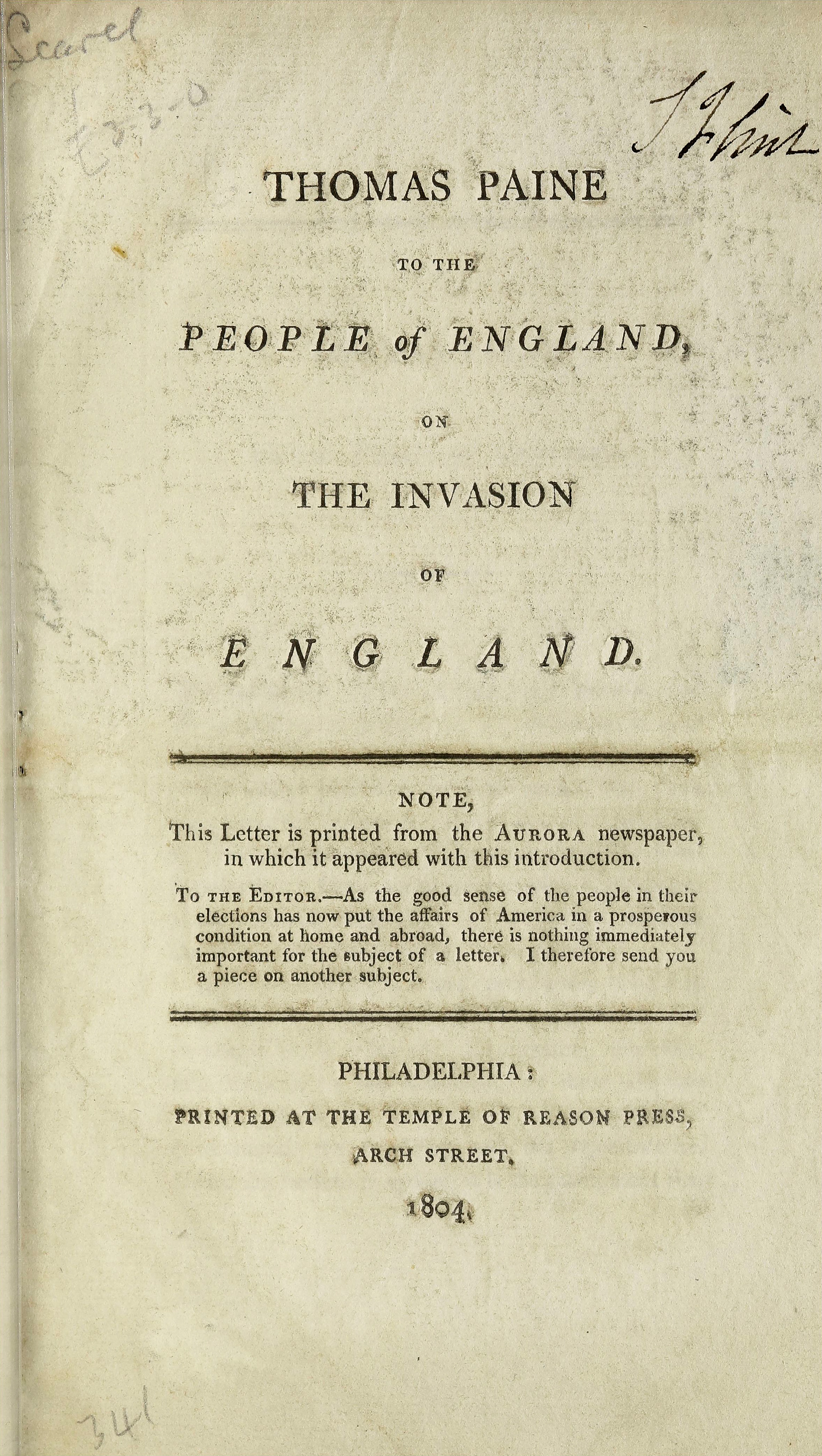
Our latest “Document of the Week” was chosen by our Academic Liaison Manager, Dr Catherine Bateson. It is an 1804 pamphlet page published by Thomas Paine in America addressed to the people of England about tensions with France.
“In casting my eye over England and America, and comparing them together, the difference is very striking”, Thomas Paine observed at the start of his 1804 letter addressed “To the People of England, on the Invasion of France”. Published in Philadelphia, America, “At the Temple of Reason Press”, this title page comes from a sixteen-page pamphlet edition of Paine’s missive which he penned in May 1804. Now later into his radical life, the document picked up a theme that first appeared in the late 1790s when Paine turned his political attention to affairs in France, the revolutionary fallout after 1789, and the Napoleonic Wars. Indeed, much of the pamphlet warns “the People of England” about whether they could defend themselves from the French and the chaos that would follow should invasion occur—an outcome Paine was in favour of as he saw invasion as being the only way to bring about revolutionary change to his former home country and to end the hereditary government structures which he believed shackled citizens. Even though he grew wary of Napoleon’s power, Paine longed for Britain to follow America and France into revolutionary progress, and that Britain should follow America’s inspired “new principles” of early republican governance.
The title page of this particular edition of Paine’s work also reveals the wider changing political contexts in which he operated. A note to the editor under the heading addresses Americans’ “good sense […] in their elections”, putting the “affairs of America in a prosperous condition at home and abroad”. He was referring here to the coming political changes of administration and rise of Thomas Jefferson—far more of a seeming friend to revolutionary France than President John Adams in Paine’s eyes. Yet Paine hinted in the pamphlet’s conclusion that while “the American revolution began on untried ground”, the French example was a cautionary tale. He concluded his letter observing how “the people of England have now two revolutions before them: the one as an example; the other as a warning”—meaning America and France respectively.
Wisdom would help Britain decide which path to follow in order to bring about “their happiness, combined with the common good of mankind”, even if a revolutionary invasion and uprising had to help the process in Paine’s mind. Such was the power of his pen, even in old age, that this pamphlet letter to the country was reprinted in 1812 alongside reissues of Paine’s more famous Rights of Man (1791); BOA has a copy of this version to view too. The people of Britain, France, and America continued to note his advice into the nineteenth century and eras of political reform.
Where to find this document
This image comes from our primary source collection, Radicalism and Popular Protest in Georgian Britain, c. 1714–1832. The collection contains a range of differing primary source material types—including pamphlets and broadside balladry—that examine areas of protest, dissent, activism, unrest, conspiracies, rebellion, and grievances in Georgian Britain. The sources spotlight numerous agricultural, social, political, and economic grievances in the eighteenth and early nineteenth centuries, including several commentary pieces by and about Thomas Paine in relation to Britain, revolutionary America, and France.
Visit the collection page to learn more.