

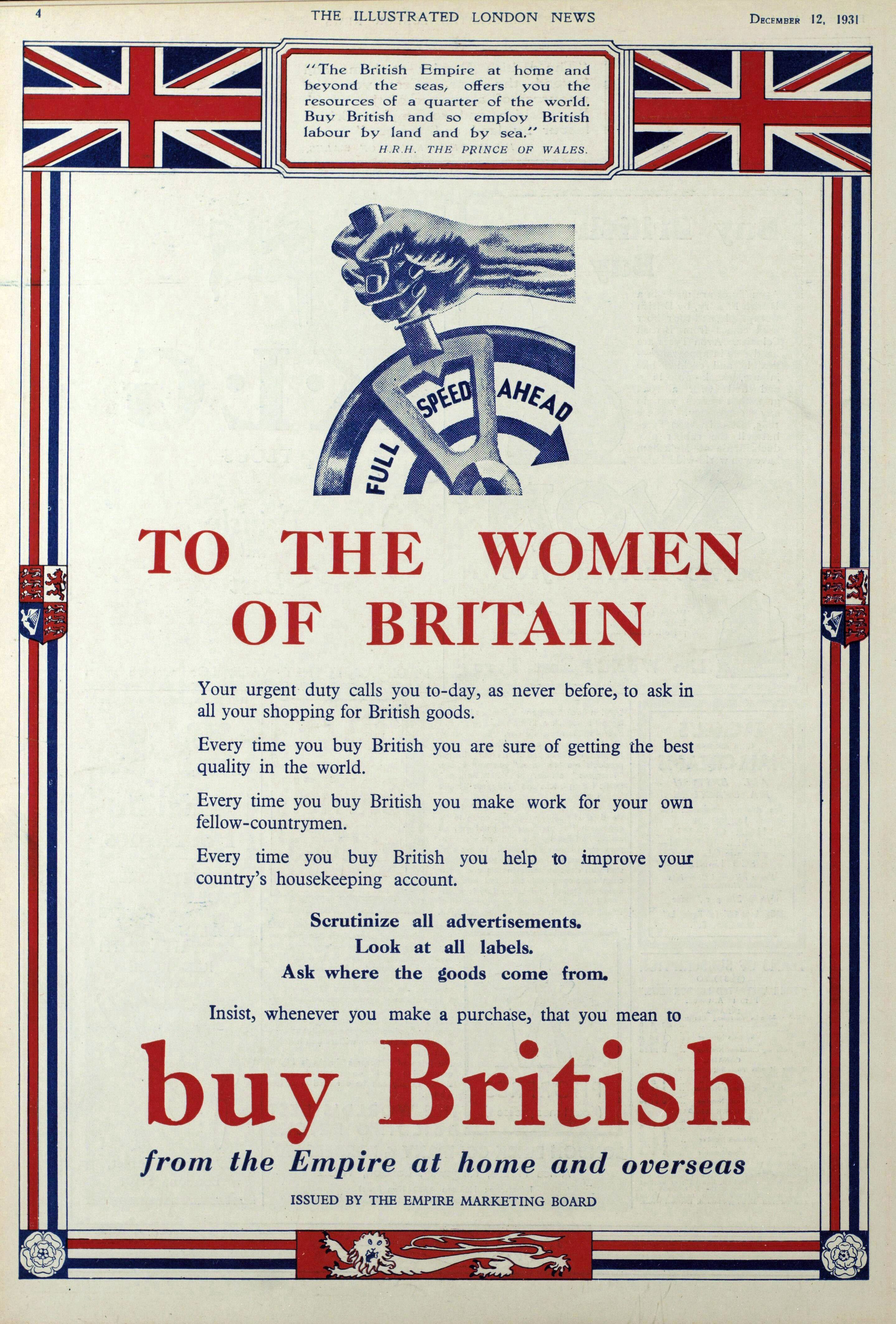
Our latest “Document of the Week”, chosen by Editorial Assistant, Chloe Haney, is an advertisement published in The Illustrated London News (ILN) on 12 December 1931. Issued by the Empire Marketing Board (EMB), the advertisement called on “the women of Britain” to “buy British”.
The EMB was a short-lived organisation, formed in 1926 and dissolved in 1933, which promoted trade within the British empire through extensive marketing campaigns and scientific research. It produced various forms of marketing, including posters, films, radio shows, and promotional campaigns, all of which aimed to improve public knowledge of empire-produced goods and to encourage the widespread purchasing of imperial products.
As seen in this 1931 advertisement, the EMB’s marketing campaigns often took a gendered approach, targeting men and women separately and within the scope of traditional gender roles. This example, aimed at “the women of Britain”, positioned women as the primary consumers in the household, drawing on the traditional feminine role of homemaker. Here, the EMB called on women’s patriotism to communicate its “buy British” message, framing women’s purchasing power as essential to the success of their “fellow-countrymen”, and their everyday financial choices as an “urgent duty”.
In a sense, this framework conveyed a feeling of empowerment to the company’s female audience (albeit within a strictly defined, traditional idea of the female household role), by presenting their daily domestic actions as influential and important. This is particularly evident through the repeated use of the second-person pronoun, “you”, to speak directly to the female reader (“Your urgent duty”, “Every time you buy British you help” [emphasis added]). Through this, the EMB presented intra-empire trade as something that the women of Britain could partake in to empower themselves, reframing the domestic homemaker role as a position with international influence.
While its marketing campaigns were well constructed and elaborately tailored to target the inter-war British audience, the EMB was regarded to have been ultimately unsuccessful in its efforts to increase trade within the British empire. It was dissolved in 1933, two years after this advertisement’s publication, as the system of imperial preference was introduced, reducing tariffs on imperial trade.
Where to find this document
This document is from our collection, The Illustrated London News, 1842–2003. This comprehensive resource covers over 150 years, facilitating examination of an almost endless variety of historical events, concepts, and themes, British and otherwise. The extensive back catalogues of the ILN’s nine so-called “sister” titles are also available to explore on BOA’s digital archive. Visit the collection page to learn more.