

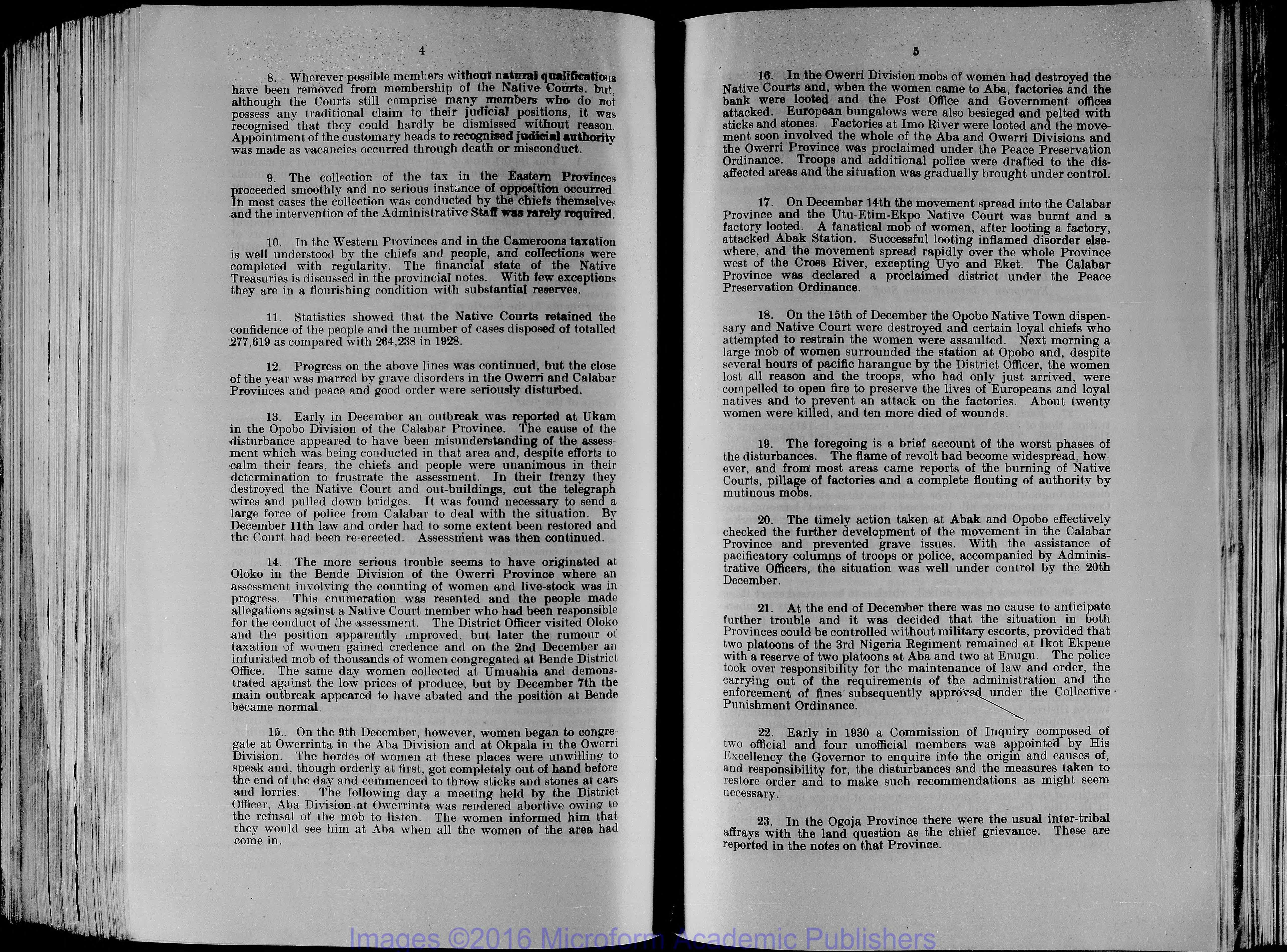
Our latest “Document of the Week” was chosen by our Senior Curator, Dr Mary Wills. It is an extract from the 1929 Annual Report on the Southern Provinces in Nigeria, which covered “Outstanding Events of the Year” in the colony. British colonial rule in Nigeria lasted from 1885 until 1960. It was resisted in various forms, and in particular by a long history of collective action by Nigerian women.
Reports of “grave disorders in the Owerri and Calabar Provinces” relate to a period of protest at the end of 1929 led by women from six ethnic groups: Igbo, Ibibio, Andoni, Ogoni, Efik, and Ijaw. The disorders were known as “Ogu Umunwanyi” or “Ekong Iban” in the Igbo and Ibibio languages; or “Women’s War” in English.
Colonial rule reduced the traditional ability of women to participate in and influence government and society. Women had previously protested by petitioning British officials; for example, in 1928 Igbo women were led in their petitioning efforts on socio-political and economic issues by Madam Chinwe.
Direct confrontation occurred in 1929 in response to the introduction of direct taxation and new local courts by the colonial government. The role of Warrant Chiefs (local leaders appointed by the British colonial administration to enforce tax collection etc.) became a particular focus of resentment, as they were perceived to abuse their power. More than 10,000 women from the Bende division and other regions of South-East Nigeria travelled to the town of Oloko to protest. Tactics mainly took the form of “sitting on” the local Warrant Chief, consisting of singing and dancing around his house for a number of days and nights.
The protests spread. Many Warrant Chiefs were forced to resign and so-called Native Courts were attacked, most of which were destroyed. Prisoners were released and European factories were looted. The women’s protest was seen as a threat to colonial authority and in response, protests were dispersed with gunfire, resulting in several deaths.
This annual report offers a partial account of the protests, framed by colonial understandings of Nigerian society. Descriptions of a “fanatical mob of women” also reveal a gendered perspective. The report does show, however, the geographical extent of the unrest, and the difficulties the colonial authorities faced as a result of the widespread “flame of revolt”. It highlights women’s roles as political agitators, and the tactics pursued to resist and seek redress within the male-dominated colonial framework.
In 1930 the colonial government abolished the system of Warrant Chiefs, and appointed women to the Native Court system. The events of 1929 are seen as inspiration for later protests.
Where to find this document
This document features in our primary source collection, Nigeria and Cameroon Under Colonial Rule, in Government Reports, 1887-1962, containing papers from British colonial government in Nigeria and Cameroon. It is a key resource for students and researchers of the British empire. British Online Archives (BOA) hosts extensive British colonial government records from a number of African countries, which can provide unique insights into the lives of people living under colonial rule. Visit the collection page to learn more.