

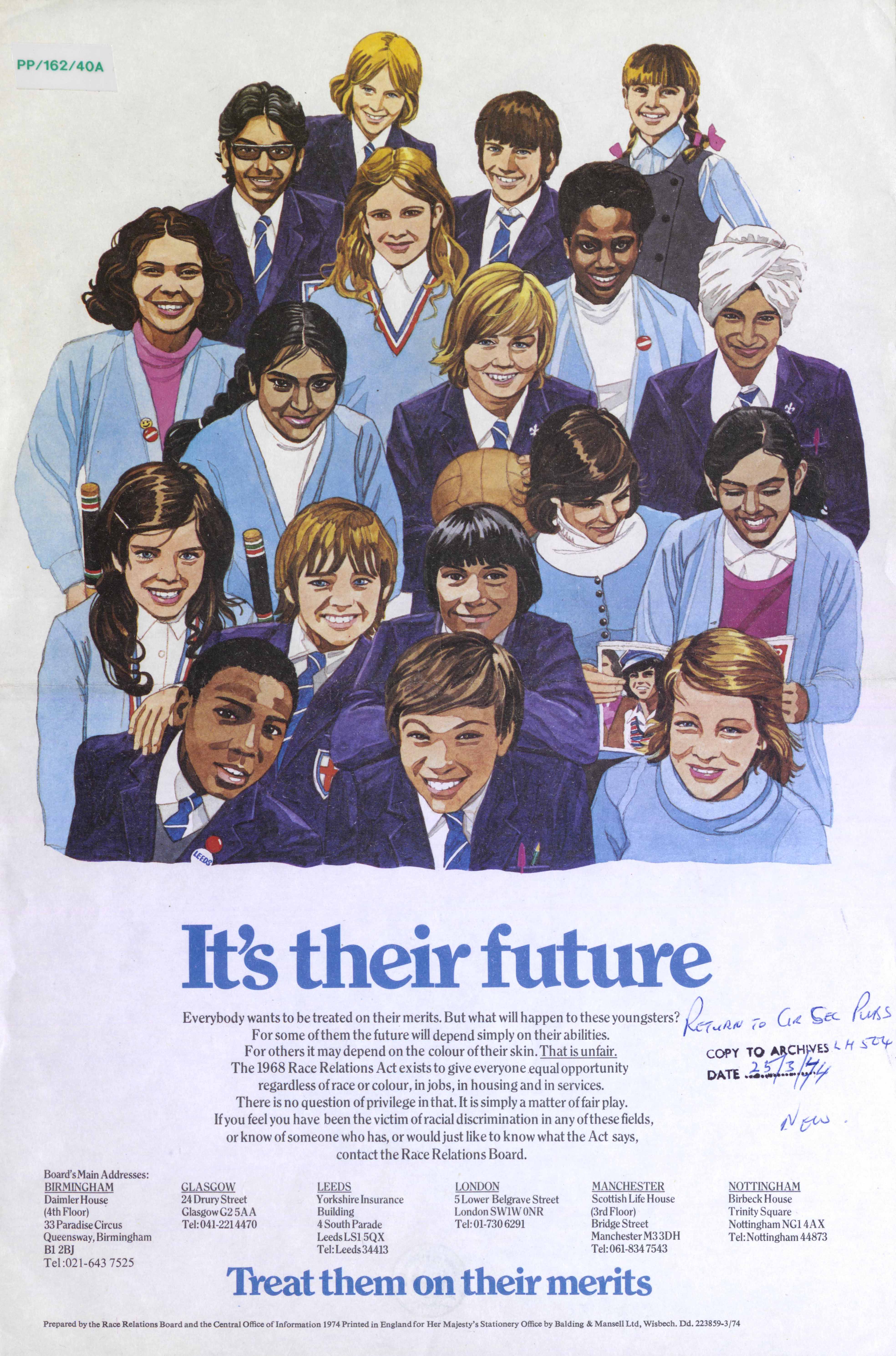
Our latest “Document of the Week” was chosen by our Editor, Nishah Malik. This week, we spotlight a poster that promoted the Race Relations Act that was passed by the UK government in 1968. Produced by the government’s Race Relations Board, this striking visual campaign was designed to promote equality and challenge racial discrimination in Britain.
The poster, titled “It’s Their Future”, features a group of schoolchildren from a range of ethnic and cultural backgrounds. The campaign emphasised the importance of fairness and equal opportunity for the next generation, highlighting that it is unfair for a child’s future to depend upon their skin colour rather than on their abilities. It sought to reinforce the idea that children should be judged on their merits and character, not on their race or background. The poster concludes by urging those who have faced racial discrimination to contact the Race Relations Board for advice.
The Race Relations Act of 1968 was a landmark piece of legislation in the UK. Extending earlier legislation, it made discrimination illegal in key areas, such as employment, housing, and public services. The Race Relations Board, responsible for enforcing the Act, launched promotional campaigns to raise awareness of it and to encourage public support.
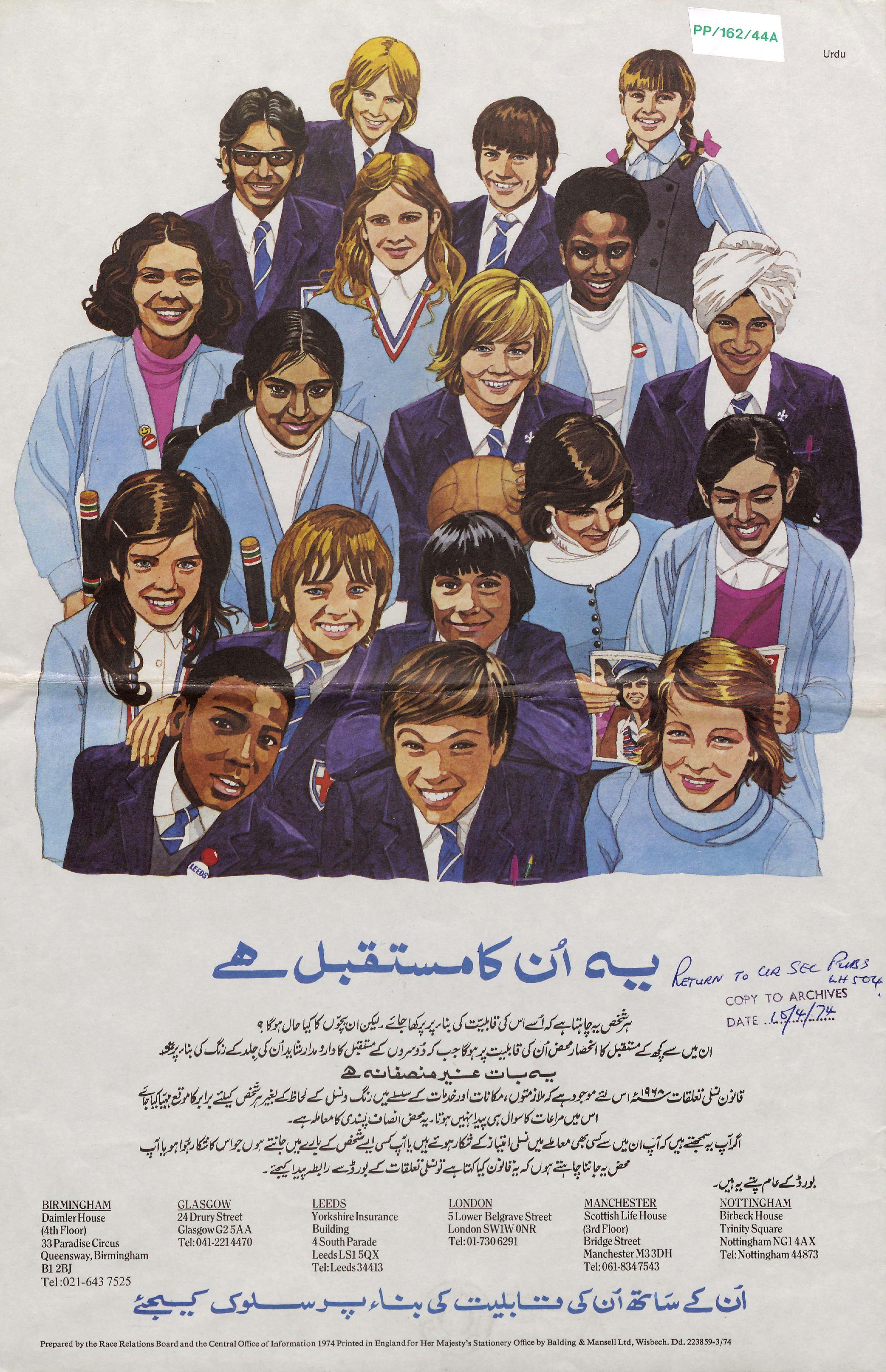
An important feature of this particular poster is its accessibility; it was produced in multiple languages, including English, Urdu, Gujarati, Hindi, Bengali, and Punjabi, reflecting Britain’s increasingly diverse population. This multilingual approach ensured that the board’s message reached communities who may have been directly affected by discrimination, reinforcing the idea of equality under the law.
This document is significant as it represents a key moment in Britain’s journey towards a more inclusive, pluralist society. At a time when racial discrimination was high, the poster illustrates how legislation and public campaigns can work hand in hand to promote fairness in society.
Where to find this document
This item comes from our primary source collection, British Government Information and Propaganda, 1939–2009. Comprising over 27,000 images drawn from files at the British Library, this collection provides a wide range of propaganda and public information materials that were produced by the British government throughout much of the twentieth century. The collection offers fascinating insights into the ways that the state has sought to communicate with the public on a wide range of issues, such as war and defence, pensions, healthcare, and Britain’s relationship with Europe. Visit the collection page to learn more.