

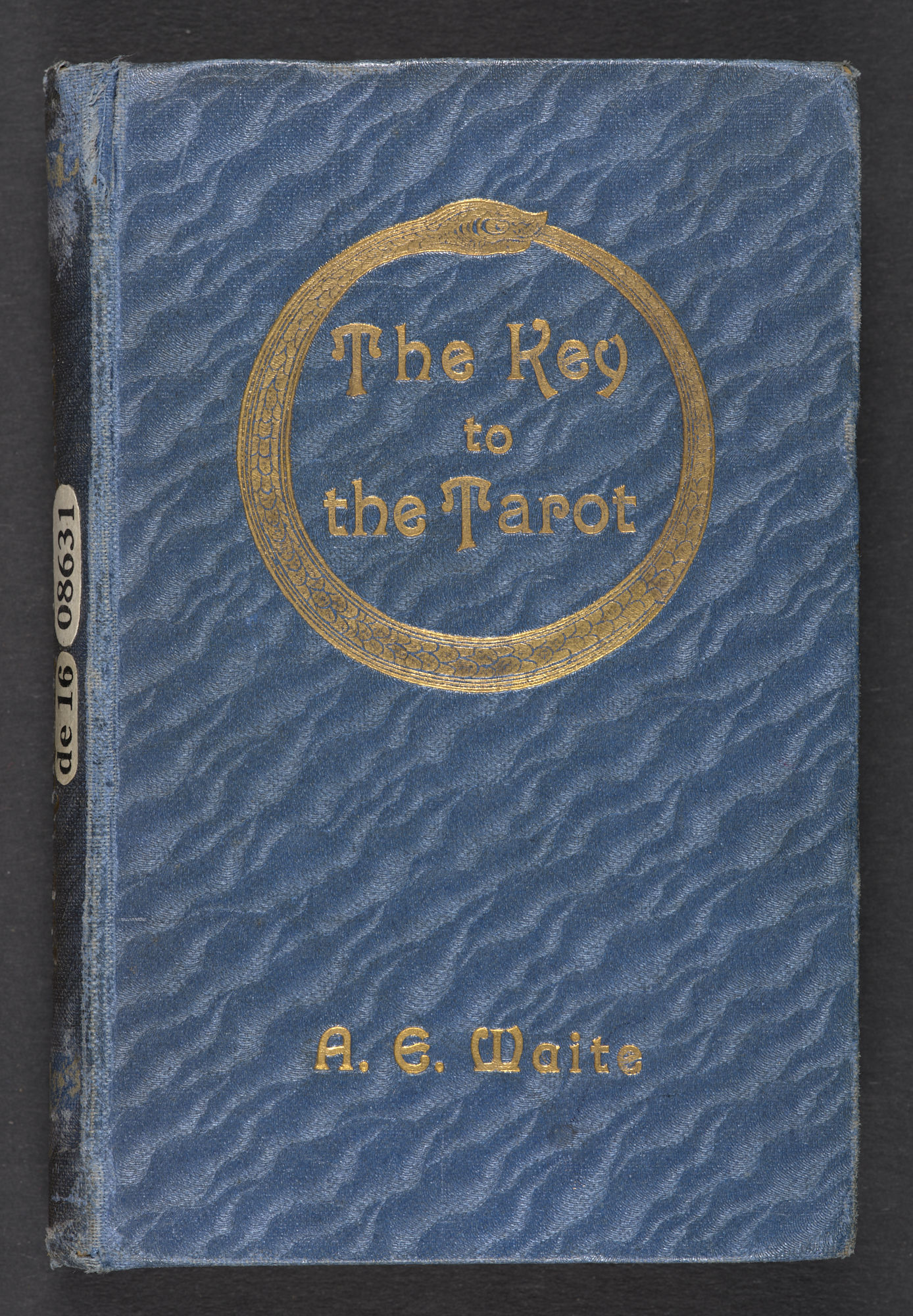
Our latest “Document of the Week” was chosen by our Senior Curator, Dr Mary Wills. Taken from our new primary source collection, Witchcraft and Magic in England c. 1400–1920, Arthur Edward Waite’s The Key to the Tarot (1910) offers fascinating insight into the traditions, interpretations, and history behind tarot cards. Arthur Waite (1857–1942) was a scholarly mystic who wrote numerous texts on divination, Western esotericism, ceremonial magic, and alchemy, but he is best known as co-creator of the Rider-Waite Tarot, first published in 1909.
Today regarded as a tool for fortune-telling, the origins of tarot cards are elusive. The history of tarot has been traced back to medieval India, Egypt, China, and Korea. Originally, tarot was played for fun, and, like other card games, was a product of cultural exchange, as the cards were played by traders, merchants, and other seafarers.
In the late eighteenth century, tarot cards began to be used for fortune-telling, or cartomancy. The use of tarot as a divination tool gained in popularity as scholarly interest in the occult increased during the nineteenth and early twentieth centuries. Occultism refers to the pursuit of hidden or secret knowledge and practices outside mainstream science and religion, focusing on traditions like supernatural beliefs, magic, and mysticism.
In 1861, French occultist, Éliphas Lévi, published his book turning tarot from a parlour game to an esoteric tool for divination. Elements of the tarot were modified to correspond with beliefs from different religions and mythologies, such as Kabbalah (mystical religious interpretations within Judaism). Inspired by Lévi’s work, Arthur Waite’s tarot deck was illustrated by Pamela Colman-Smith; both were members of the Hermetic Order of the Golden Dawn, a secretive society of middle and upper class men and women which studied the occult and practised ceremonial magic.
The Rider-Waite Tarot consists of 78 cards, 22 trump or “Major Arcana” cards, and 56 pip or “Minor Arcana” cards. Major Arcana have unique designs numbered from 0 to 21 and include archetypal figures (such as the Emperor, the Devil, and the Fool), astrological elements, and other eclectic symbols such as Strength, the Tower, and Death. The Wheel of Fortune is number X and features abundant symbolism.
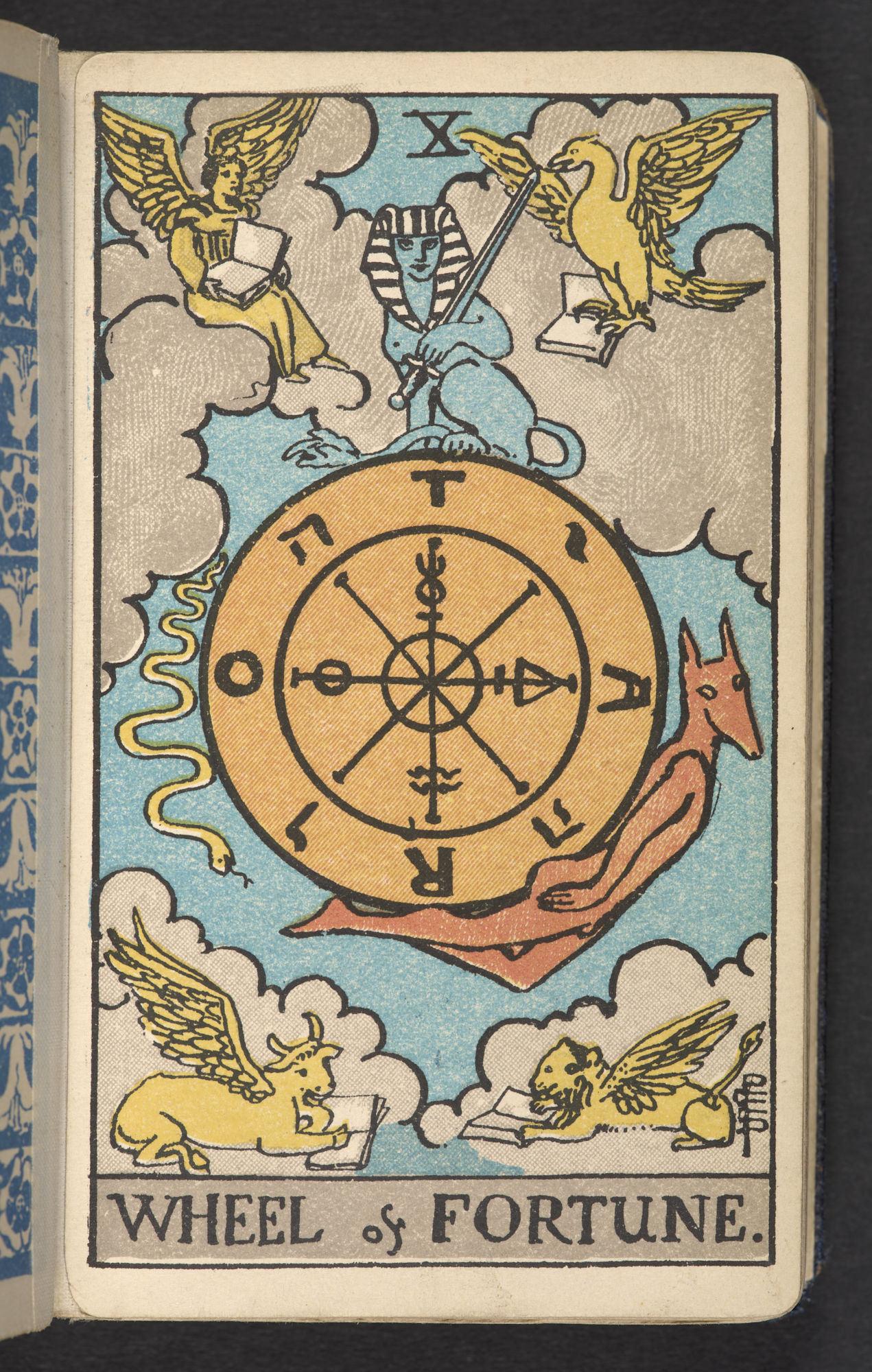
This card refers to the medieval concept of Rota Fortunae, the wheel of the goddess Fortuna, a symbol of the nature of Fate. According to Waite, the wheel represents several divinatory associations including “Destiny, fortune, success, luck, felicity”. When reversed, it symbolises “Increase, abundance, superfluity.” The letters R-O-T-A is the Latin term for wheel. Alternating with the letters are Hebrew letters, usually transliterated as YHWH (Yahweh, the name of God in the Hebrew Bible). Also inscribed are alchemical symbols representing the four elements: Earth, Air, Fire, and Water.
The symbolic winged creatures in each corner (Man, Lion, Ox, and Eagle) represent the four Evangelists in Christian traditions (Matthew, Mark, Luke, and John) and the four fixed signs in the zodiac (Aquarius, Leo, Taurus, and Scorpio). A depiction of the Egyptian god, Anubis (guide to the underworld), is seen rising with the wheel on the right hand side, while Typhon in snake form (representing the fall of evil) descends on the left. The sphinx on top of the wheel represents equilibrium and balance.
The figures are rotating, in a cycle, which, as Waite explained, “stands for the perpetual motion of a fluidic universe and for the flux of human life.” A common aspect to most interpretations of the Wheel of Fortune is the element of change, creating a cycle of fortune and misfortune beyond an individuals’ control.
Where to find this document
This document features in our new primary source collection, Witchcraft and Magic in England, c. 1400–1920. This fascinating resource charts the evolution of witchcraft and magic in England over five centuries. Incorporating a broad range of records and texts, it facilitates exploration of an array of key topics and themes, such as gender, medicine, politics, religion, and science. Interdisciplinary in ethos and expansive in terms of its chronological scope and the archival materials that it contains, this collection will appeal to students, educators, and researchers working within a range of scholarly fields. Visit the collection page to learn more.