

The development of the atomic bomb, and its first use by the United States against Japan in August 1945, changed warfare forever. It showed that a single bomb, delivered by a single aircraft, could all but destroy an entire city. It also sparked off an arms race as hostile nations sought to explore, and expand, the full potential of applying nuclear physics to the art of destruction. By the early 1950s, both the USA and the Soviet Union had successfully tested a hydrogen bomb, ushering in the era of thermonuclear warfare.
Whereas the conventional atomic device dropped on Nagasaki had the explosive power equivalent to 20,000 tons of TNT, hydrogen bombs had the potential to deliver an explosion equivalent to ten million tons (or ten megatons). Moreover, such an explosion would produce an enormous volume of radioactive dust and debris (known as fall-out), which would be dispersed by the wind over a vast area, poisoning the air, water and foodstuffs, and causing sickness, incapacitation and death. Now it wasn’t just individual cities at risk or almost immediate obliteration, but whole countries. In other words, “Hydrogen bomb war would be total war in a sense not hitherto conceived. The entire nation would be in the front line.”[1]
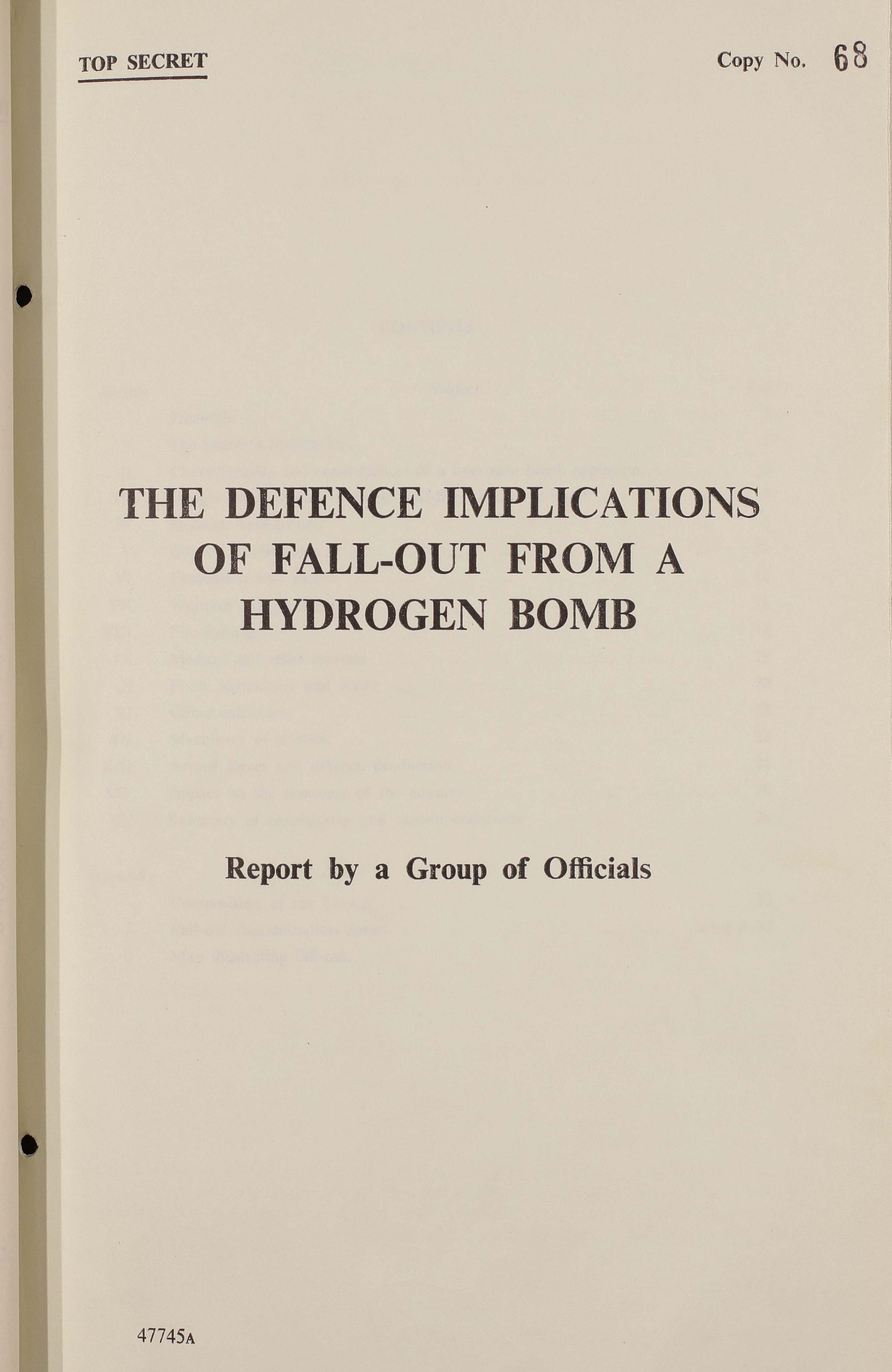
This was the reality which Britain, along with other major world powers, had to confront less than a decade after the end of the Second World War. To that end, the Home Defence Committee of the Cabinet tasked William Strath, head of the government’s Central War Plans Secretariat, with assembling a group of experts and considering what a hydrogen bomb attack on Britain would look like, and what measures could be taken to mitigate its effects. They worked on this problem throughout the winter of 1954–55 and presented their report to the Home Defence Committee in March. The report was titled, “The Defence Implications of Fall-Out from a Hydrogen Bomb”, though it quickly became known as the Strath Report. It is a powerful document that presents, in clear and accessible prose, a terrifying vision of Britain under thermonuclear attack.
In introducing the report, Strath did not mince his words: “Fall-out, combined with the vast explosive power of the hydrogen bomb, presents problems of a revolutionary character for the defence of this country and a threat of the utmost gravity to our survival as a nation.”[2] The scenario which the report sought to analyse was an attack by the Soviet Union which saw ten hydrogen bombs, each ten megatons in size, dropped on the United Kingdom, with large population centres as the principal targets. If such an attack happened suddenly, with no advance warning and limited preparation, the report estimated a death toll of 12 million people, with a further four million seriously injured or disabled. “Casualties on such a scale would be intolerable; they would mean the loss of nearly one third of the population”—in other words, an attack of this nature would almost immediately knock Britain out of the war.[3]
While the explosive power of the hydrogen bomb was staggering—Strath predicted that a 10-megaton bomb would “form a crater about 1 mile across and up to 300 feet deep at its centre”—the basic concept and form of this destruction would have been familiar to British official audiences. It was the same core principle of the bombing that had been experienced during the Second World War; the only difference was one of scale. What was much more poorly understood was the implications of fall-out, and this was where Strath directed much of the focus of his report. He explained how the fall-out produced by one 10-megaton bomb would “drift rapidly down to the ground over a distance of one to two hundred miles, creating a region of great danger for human life due to radio-activity”.[4]
This was particularly problematic in a country as small and densely-populated as the United Kingdom. As the report put it, “virtually no part of a country as small as ours would be free from the risk of contamination”. It went on to outline the merits of a large-scale evacuation scheme but made it clear that such a scheme would have to be deployed preventatively; Britain could not afford to wait until an attack was imminent to try and evacuate its cities. Beginning official evacuation early would run the risk of triggering “unofficial evacuation on an uncontrollable scale. Unorganised flight to unprepared positions would be more dangerous than staying put in a high risk area.”[5]
Given this concern, the report also considered the options for shelters, acknowledging up-front that the government could not afford to provide adequate shelters for the entire population. Instead, that burden would fall on “industries, institutions and private householders”.[6] The main options available were covered trenches, dug in gardens and parks, or refuge rooms within houses, especially if located in cellars. “All shelters would have to be equipped to make their occupants self-sufficient for a week or so during which they would have to remain in them. The shelters would have to be stocked in advance with the necessities of life, particularly food and water and warm clothing. Some method of receiving information from the outside world would have to be available.”[7]
This connection to the outside world revealed another serious concern which the report considered—that “hydrogen bombing would place a very severe strain on public morale and on the forces of law and order”.[8] In the heavily contaminated zones, where a lack of clean water and reliable food would make conditions especially dire, there would be a “grave risk of total and irretrievable collapse”. Survivors in those areas would be isolated from one another and “the household would become the unit of survival”.[9] In the most serious circumstances, especially if several large hydrogen bombs fell in one area, the report predicted that “there might be complete chaos for a time and civil control would collapse”.[10]
Ultimately, though, the report conceded that it was “impossible to forecast how the nation would react to nuclear assault. The effect of this on dense populations would remain beyond the imagination until it happened.” Nonetheless, the expectations were far from upbeat. The picture which the report painted of Britain after a thermonuclear attack was a bleak and horrifying one, with millions dead and the survivors isolated, starving, vulnerable to radiation sickness, and prone to panic and potential violence. All of this had to be imagined against a backdrop of an ongoing war, likely involving a number of other world powers. As the report grimly reflected: “Whether the country could withstand an all-out attack and still be in any state to carry on hostilities must be very doubtful.”[11]
[1] British Online Archives, Britain Under Threat: Civil Defence in the Era of Total War, 1914–1989, “CAB 134/940: Home Defence Committee: Meetings, January to December 1955”, available at https://britishonlinearchives.com/documents/60457/cab-134940-home-defence-committee-meetings-january-to-december-1955#?xywh=-1500%2C0%2C8507%2C4776&cv=63, image 64.
[2] British Online Archives, Britain Under Threat: Civil Defence in the Era of Total War, 1914–1989, “CAB 134/940: Home Defence Committee: Meetings, January to December 1955”, available at https://britishonlinearchives.com/documents/60457/cab-134940-home-defence-committee-meetings-january-to-december-1955#?xywh=-400%2C-1%2C3512%2C4770&cv=55, image 56.
[3] British Online Archives, Britain Under Threat: Civil Defence in the Era of Total War, 1914–1989, “CAB 134/940: Home Defence Committee: Meetings, January to December 1955”, available at https://britishonlinearchives.com/documents/60457/cab-134940-home-defence-committee-meetings-january-to-december-1955#?xywh=-386%2C0%2C3515%2C4773&cv=65, image 66.
[4] British Online Archives, Britain Under Threat: Civil Defence in the Era of Total War, 1914–1989, “CAB 134/940: Home Defence Committee: Meetings, January to December 1955”, available at https://britishonlinearchives.com/documents/60457/cab-134940-home-defence-committee-meetings-january-to-december-1955#?xywh=-405%2C0%2C3516%2C4775&cv=57, image 58.
[5] British Online Archives, Britain Under Threat: Civil Defence in the Era of Total War, 1914–1989, “CAB 134/940: Home Defence Committee: Meetings, January to December 1955”, available at https://britishonlinearchives.com/documents/60457/cab-134940-home-defence-committee-meetings-january-to-december-1955#?xywh=-366%2C-1%2C3498%2C4752&cv=66, image 67.
[6] British Online Archives, Britain Under Threat: Civil Defence in the Era of Total War, 1914–1989, “CAB 134/940: Home Defence Committee: Meetings, January to December 1955”, available at https://britishonlinearchives.com/documents/60457/cab-134940-home-defence-committee-meetings-january-to-december-1955#?xywh=-397%2C0%2C3521%2C4781&cv=69, image 70.
[7] British Online Archives, Britain Under Threat: Civil Defence in the Era of Total War, 1914–1989, “CAB 134/940: Home Defence Committee: Meetings, January to December 1955”, available at https://britishonlinearchives.com/documents/60457/cab-134940-home-defence-committee-meetings-january-to-december-1955#?xywh=-379%2C0%2C3498%2C4750&cv=68, image 69.
[8] British Online Archives, Britain Under Threat: Civil Defence in the Era of Total War, 1914–1989, “CAB 134/940: Home Defence Committee: Meetings, January to December 1955”, available at https://britishonlinearchives.com/documents/60457/cab-134940-home-defence-committee-meetings-january-to-december-1955#?xywh=-331%2C-1%2C3498%2C4752&cv=76, image 77.
[9] British Online Archives, Britain Under Threat: Civil Defence in the Era of Total War, 1914–1989, “CAB 134/940: Home Defence Committee: Meetings, January to December 1955”, available at https://britishonlinearchives.com/documents/60457/cab-134940-home-defence-committee-meetings-january-to-december-1955#?xywh=-389%2C-1%2C3506%2C4762&cv=64, image 65.
[10] British Online Archives, Britain Under Threat: Civil Defence in the Era of Total War, 1914–1989, “CAB 134/940: Home Defence Committee: Meetings, January to December 1955”, available at https://britishonlinearchives.com/documents/60457/cab-134940-home-defence-committee-meetings-january-to-december-1955#?xywh=-331%2C-1%2C3498%2C4752&cv=76, image 77.
[11] British Online Archives, Britain Under Threat: Civil Defence in the Era of Total War, 1914–1989, “CAB 134/940: Home Defence Committee: Meetings, January to December 1955”, available at https://britishonlinearchives.com/documents/60457/cab-134940-home-defence-committee-meetings-january-to-december-1955#?xywh=-331%2C-1%2C3498%2C4752&cv=76, image 77.