

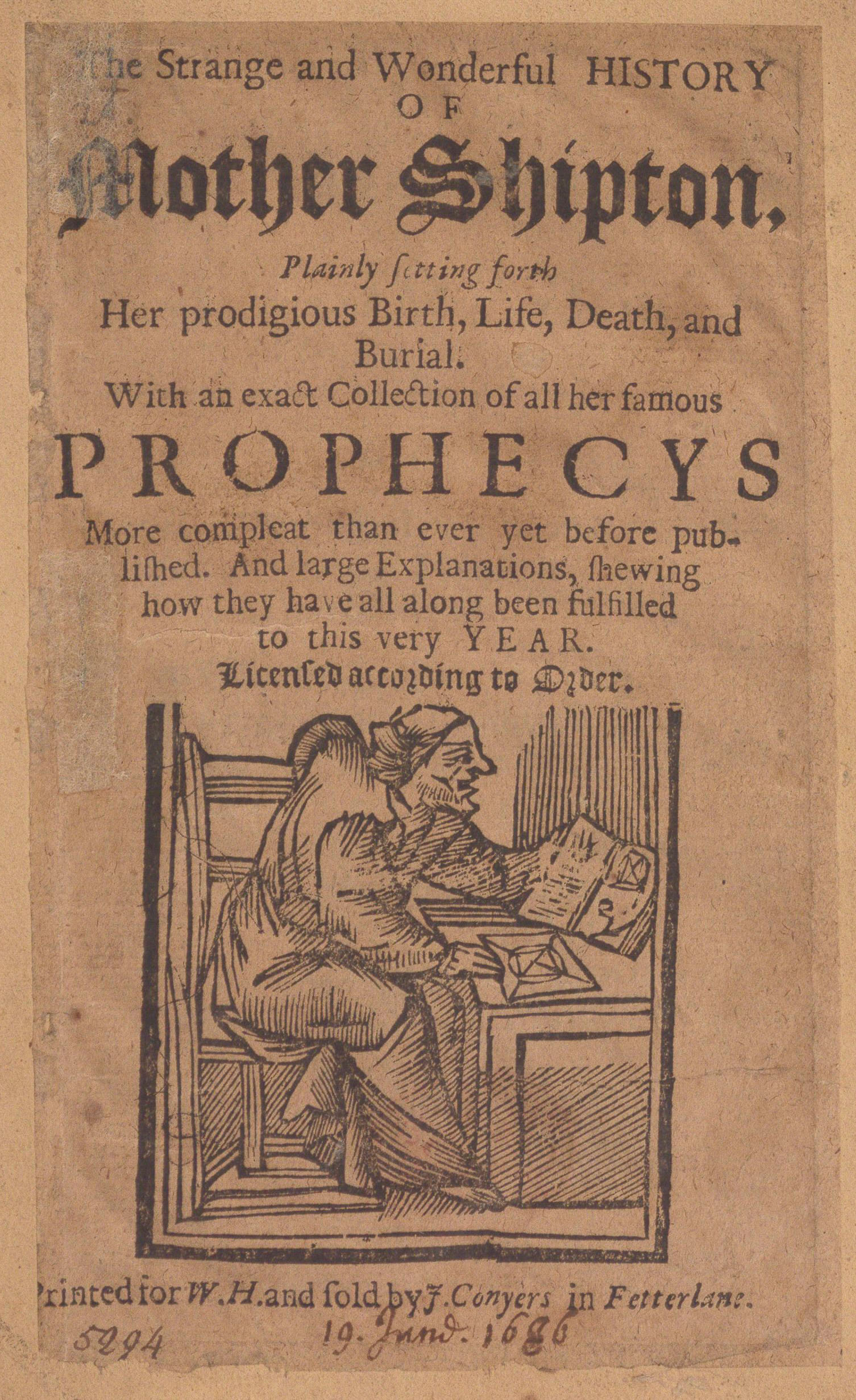
With a reputation as both a visionary prophet and a devilish witch, the legendary Mother Shipton offers a clear example of the slippery boundaries between the early modern prophet and witch.[1] Witchcraft and Magic in England, c. 1400–1920, holds four documents containing the prophecies of Mother Shipton. This includes The Strange and Wonderful History of Mother Shipton Plainly Setting forth Her prodigious Birth, Life, Death, and Burial. With an exact Collection of all her Famous Prophecys (London, 1686). This printed pamphlet details the life and birth of Mother Shipton and her many prophecies which the author claims were each miraculously “fulfilled”. This text is of significance as it also reveals how Shipton’s identity as a “seer” or prophet could quickly shift to that of evil witch. It begins with the title page image which presents Shipton sitting at a desk hunched over her book of prophecies while also depicting her as a stereotypical witch, an old woman with a humpback and long, hooked nose. This ambiguity in the formation of Shipton’s identity then unfolds throughout the pages of this document.
Born Ursula Shootheil in 1488 in a cave in the Yorkshire town of Knaresborough, Shipton became embedded in English folklore, recognised as an accurate foreteller or prophet but also widely known as the “Yorkshire Witch”.[2] Her mother Agatha, an orphaned teenager, was also cast as a witch who was seduced by the Devil.[3] Constructing Shipton’s identity as a witch, the author gives an account of Shipton’s ‘monstrous’ birth as evidence that the prophetess was indeed the “Devil’s Daughter”.[4] Birthed during a loud tempest, the new born was described as having an ‘uncouth shape’ and a devilish appearance with a “long body” and “very big bones, great goggling eyes, very sharp and fiery”. Her body was ‘crooked’ and her face “adorned with great pimples”. The author alleges that by the age of two her mother sensed the child’s “evil” and “wicked spirit”.[5] As she matured, she used her evil powers to curse and inflict misfortune upon those who verbally abused her, calling her the “Devil’s bastard” or “hag face”. As further evidence of her magical powers and witchery, it was also said she used a “love potion” to unwittingly attract a suitor, a carpenter named Toby Shipton, whom she then married.[6] In another contemporary account, the author portrayed Shipton as an “esteemed” “prophetess”, while also noting that it was “verily believed she was a witch”. [7] He repeated the popular witchcraft tropes surrounding her life and identity and the claim that her mother Agatha’s house was filled with her familiars such as “toads and adders”, another hallmark of a witch.[8]
Legend has it that Shipton continued to live in the cave at Knaresborough, where she administered potions, told fortunes and delivered her prophecies concerning local and national events.[9] The document details her many famous foretellings presented during the reign of King Henry VIII. These included her prediction that “Cardinal Wolsey would never come to York”. Shipton’s reputation as a “cunning woman” came before her and the cardinal himself declared: “there was a Witch said, I should never see York” and he “vowed to burn her when he came there”. Her prediction, however, was fulfilled as witnesses reported that when the cardinal was within eight miles of York, the king had summoned him back to London and he died on the return journey.[10] Her other prophecies included a “tempest” which toppled the Trinity steeple in York, the Owes-bridge destroyed by flood, the Great Fire of London, the Great Plague of 1665, Queen Elizabeth’s defeat of the Spanish Armada, the establishment of Protestantism and the Scottish “Kirk” which ended “popish superstition”, followed by the “lamentable” Civil Wars and Cromwell’s “usurpation” of power.[11]
Although Shipton’s prophesying took place during the early 1500s, references to Shipton the prophet/witch appeared in some three hundred texts published well into the seventeenth century and later nineteenth-century political satirical texts and cartoons. Her many transformations in print can be linked to periods of change or conflict such as the English Civil War period, where her fluid identity as both prophet and witch served the religious and political propaganda of the times.[12] Historian Darren Oldridge observes Shipton’s various reincarnations and asserts that her identity as a witch coincided with the most intense period of English witch-hunting of the 1640s.[13] He notes that although Shipton achieved renown for her prophecies of ‘great events in the nation’s history’ this “Yorkshire seer” was transformed in print “from a sorceress to a witch in the 1640s, and from a witch to the Devil’s daughter after 1667”.[14] Shipton’s legend and prophecies lived on well after her death and her fluid identity as both prophet and witch served various contexts and political agendas.
This document demonstrates the vulnerability of the early modern female prophet to accusations of witchcraft. It shows how popular images of Shipton subscribed to the early modern tropes of the female witch such as her monstrous birth and physical deformities. It also includes claims that Shipton’s mother was a witch and that Shipton’s monstrosity and powers of prophecy were indeed the work of the Devil. The connection of Shipton and her mother with the demonic reflected contemporary belief of the pivotal role of the Devil in English witchcraft. Shipton’s alleged ability to accurately predict future events earned her a reputation as a visionary prophet, but the association of Shipton with the Devil and witchcraft also cemented her identity as the legendary “Witch of York”.
[1] For more on early modern prophets as witches see Debra Parish, Prophets and Witches: Witchcraft, Gender and Politics in Revolutionary England (Routledge, 2026).
[2] Mother Shipton’s Cave in the town of Knaresborough is now open as a Yorkshire tourist attraction.
[3] "C.40.g.21: The Strange and Wonderful History of Mother Shipton", 1686, images 8–9, available via BOA at https://britishonlinearchives.com/documents/60858/c40g21-the-strange-and-wonderful-history-of-mother-shipton#?xywh=-1830%2C0%2C6327%2C3423&cv=7.
[4] "C.40.g.21: The Strange and Wonderful History of Mother Shipton", image 11, available via BOA at https://britishonlinearchives.com/documents/60858/c40g21-the-strange-and-wonderful-history-of-mother-shipton#?xywh=-1915%2C0%2C6304%2C3411&cv=10.
[5] "C.40.g.21: The Strange and Wonderful History of Mother Shipton", images 11–12, available via BOA at https://britishonlinearchives.com/documents/60858/c40g21-the-strange-and-wonderful-history-of-mother-shipton#?xywh=-1915%2C0%2C6304%2C3411&cv=10.
[6] "C.40.g.21: The Strange and Wonderful History of Mother Shipton", image 16, available via BOA at https://britishonlinearchives.com/documents/60858/c40g21-the-strange-and-wonderful-history-of-mother-shipton#?xywh=-1830%2C0%2C6327%2C3423&cv=15.
[7] Richard Head, The Life and Death of Mother Shipton giving a wonderful account of her strange and monstrous birth, life, actions and death (London, 1677), 49.
[8] Head, Life and Death, 4, 6, 8–9.
[9] Although now part of local folklore, there is no historical evidence or contemporary source to support this part of Shipton’s legend.
[10] "C.40.g.21: The Strange and Wonderful History of Mother Shipton", images 18–19, available via BOA at https://britishonlinearchives.com/documents/60858/c40g21-the-strange-and-wonderful-history-of-mother-shipton#?xywh=-1856%2C-1%2C6378%2C3452&cv=17.
[11] "C.40.g.21: The Strange and Wonderful History of Mother Shipton", images 20–21, 23–24, 26, available via BOA at https://britishonlinearchives.com/documents/60858/c40g21-the-strange-and-wonderful-history-of-mother-shipton#?xywh=-1856%2C-1%2C6378%2C3452&cv=19.
[12] See Debra Parish, Prophets and Witches, chapter two.
[13] Oldridge is referring to the notorious East Anglia witch-hunts of 1645–47 led by the witch-finder Matthew Hopkins, where some 250, mainly women, were examined for witchcraft and an estimated 100 of the accused witches executed by hanging.
[14] Darren Oldridge, “Mother Shipton and the Devil”, in The Extraordinary and the Everyday in Early Modern England: Essays in Celebration of the Work of Bernard Capp, ed. A. McShane and G. Walker, 1st ed. (London: Palgrave Macmillan UK, 2010), 211–12.