

The democratic reform movement and workers’ collective action developed rapidly in Britain between the 1790s and the 1830s. The Working Class Movement Library collection contains a wide range of pamphlets, posters, cartoons, writings and other items produced by these burgeoning movements as a means of spreading their message and making their claim in the political public sphere. The National Archives (UK) collection offers a different view from which to understand the “age of reform”. The hundreds of letters sent to the Home Office and Treasury Solicitor from across Britain provide key evidence for how government, local authorities, and members of elite society reacted to popular political movements.[1] We can use these documents to understand the ideologies and actions of the state against the rise of democratic and trade union movements first-hand.
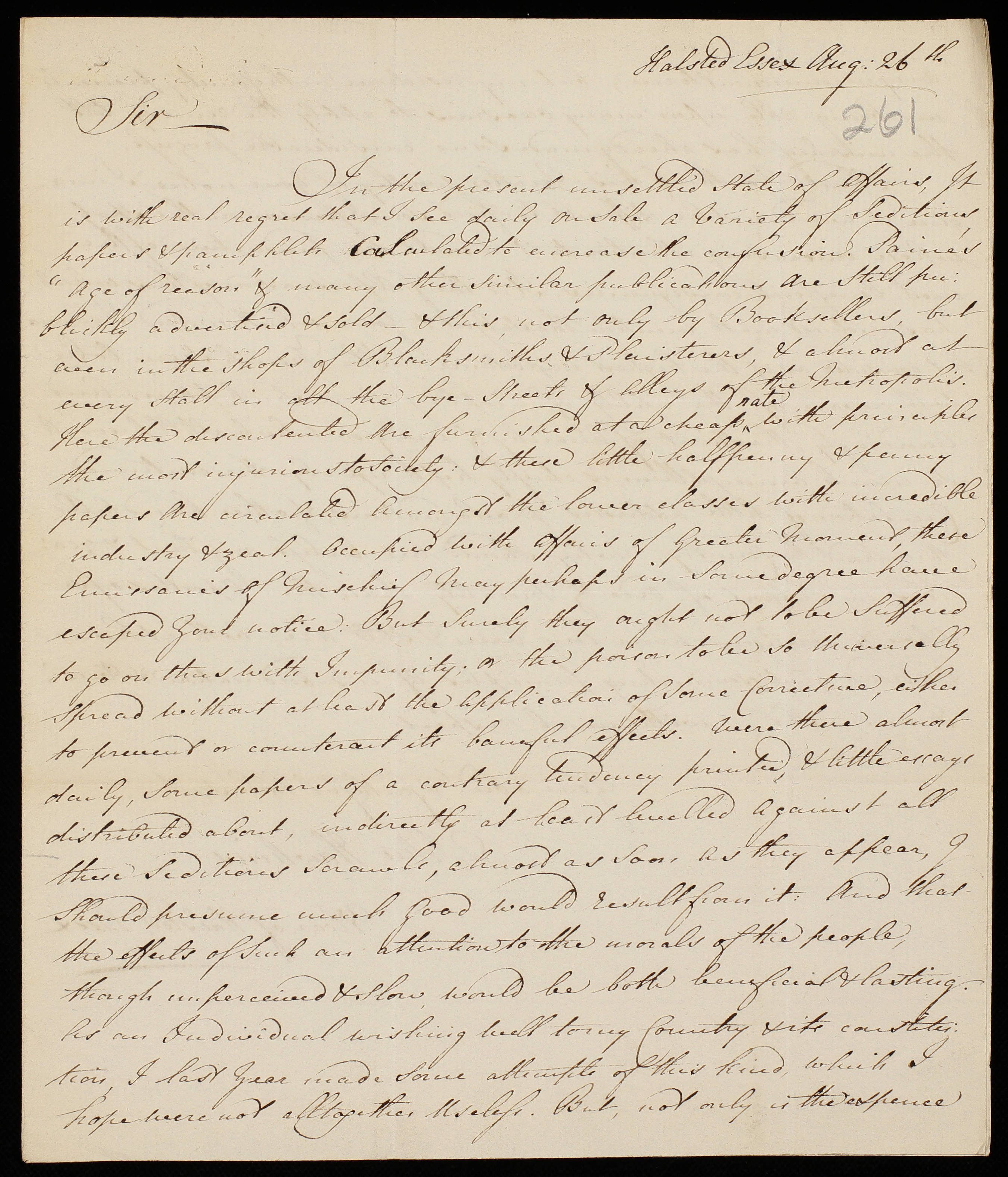 HO 42/33/130, f.261, Letter from Rev. John Hawkins to Home Office(26 August 1794).A typical example from the Home Office archives is a letter dated 26 August 1794, written by Reverend John Hawkins, rector of Halstead in Essex. He complained,
In the present unsettled State of Affairs, it is with regret that I see daily on sale a Variety of Seditious newspapers and pamphlets calculated to increase the confusion. Paine’s “Age of Reason” and many other similar publications are still publicly advertised and sold - and this, not only by Booksellers, but even in the shops of Blacksmiths and Plaisterers and almost at every stall in all the bye-streets and alleys of the Metropolis.”
The Home Office received many similar letters from local magistrates, vicars, and other self-described “respectable inhabitants” from across Britain during the French Revolutionary and Napoleonic Wars. Thomas Paine’s writings had a major impact in spreading ideas of democracy and reform among the working classes during the French Revolution. In particular, Paine’s Rights of Man, a two-part call to action published in 1791–92, was widely read.[2] The government banned the book, and Paine’s works were burned in the streets alongside his effigy in gatherings organised by local groups such as “Church and King” clubs.[3] Halstead’s complaint was representative of a growing conservative reaction against all forms of political reform, as expressed by Whig politician Edmund Burke, in his political tract, Reflections on the Revolution in France (1790).[4] Loyalists feared the democratising impact of “seditious” writings in the context of the “Terror” in France that led to regicide in 1793.
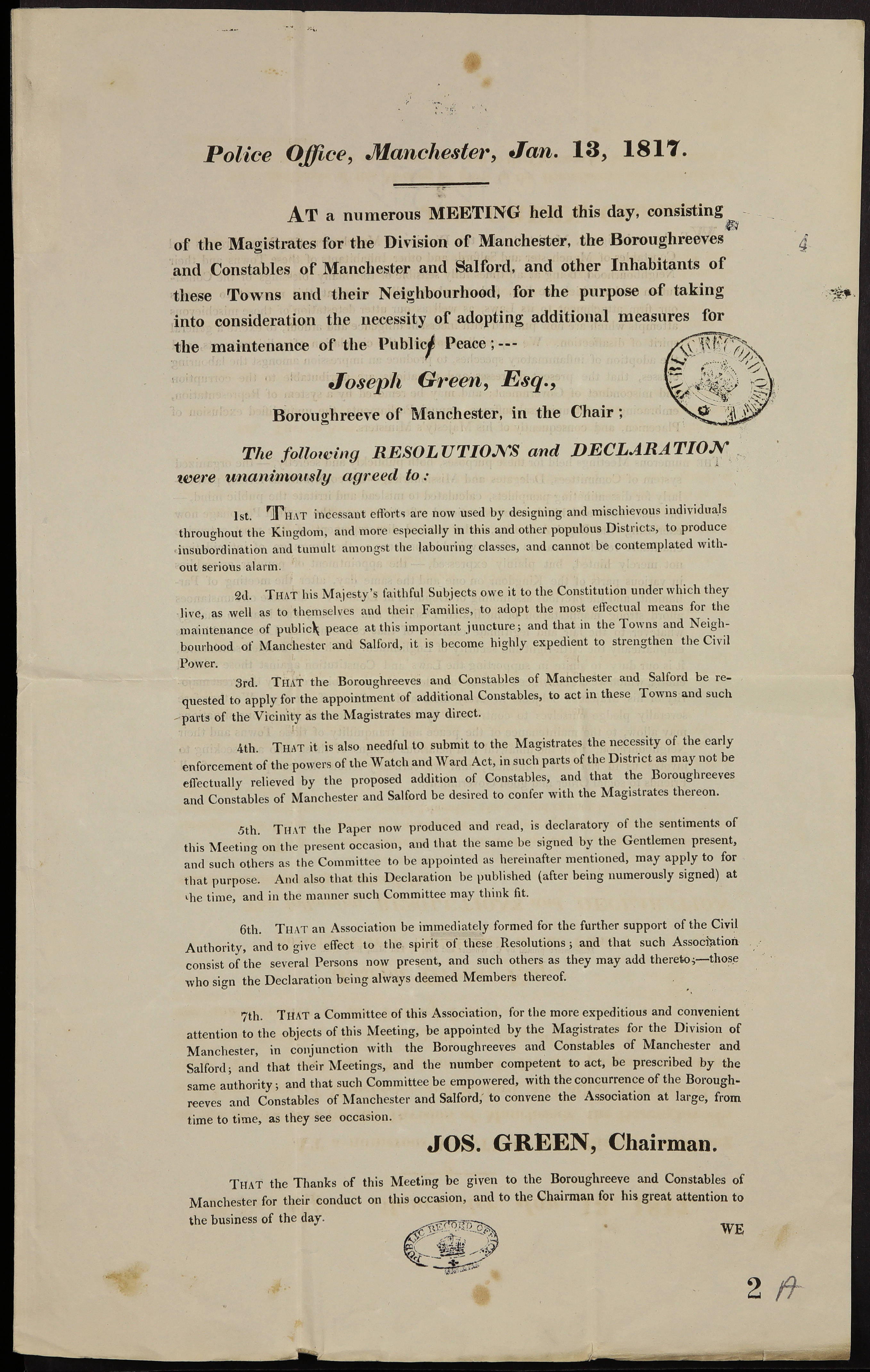 TNA, HO 40/9/1/f.4, List of resolutions of a meeting in Manchester(13 January 1817). The fear of democratic radicalism continued after the end of the Napoleonic Wars in 1815, when economic depression and unemployment fuelled a revival of popular activism for parliamentary reform. The language of loyalism punctuates the letters from local authorities, the resolutions of civic meetings and addresses to George III and the Prince Regent, and this continued through and after the Napoleonic Wars. For example, in 1817, the boroughreeve and constables, who formed part of the manorial authorities of Manchester and Salford, held a meeting on 13 January to warn their inhabitants “that incessant efforts are now used by designing and mischievous individuals throughout the Kingdom, and more especially in this and other populous Districts, to produce insubordination and tumult amongst the labouring classes, and cannot be contemplated without serious alarm”. By contrast, the authorities reminded their townspeople that “his Majesty’s faithful Subjects owe it to the Constitution under which they live”, and should remain loyal.
The Impact of Loyalist Repression: Legislation, Local Authorities, and Spies
Historians have debated why Britain did not experience a popular revolution during the French Revolutionary and Napoleonic Wars, a time of severe economic distress and popular political discontent.[5] One answer is laid at the strength of the Tory governments’ repressive measures against the democratic and working-class movements. William Pitt the Younger’s Tory government passed the Treasonable and Seditious Practices Act in 1795, which extended the definition of treason to include speaking and writing. The new definition of treason was accompanied by another act in 1795, the Seditious Meetings Act, which required organisers of meetings about political matters to seek permission from two magistrates. The Combination Acts, passed in 1799–1800, prohibited workers from collective bargaining with employers and drove trade unions to form secret associations, bound by oaths, which were also made illegal under the acts. Repressive legislation passed under Lord Liverpool’s premiership included the 1817 Suspension of Habeas Corpus Act, the 1817 Seditious Meetings Act, and the 1819 “Six Acts”.[6]
The Tory governments sought to make a show of arrested leaders of radical societies. In 1794–95, the leaders of the corresponding societies of Edinburgh and London were arrested and tried for sedition and treason, though they were eventually acquitted.[7] After the Napoleonic Wars, the organisers of “mass platform” reform demonstrations were arrested, tried, and convicted, most notably Henry “Orator” Hunt and local leaders, such as Samuel Bamford, after the “Peterloo Massacre” in Manchester on 16 August 1819. Their radical supporters published accounts of the trials in pamphlet form to publicise their perceived injustice.[8]
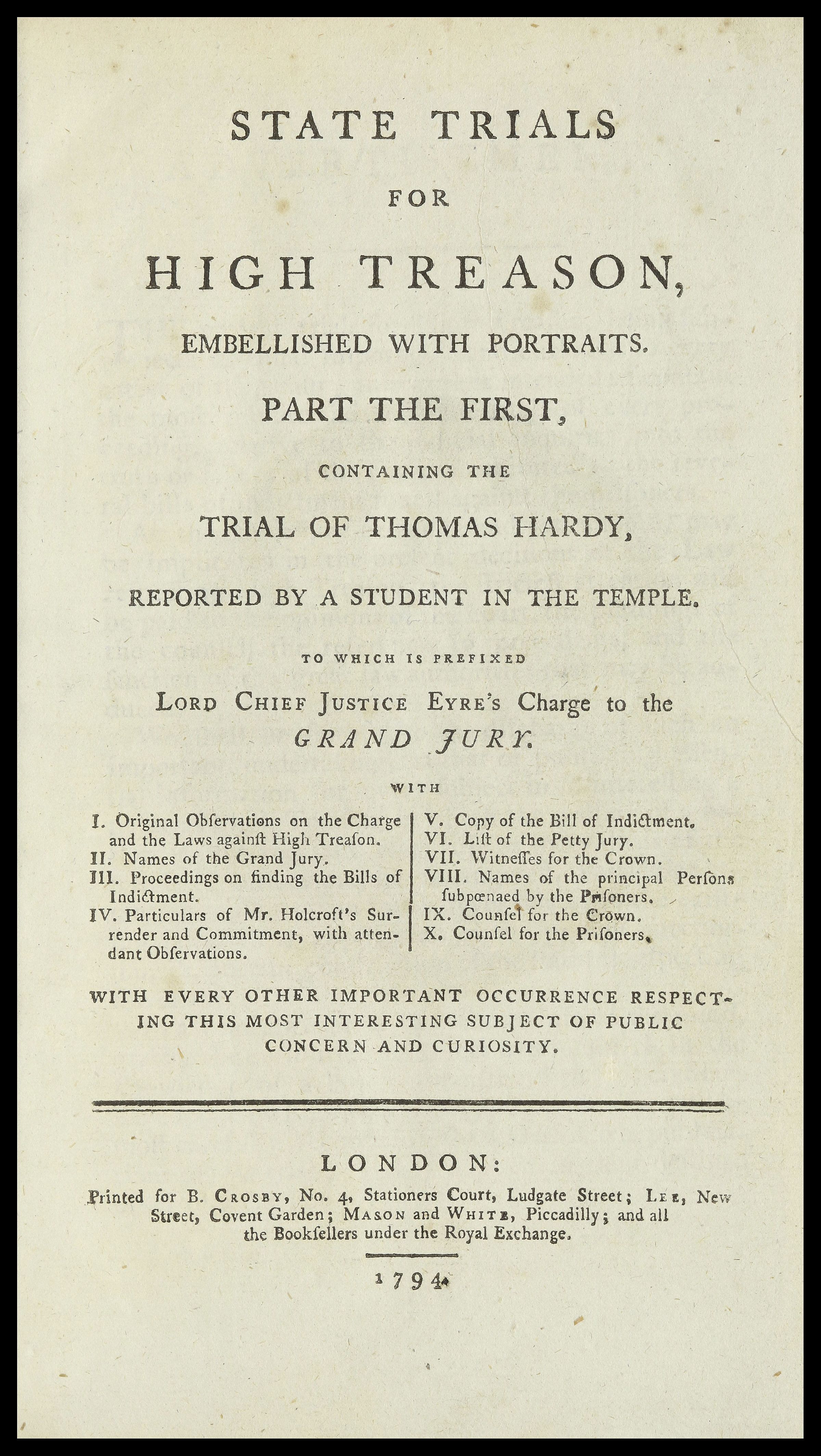 WCML, D03, State Trials for Treason(1794).There was no regular police force in this period. Local magistrates were the main forces of order. They could call up special constables to put down popular unrest, and use military assistance to suppress riots by force under the Riot Act of 1714. But the emergence of the radical reform movement increased the atmosphere of suspicion and fear of revolution, and local authorities and the government felt it necessary to use more secretive methods to uncover the activities of the democratic societies and workers’ combinations. Such societies were especially active in the rapidly expanding industrial cities of northern and midland England. The Home Office documents contain a list of the code names given to the spies, from “A”, “B”, to “XY”, the latter referring to the notorious William Chippendale of Oldham.[9] Chippendale was employed by Colonel Ralph Fletcher, magistrate of Bolton, who would later become one of the leading justices on the bench that ordered the yeomanry cavalry to charge the crowd at Manchester on 16 August 1819, the “Peterloo Massacre”.
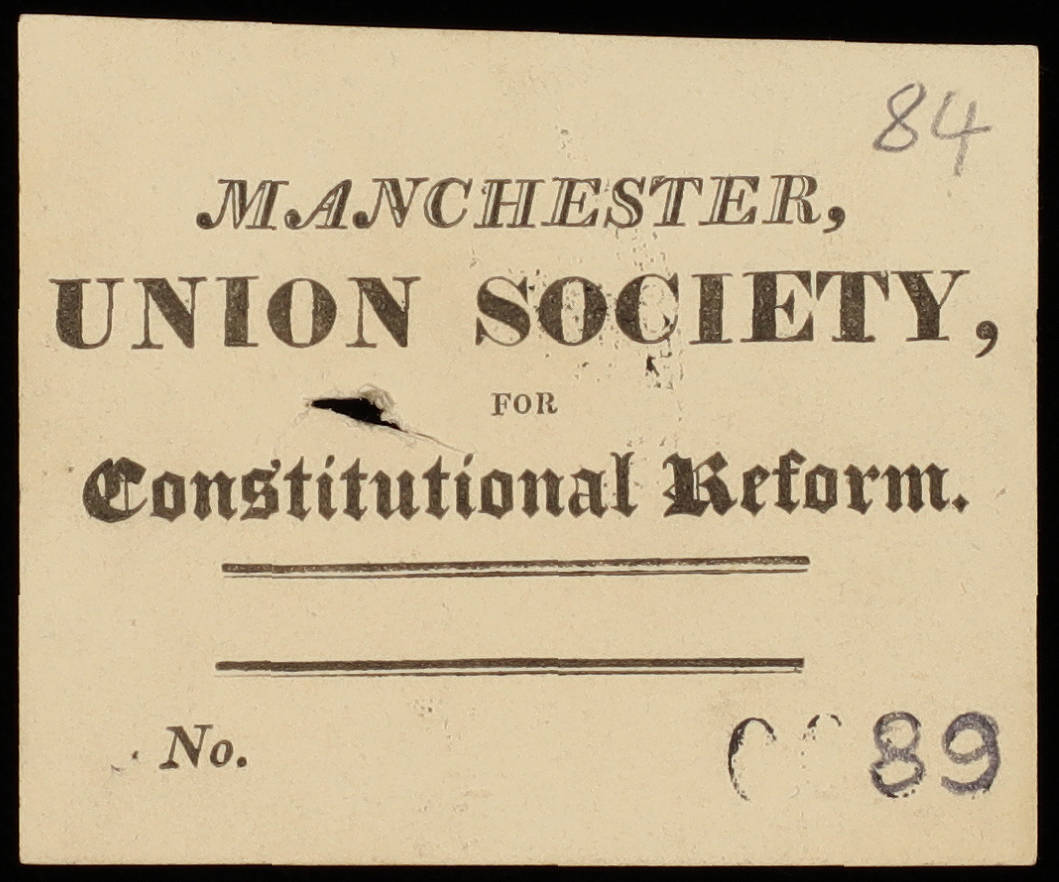 TNA, HO 40/10/2/f.84, List of agents sent to infiltrate the Hampden Clubs, with a membership card for the Manchester Union Society for Constitutional Reform(1817).Suspicion of spies and government informers was rampant. In May 1812, led by veteran campaigner John Knight, a group of thirty-eight working men in Manchester revived a society to petition the Prince Regent for parliamentary reform. Samuel Fleming, an Irish weaver and former member of Colonel Silvester’s militia, informed the boroughreeve and constables that they were holding a meeting at a pub on 11 June 1812. The deputy constable of Manchester, Joseph Nadin, notorious for his severity against criminals, entered the room with a band of soldiers and arrested the men on a charge of administering an illegal oath to Fleming. The prisoners were sent to Lancaster Castle. The trial of the “Thirty Eight” took place at the height of the Luddite machine-breaking outbreaks in Lancashire, and magistrates suspected that the radicals were connected with working-class combinations. The trial was widely publicised, including in a pamphlet issued by Knight, who later became one of the leaders of the Manchester radical society that organised the mass meeting on St Peter’s Fields on 16 August 1819.[10]
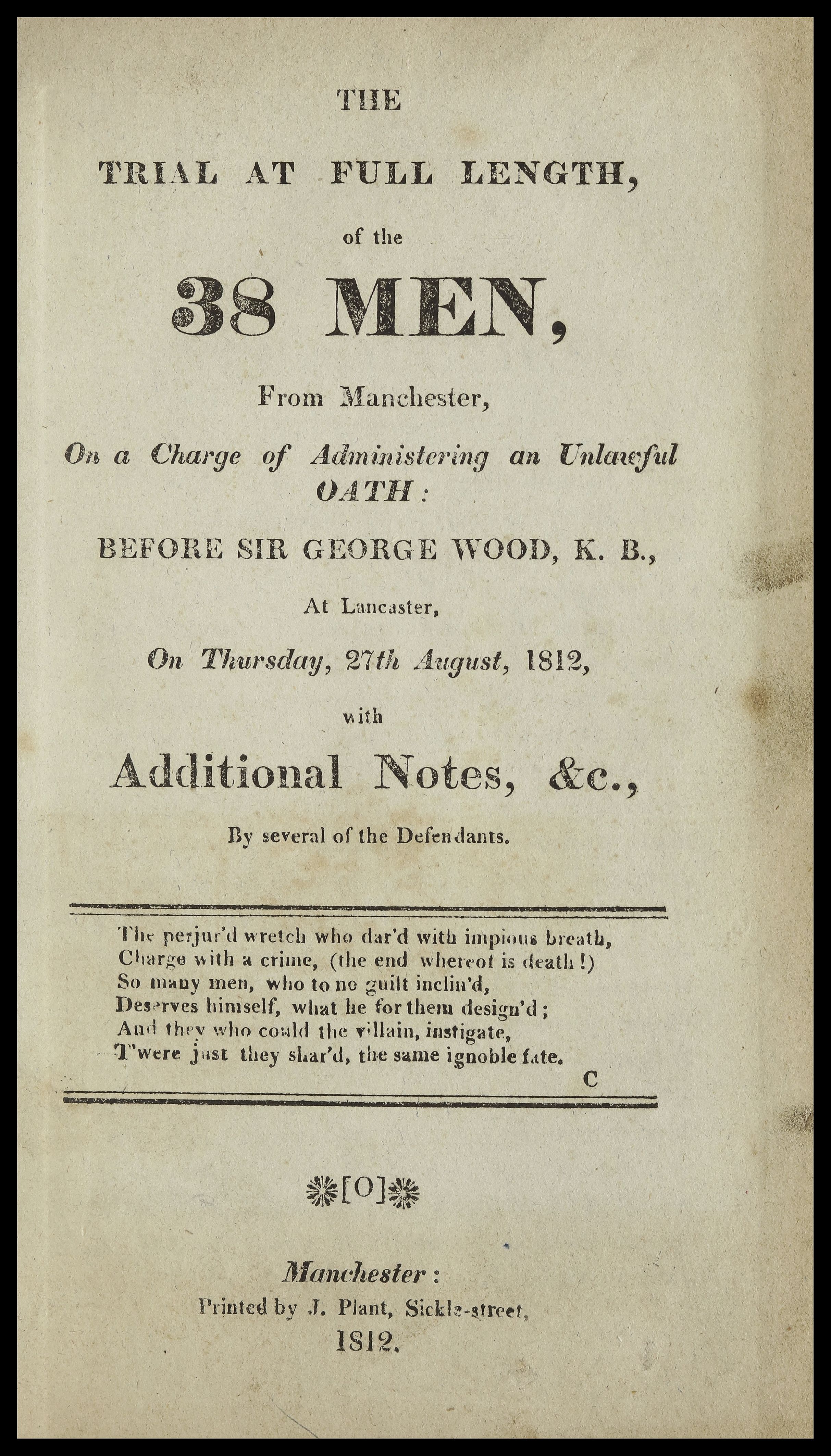 WCML, D31, pamphlet, Trial at Full Length of the Thirty-Eight Men From Manchester on a Charge of administering an Unlawful Oath(27 August 1812).The most infamous spy was named “Oliver”. He acted as agent provocateur in the reporting back to Home Secretary Lord Sidmouth about working men’s plans to stage armed uprisings across the industrial cities of northern and midland England. Upon Oliver’s testimony about participants in the failed Pentrich Uprising in Derbyshire in June 1817, three men were tried for treason and hanged, while several others were sentenced to transportation to Australia.[11] Oliver’s treachery was soon publicly exposed, and severe criticism of the government informer network was raised by reformers, such as Edward Baines, editor of the Leeds Mercury newspaper.[12]
The “war of the unstamped” and the Role of the Popular Press
The wealth of printed material in these collections illustrates how the early nineteenth century was an era of mass print culture. The new political associations used pamphlets, newspapers, prints, and cartoons skilfully to spread the message of reform. The government could use seditious libel laws against writers whom they felt were a threat, but the main tool of censorship was financial. A stamp duty was imposed on popular literature and the cheap press. Radical printers, publishers and booksellers therefore saw themselves fighting a “war of the unstamped” and against “taxes on knowledge”, especially in the 1820s and 1830s.[13]
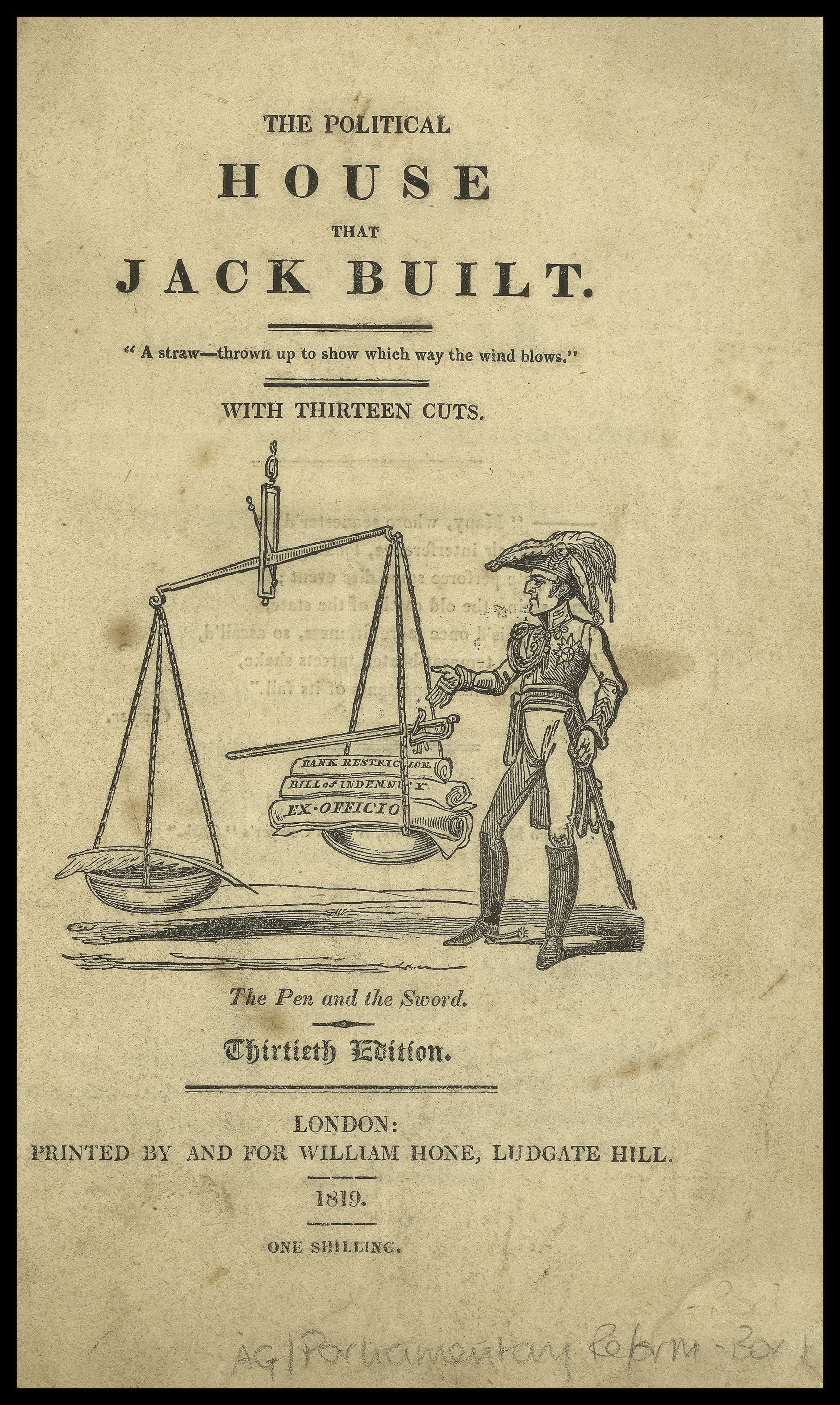 WCML, AG Parliamentary Reform Box 1: pamphlet, William Hone, The Political House That Jack Built(1819).William Hone, publisher and newspaper editor, was prosecuted several times for libel for his satirical publications. His most popular work was The Political House That Jack Built, published as a response to the Peterloo Massacre and the passage of the repressive “Six Acts” in 1819. Cleverly composed in the form of the popular nursery rhyme, with accompanying illustrations by caricaturist George Cruickshank, Hone sharply blamed the authorities for their repression of the poor. One page shows a sketch of army officers that Hone argued had turned against their own people at Peterloo. The rhyme complained of the authorities putting down the freedom of the press (“the Thing”):
These are the reasons of lawless power,
That back the Public Informer [the Chief Justice]
Who would put down the Thing
And attempts to restrain it, by Soldiers or Tax
Will Poison the Vermin [justices of the peace and judges]
That plunder the Wealth [Magna Carta and the 1689 Bill of Rights]
That lay in the House
That Jack built [the constitution].”[14]
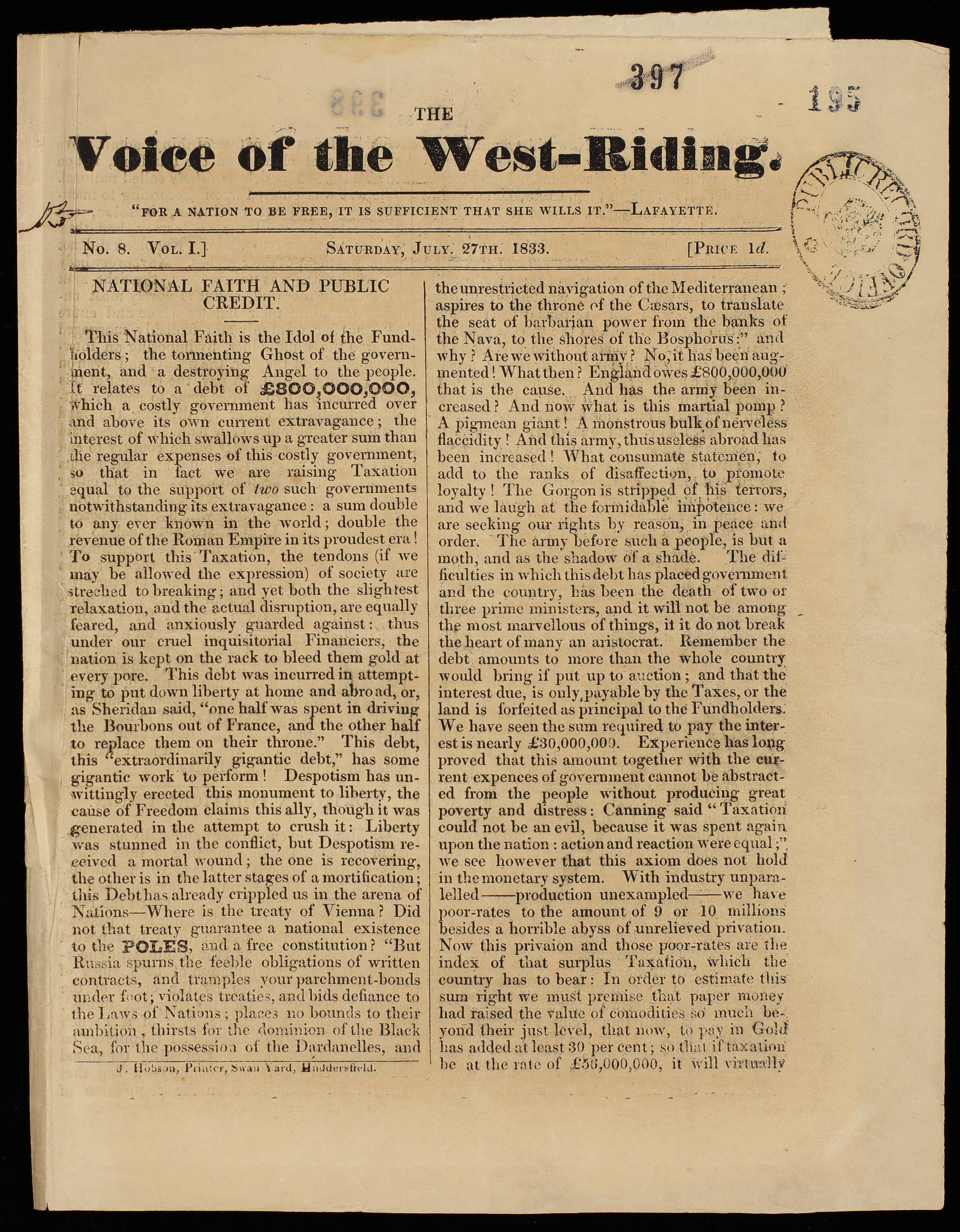 TNA, HO 40/31/5/f.195,Voice of the West Riding(27 July 1833).Writers and publishers from across the spectrum of the popular press popularised calls for the repeal of the stamp duty, reaching a peak in the 1830s. The Voice of the West Riding was a Yorkshire newspaper issued by Huddersfield factory reform campaigner Joshua Hobson. This issue of July 1833 complained of the huge National Debt of £800 million as a result of the Napoleonic Wars, and consequent high taxes with a disproportionate burden levied on the poor.[15] Reporting on a public meeting of the Northern Political Union in North Shields in 1833, the reformers’ discontent with the 1832 Reform Act would later translate into the emergence of Chartism from 1837 onwards, the largest working-class movement for parliamentary reform. Francis Place, a tailor and social reformer who had been a member of the London Corresponding Society in the 1790s, issued a pamphlet in 1835 calling for repeal of the duty, noting, “It has often been remarked that the Government of this Country is at least half a century behind the well-informed portion of the community in knowledge”.[16] Place would then go on to help form the London Working Men’s Association in 1837, and would draft the People’s Charter with William Lovett in 1838, the key document of the Chartist movement.
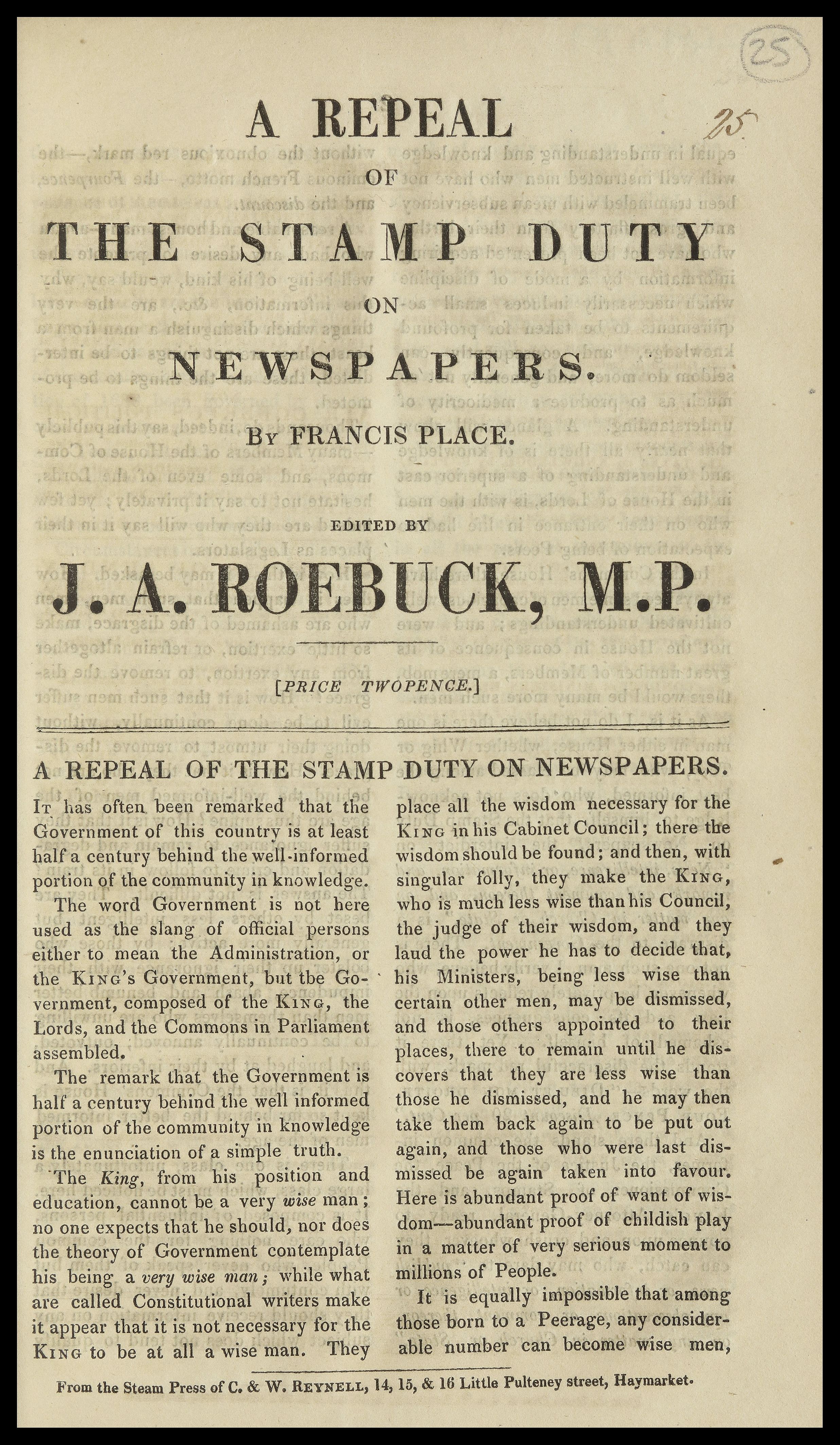 WCML, D30, pamphlet by Francis Place, A Repeal of the Stamp Duty on Newspapers(1835).We must not conclude, however, that the British state was all powerful. These documents reveal how the governments’ response to the rise of the reform and trade union movements was not a coherent ideology or strategy. Rather, it was often reactive, patchy, and reliant on the efforts of local magistrates or the exaggerated information provided by anonymous spies and informers. Though the attempted suppression of the democratic and working-class movements was particularly severe in times of tension—especially in 1795 and 1819—it was not completely autocratic. The breadth of pamphlets, cartoons, printed resolutions, and other material produced by the new political and social movements is testimony to their determination to organise locally and nationally. By the time of the agitation for the first Reform Act of 1832, politicians and the populace had largely accepted that some reform of the electoral system was needed to give representation to the industrial cities.
[1] The National Archives (hereafter TNA), Home Office domestic correspondence “disturbances papers”, HO 40, 42, 44, and 52.
[2] Working Class Movement Library (hereafter WCML), D66, Thomas Paine, Rights of Man (London, 1792), part one available via British Online Archives (hereafter BOA) at https://britishonlinearchives.com/documents/58473/d66-political-pamphlets-1792-93-rights-of-man; part two available at https://britishonlinearchives.com/documents/58474/d66-political-pamphlets-1792-93-rights-of-man-part-the-second?#uv-wrapper.
[3] Frank O’Gorman, “The Paine Burnings of 1792–1793”, Past & Present 193 (2006), 111–155.
[4] WCML, D73, Edmund Burke, Reflections on the Revolution in France (London, 1795 edn), available via BOA at https://britishonlinearchives.com/documents/58524/d73-reflections-on-the-revolution-in-france.
[5] Emma MacLeod, “British Attitudes to the French Revolution”, Historical Journal 50, 3 (2007), 689–709, https://doi.org/10.1017/S0018246X07006310.
[6] Kevin Gilmartin, “In the Theater of Counterrevolution: Loyalist Association and Conservative Opinion in the 1790s”, Journal of British Studies 41, 3 (2002), 291–328, https://doi.org/10.1086/341151.
[7] WCML, D31, The Trial of Thomas Muir, Edinburgh, 1794, available at https://britishonlinearchives.com/documents/58328/d31-the-trial-of-thomas-muir-esq.
[8] WCML, D34, The Trial of Henry Hunt, etc, Manchester, 1820, available via BOA at https://britishonlinearchives.com/documents/58338/d34-the-trial-of-henry-hunt-esq-for-an-alleged-conspiracy-to-overturn-the-government.
[9] TNA, HO 40/10/2/f.84, List of agents sent to infiltrate the Hampden Clubs, 1817, available via BOA at https://britishonlinearchives.com/documents/59768/ho-40102-papers-relating-to-agents-informers-and-prisoners-in-several-counties#?xywh=677%2C212%2C1611%2C795&cv=6, images 3–9.
[10] Katrina Navickas, “Political Trials and the Suppression of Popular Radicalism in England, 1799–1820”, in Political Trials in an Age of Revolution: Britain and the North Atlantic, 1793–1848, ed. Gordon Pentland, Emma Macleod, and M. T. Davis (Basingstoke: Palgrave Macmillan, 2018), 185–212.
[11] TNA, HO 40/9/2, “Narrative of a Government Agent, Employed as an Informer”, 1817 https://britishonlinearchives.com/documents/58816/ho-4092-narrative-of-a-government-agent-employed-as-an-informer#?xywh=-2664%2C-216%2C7970%2C4313; see also https://www.nationalarchives.gov.uk/education/resources/protest-and-democracy-1816-to-1818/oliver-spy/.
[12] See also WCML, D60, William Tait, Exposure of the Spy System of 1816–17 (Edinburgh, 1817), available at https://britishonlinearchives.com/documents/58446/d60-exposure-of-the-spy-system-of-1816-17; D57, The Black Dwarf, vol 1, 1817.
[13] Ian Haywood, The Revolution in Popular Literature: Print, Politics and the People, 1790–1860 (Cambridge: Cambridge University Press, 2004).
[14] WCML, AG Parliamentary Reform Box 1: pamphlet, The Political House That Jack Built, by William Hone, 1819, available via BOA at https://britishonlinearchives.com/documents/58168/ag-parliamentary-reform-box-1-the-political-house-that-jack-built-30th-edition, image 9.
[15] TNA, HO 40/31/5/f.195, Voice of the West Riding, 27 July 1833, available via BOA at https://britishonlinearchives.com/documents/58810/ho-40315-miscellaneous-correspondence-and-political-publications, images 114–115.
[16] WCML, D30, Francis Place, A Repeal of the Stamp Duty on Newspapers (London, 1835), available via BOA at https://britishonlinearchives.com/documents/58802/d30-pamphlets-for-the-people-a-repeal-of-the-stamp-duty-on-newspapers#?xywh=-3068%2C0%2C8607%2C4251&cv=, image 1.