The Industrial Revolution: Technological Innovation in the Textile Industry, 1672–1929

  • Home
  • Collections
  • The Industrial Revolution: Technological Innovation in the Textile Industry, 1672–1929
A woman works at a power loom weaving in a cotton mill in Lancashire, England, 1835

Bolton's textile industry throughout the eighteenth and nineteenth centuries: manufacture, trade, and politics

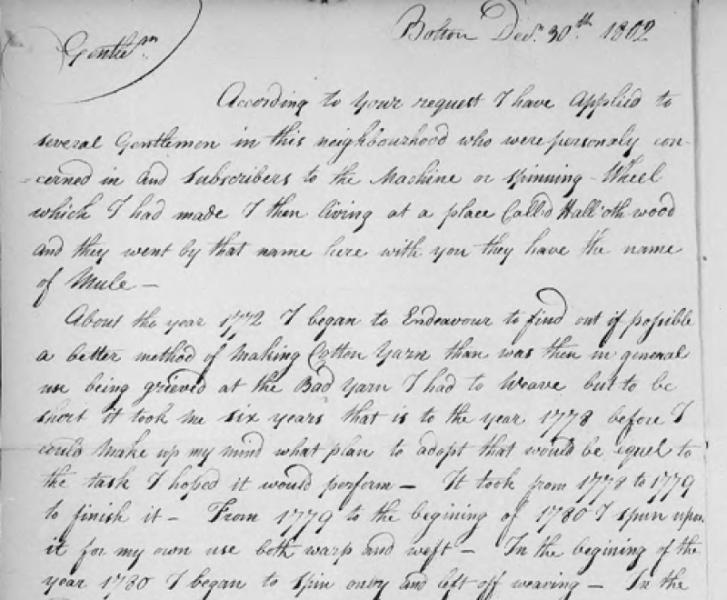
About the year 1772 I began to endeavour to find out, if possible, a better way of making cotton yarn than was then in general use; being grieved at the bad yarn I had to weave. But to be short, it took me six years
Samuel Crompton, Dec 1802,  
The Crompton papers, 1672-1929: General Correspondence & Papers (1802), image 8.

Access the full collection

Access the full archive of The Industrial Revolution: Technological Innovation in the Textile Industry, 1672–1929.

Institutional Free Trial

Start your free trial 

Register for a free 30-day trial of The Industrial Revolution: Technological Innovation in the Textile Industry, 1672–1929, for your institution.

Institutional Sales

Visit Sales Pagesell

For more information on institutional access, visit our sales page.

Single User License

Purchase a license below to view the full collection.

Already have a license? Sign in.

Explore the industrial revolution across North West England

The Samuel Crompton Memorial Statue in Bolton, photo taken in 2008

This collection traces the development of the Industrial Revolution in Britain through two prominent families connected to Bolton’s textile industry: the Cromptons and the Heywoods.

The Crompton family were significant due to Samuel Crompton’s invention of the revolutionary spinning mule in 1779, an innovation which faciliatated massive productivity when producing textiles on a grand scale. The Heywoods became famous through Robert Heywood, who used his successful textile business to launch a political career during the rise of the Chartist movement.

Correspondence between key figures amongst the family and their respective businesses make up the bulk of the collection. The collection also includes property descriptions and valuations, newspaper cuttings, and travel journals. Significantly, these papers track the social, political, and economic impact of the Industrial Revolution throughout northern England and beyond.

Contents

The Industrial Revolution: Technological Innovation in the Textile Industry, 1672–1929...

Bolton's textile industry throughout the eighteenth and nineteenth centuries: manufacture, trade, and politics

Discover 
An engraving of seven women working in a fabric shop, 1885.

Highlights

Section of a handwritten letter dated Bolton Dec. 30th 1802.

Licensed to access Crompton’s Spinning Mule

Robert Crompton did not patent his spinning mule, denying himself a fortune. During the early 1800s, he petitioned parliament for a grant in recognition of the economic benefit that the nation had derived from the mule. This letter (images 8–9), written in December 1802, formed part of that campaign. In it, Crompton describes the process whereby he invented the mule. 
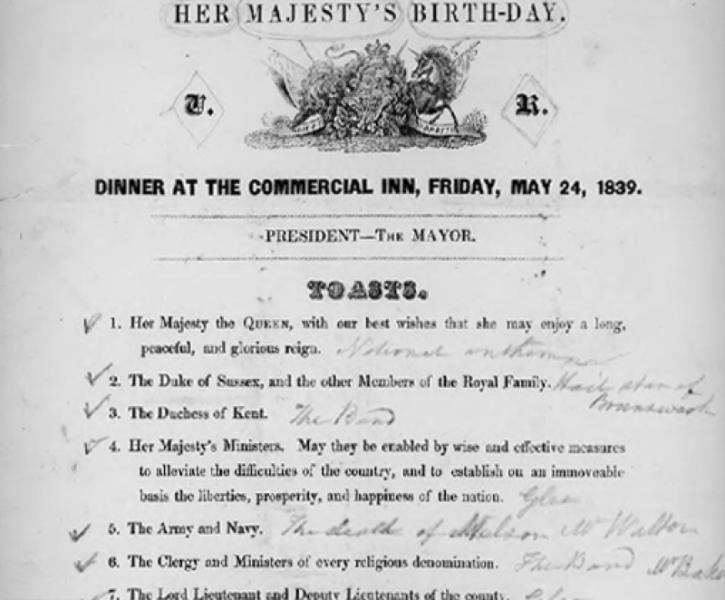
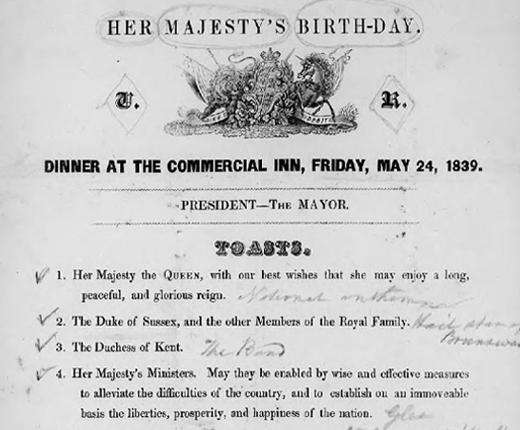
Section of a document titled Her Majesty's Birthday, followed by the coat of arms of the United Kingdom, and the subtitle Dinner at the Commercial Inn, Friday, May 24, 1839. Visible is a section of the document titled Toasts, followed by 7 numbered points.

Licensed to access “Peace and Prosperity to Ireland”

This document (image 195) lists various toasts that were raised at Bolton’s Commercial Inn in May 1839 by Robert Heywood, the city’s mayor at the time. Like so many of Heywood’s papers, this source illuminates key events, issues, and trends in wider British politics during his lifetime. For example, “Peace and Prosperity to Ireland” was among the toasts raised—“May those animosities that interfere with her welfare be speedily and for ever allayed”. 
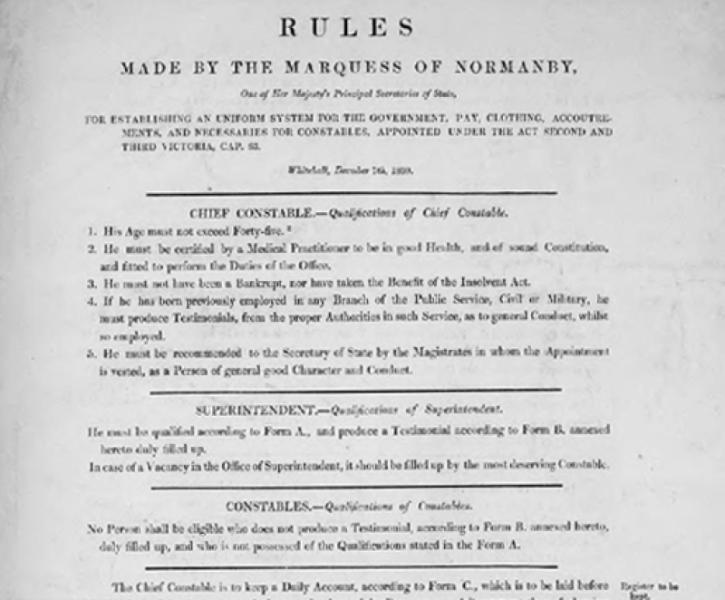
Section of a document titled Rules Made by the Marquess of Normanby, featuring sections titled Chief Constable, superintendent, and Constables.

Licensed to access Development of a Modern Police Force

In 1839, the Rural Constabulary Act was passed by the British government, allowing county areas to establish police forces. Heywood’s papers contain a set of rules (image 158), drawn up by the 1st Marquess of Normanby, Home Secretary in Lord Melbourne’s government at the time, for “Establishing a Uniform System for the Government, Pay, Clothing, Accoutrements, and Necessaries for Constables”. 
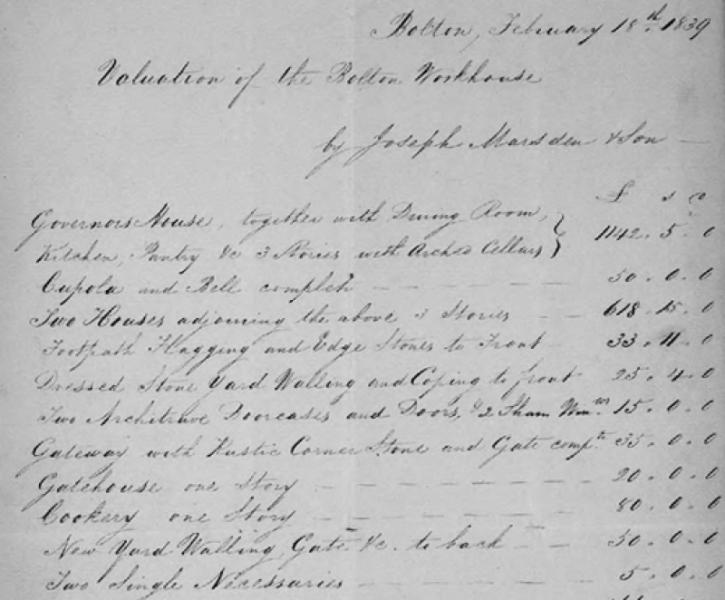
Section of a handwritten document titled Valuation of the Bolton Workhouse, dated Bolton, February 18th 1939.

Licensed to access Workhouse Valuation

The Poor Law Amendment Act of 1834 introduced the controversial workhouse system. Heywood’s papers contain documentation relating to the administration of Bolton’s workhouse, such as this valuation (image 128) dating from February 1839. 

Insights

  • The Heywood papers contain information on his international travel and trade. They also include correspondence regarding Bolton's politics, including the growth of the Chartist movement and associated riots.
  • The Crompton Papers are the largest part of this collection. The majority of these papers are letters from 1672 to 1862.
  • The latter three pages of Crompton document listings cover Crompton as the inventor of the mule. They also include family wills, extracts of items on the cotton industry and his account books.
  • Charles Dickens' journal All The Year Round features within papers on the doctrines of Emanuel Swedenborg. The volume from April in 1860 includes a biography of Samuel Crompton. 
lock_open

Unlock Historical Research for Your Institution

Provide your students and researchers with direct access to unique primary sources.

Related Media

The Crompton Archive: An Introduction Contextual Essays

IntroductionAs historians have often pointed out, the importance of technological innovation in promoting Britain's Industrial Revolution can easily be overstated, especially in terms of the emphasis given to great inventions. Yet, from the late 18th century, the emergence of factory production utilizing new types of powered machinery played a major... Read more →
Professor Geoff Timmins
Published 1st June, 2010
Antique Engraving of Victorian England Victorian, 1840. People walk through the square with bundles.

Licensed to access Liverpool Through Time: From Slavery to the Industrial Revolution, 1766–1900

1766   1900
Liverpool Record Office logo
An engraving of Ragged School, Whitechapel. A very large school room full of children, with a teacher at the front presiding over a wooden desk

Licensed to access British Poor Schools in the Nineteenth Century, 1812–1901

1812   1901
The National Society (Church of England Education Office) logo
British & Foreign School Society logo
Back to Top