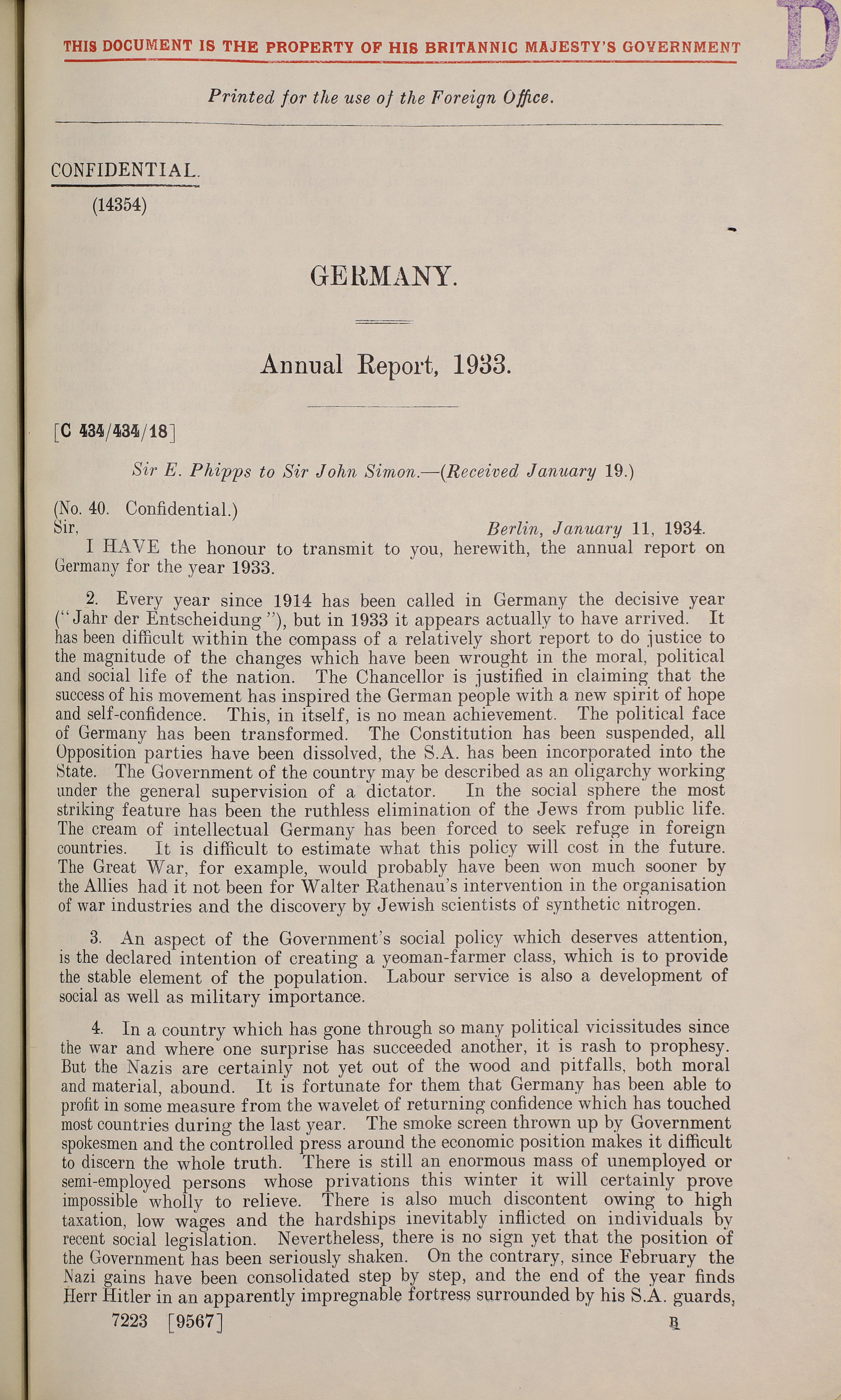
Our latest “Document of the Week” was chosen by our Senior Curator, Dr Charlie Hall. It is the annual report on Germany for 1933, produced by the staff of the British Embassy in Berlin. Each year, diplomatic staff posted across the world wrote up a report of all the major developments in their host nation, covering politics, the economy, international relations, and so on, for the benefit of Foreign Office civil servants and leading politicians back in Britain.
Anglo-German relations, especially during the interwar period, were of vital importance to British interests and the annual reports from Germany were among the most carefully compiled and widely read. The report for 1933 was perhaps the most significant of the period. Indeed, the introduction read: “Every year since 1914 has been called in Germany the decisive year, but in 1933 it appears actually to have arrived.”
The main reason for this was the appointment of Adolf Hitler to the position of Chancellor in January of 1933, and the efforts he and the Nazi Party carried out to reshape Germany in their image. As the report noted, it is difficult “to do justice to the magnitude of the changes which have been wrought in the moral, political and social life of the nation”.
For Britain, the principal concern triggered by Hitler’s ascendancy was that Germany would rebuild its military and once again bring war to Europe. In order to head this off at the pass, the British ambassador in Berlin, Sir Eric Phipps, urged a strong united front with France so as to “avoid offering Germany any undue temptation to add yet another chapter to her already all too lengthy war history”.
Where to find this document
This item comes from our primary source collection, Germany, 1920–1969: British Foreign Office Confidential Print.
Comprising over 56,000 images drawn from files at The National Archives (UK), this collection explores Anglo-German relations throughout this critical period, covering the turmoil of the Weimar era, the rise and rule of the Nazis, and the division of Germany into east and west during the Cold War.
This collection contains a range of documents, including diplomatic correspondence, guidance for military officers and strategists, and plans for the reconstruction of Germany in the immediate aftermath of Hitler’s defeat.
Visit the collection page to learn more.