

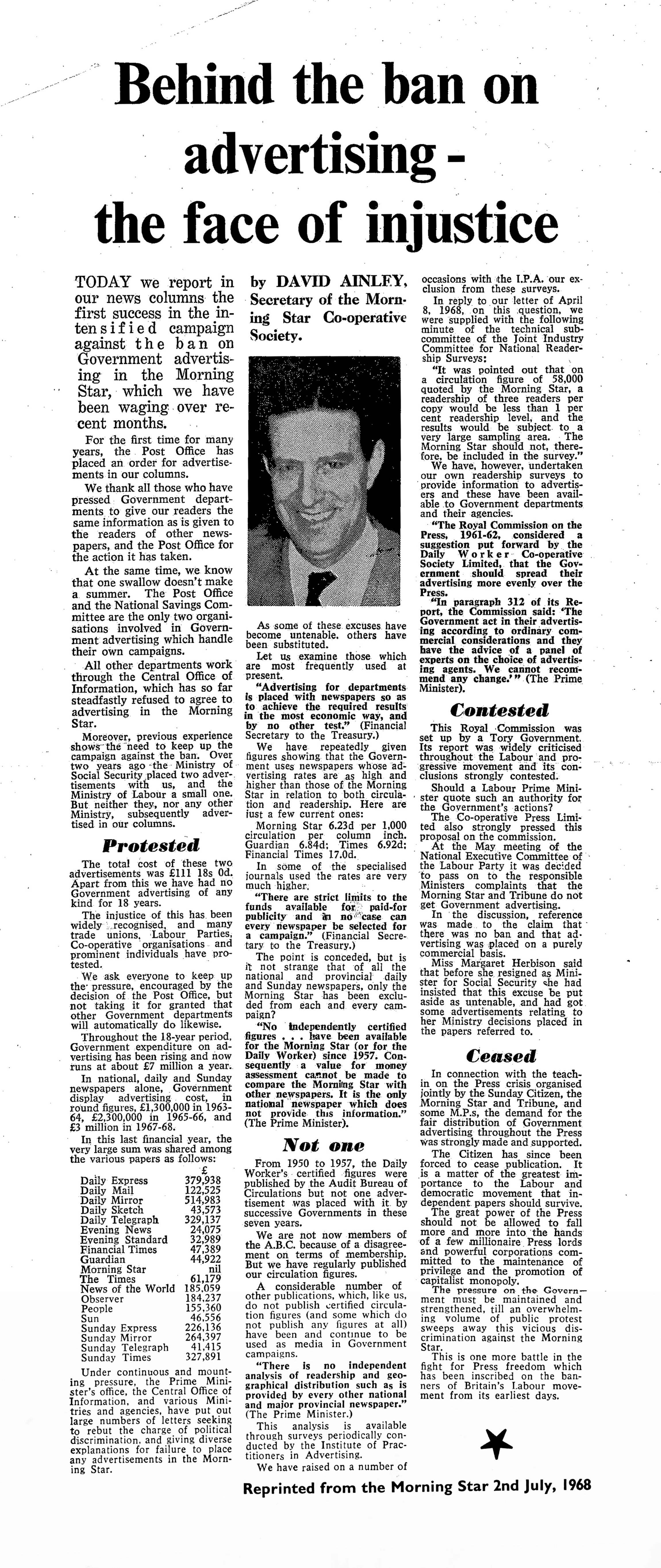
Our latest “Document of the Week”, chosen by our Editorial Assistant, Chloe Haney, is a clipping of a newspaper article by David Ainley titled “Behind the ban on advertising—the face of injustice”. It appeared in the Morning Star on 2 July 1968.
The Morning Star, named the Daily Worker until 1966, is a left-wing British newspaper founded in 1930 by the Communist Party of Great Britain (CPGB). In 1945, ownership of the paper was transferred from the CPGB to the People's Press Printing Society (PPPS), a co-operative created for the purpose of owning and publishing the Daily Worker. Within the PPPS, the Daily Worker Co-operative Society was established as the formal publishers of the Daily Worker, which was renamed the Morning Star Co-operative Society upon the rebrand of the paper.
In his article, David Ainley, the Secretary of the Morning Star Co-operative Society, reported that an order had been placed by the Post Office for an advertisement in the Morning Star. The consequence of an “intensified campaign against the ban on Government advertising in the Morning Star”, this was to be the first state advertisement in the paper since 1966, and only the fourth in the previous 18 years.
As Ainley explained, the Morning Star had been excluded from government advertising campaigns for several years. Reasons for this exclusion issued by the government were recounted by Ainley. It argued that its advertising decisions were conducted “according to ordinary commercial considerations”, and blamed the Morning Star for providing “no independently certified figures” and “no independent analysis or readership and geographical distribution” available.
Ainley contested these claims, arguing that “a considerable number of other publications [. . .] do not publish certified circulation figures”. He noted that the Morning Star had repeatedly questioned its exclusion from surveys conducted by the Institute of Practitioners in Advertising, which analysed readership and geographical distribution.
He also disagreed with the notion that government advertising was conducted on a “purely commercial basis”, taking issue with the seemingly uncritical trust placed by Harold Wilson, Labour Prime Minister at the time, in the results of the Royal Commission that produced this conclusion. As Ainley highlighted, this had been set up by a Tory government and was “widely criticised throughout the Labour and progressive movement”. Through his arguments, Ainley presented the government’s stance as thinly veiled political discrimination.
While the Post Office advertisement order was a success for the campaign against this “vicious discrimination", it was not a decisive win for the Morning Star. The Post Office was one of only two state organisations whose advertising campaigns were handled independently, not by the Central Office of Information (COI). Consequently, the order did not represent a commitment by the government to include the Morning Star in its PR campaigns. As Ainley pointed out, however, even if it were placed by a department whose advertising was handled by the COI, this was no promise of change, as was proven by the advertising orders placed by the Ministry of Social Security and Ministry of Labour two years prior. As such, Ainley concluded his article with a rallying call, insisting that “the pressure on the Government must be maintained and strengthened, till an overwhelming volume of public protest sweeps away this vicious discrimination against the Morning Star”.
Where to find this document
This item comes from our primary source collection, Science and Marxism, 1956–1985.
This collection contains records relating to William Wainwright (1908–2000), a member of the Communist Party of Great Britain who served on the party’s Science and Technology Sub-Committee and worked as the science correspondent for the Morning Star.
The materials in this collection provide students, educators, and researchers with a unique insight into the complicated relationship between Marxist thought and modern science.
Visit the collection page to learn more.


